



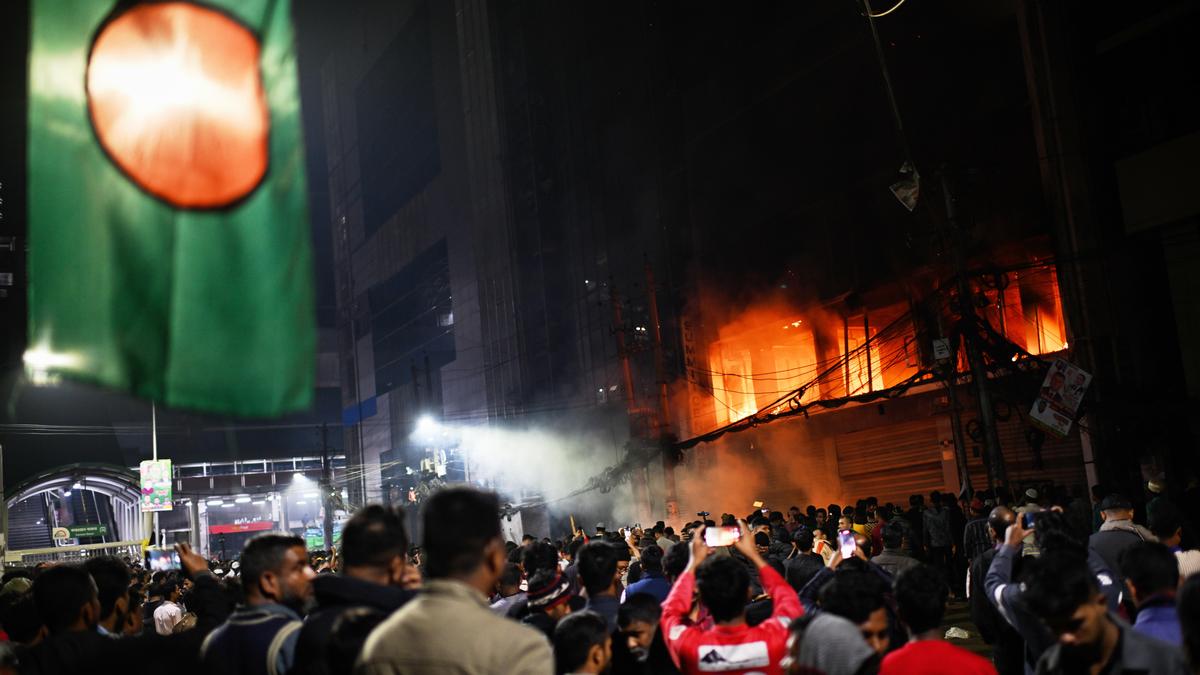


A crowd gathers near the premises of the Prothom Alo daily newspaper which was set on fire by angry protesters after news reached the country from Singapore of the death of a prominent activist Sharif Osman Hadi, in Dhaka, Bangladesh, Friday, Dec. 19, 2025. AP/PTI(AP12_19_2025_000006B)
| Photo Credit: MAHMUD HOSSAIN OPU
(This article is part of the View From India newsletter curated by The Hindu’s foreign affairs experts. To get the newsletter in your inbox every Monday, subscribe here.)
A year and a half since the students’ uprising in Bangladesh, which ousted former President Sheikh Hasina, the country faces more uncertainty, as the latest round of violence unfolding on the streets makes clear.
The pent-up resistance, widespread disillusionment, and frustration among scores of young citizens is manifesting in varied, dangerous forms, even as Chief Administrator Muhammad Yunus struggles to respond to the agitations and rein in hardline elements. Last week, angry mobs set fire to offices of Prothom Alo and Daily Star – the country’s best-known Bengali and English newspapers – signalling that more turbulence is in store. Bangladesh is on the edge yet again.
On December 11, 2025, Mr. Yunus announced that elections — there is serious concern over credibility of polls — would be held on February 12, 2026. Ms. Hasina’s Awami Leage has been banned from the contest, and Khaleda Zia’s (Bangladesh Nationalist Party) self-exiled son Tarique Rahman has announced plans return to Bangladesh after 17 years, as Kallol Bhattacherjee reported. The Jamaat-e-Islami party, too, is preparing to run. However, no political party is favoured, nor is any under pressure, Mr. Yunus’s press adviser Shafiqul Alam told Kallol Bhattacherjee.
In an another, unexpected escalation days after the polls were announced, Bangladesh youth leader Sharif Osman Hadi, who played a key role in turning the July 2024 uprising into a movement against what he called ‘cultural fascism’, was shot by unknown assailants. Days later, he passed way in Singapore. Read Kallol Bhattacherjee’s profile of the youth leader, whose killing has set off violent reactions. India on Sunday described the killing of a minority Hindu youth in Bangladesh as a “horrendous act” and expressed “strong concern” about the safety of minority communities in the neighbouring country. . Soon after the return of the mortal remains of Sharif Osman Hadi, UN Human Rights Chief Volker Turk called for a “transparent investigation” into the killing and urged “everyone to refrain from violence”.
Don’t miss the latest episode of Worldview, in which our Diplomatic Affairs Editor Suhasini Haidar breaks down what led to the current turmoil, that will not only impact Bangladesh’s immediate political trajectory significantly, but also further affect the country’s India ties, already under enormous strain.
Also check out The Hindu’s recently published e-book, in which experts give context to the tumultuous political landscape and fragile administrative arrangement in Bangladesh.
The Gaza question
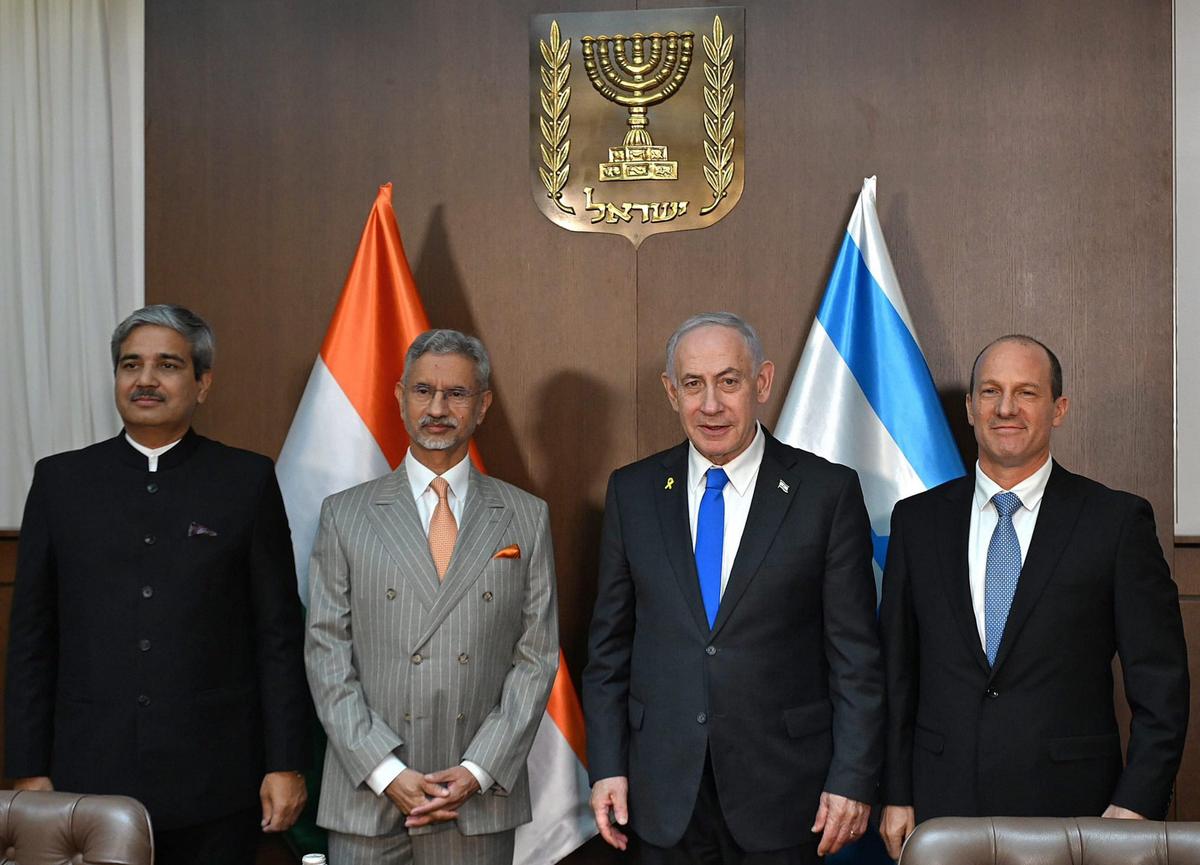
**EDS: THIRD PARTY IMAGE** In this image posted on Dec. 17, 2025, Union External Affairs Minister S Jaishankar and others during a meeting with Israeli Prime Minister Benjamin Netanyahu, in Jerusalem. (@netanyahu/X via PTI Photo) (PTI12_17_2025_000027B)
| Photo Credit:
–
Last week, External Affairs Minister S. Jaishankar met Israeli Prime Minister Benjamin Netanyahu and discussed ways to enhance cooperation in technology, economy, connectivity and security, expressing confidence that the bilateral strategic partnership will “grow from strength to strength”. “Valued his perspectives on regional and global developments. Confident that our Strategic Partnership will grow from strength to strength,” he added.
While some foreign policy wonks see it as “strategic autonomy” and “realpolitik”, the pressing moral questions that arise on India’s questionable position on Gaza remain. . The death toll in Gaza has gone past 70,000, as Israeli aggression continues despite a “ceasefire”.
Top 5 stories
1. Cyclone Ditwah | Sri Lanka’s long path from wreckage to recovery – Ground Zero feature
2. Interview | India should reassess resilience of its air defence systems purchased from Russia: U.K. weapons and military expert Jack Watling tells Sriram Lakshman
3. The Pinochet fan – Sruthi Darbhamulla profiles Chile’s next President, its most right-wing leader since the Pinochet era and an admirer of the dictator
4. Blatant foul: Washington’s militarised approach to Venezuela is a violation of international law – The Hindu editorial on Venezuela and U.S. aggression
5. The Trump NSS, Europe’s existential crisis by Priyanjali Malik
Published – December 22, 2025 12:19 pm IST