






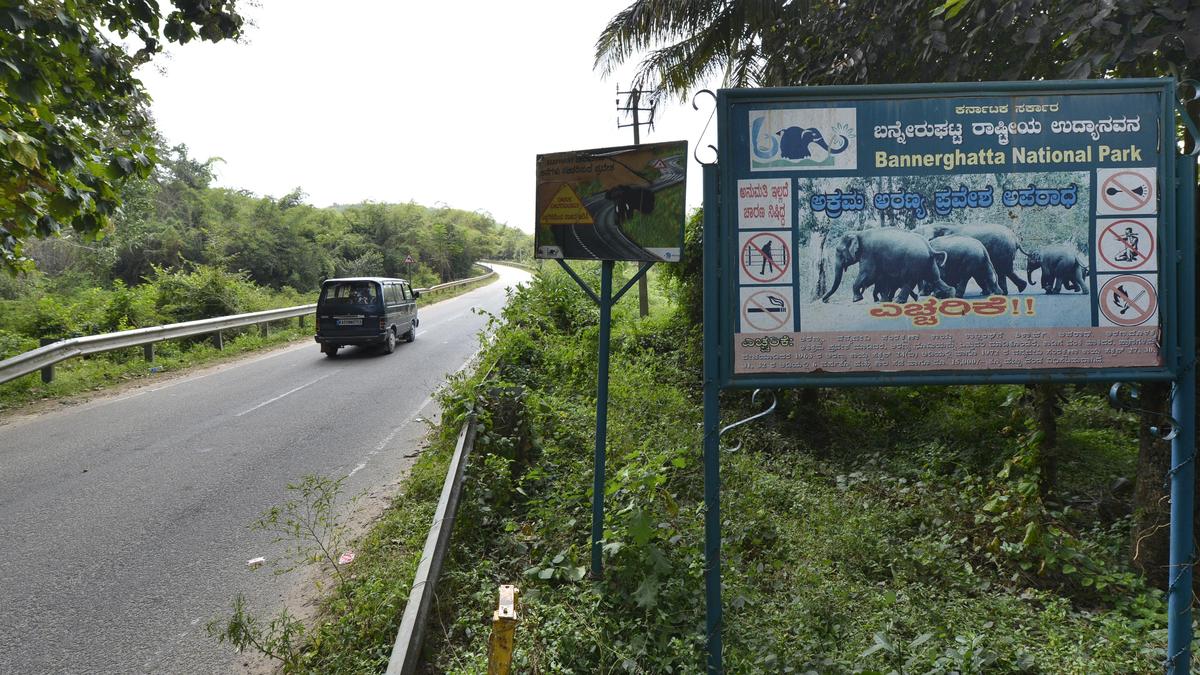

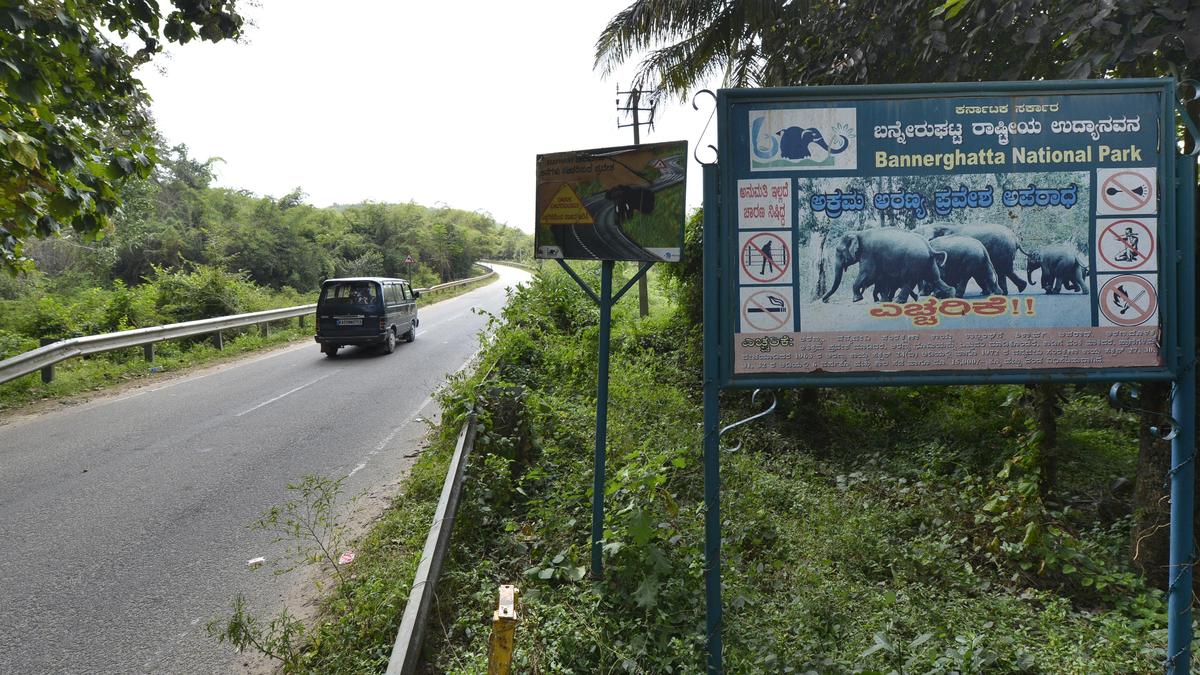
It was in 2018 that a Central government notification reduced the BNP’s Eco-Sensitive Zone from 268.9 sq. km to 168.84 sq. km. The activists note that the width of the buffer zone was reduced from 4.5 km to 1-0.1 km.
| Photo Credit: FILE PHOTO
A member of the Central Empowered Committee (CEC), constituted by the Supreme Court, is expected to visit Bannerghatta National Park (BNP) on January 2, 2026, following a petition against the reduction of Eco-Sensitive Zone (ESZ) around the national park.
Chandra Prakash Goyal, member of the CEC, will also meet the government officials in connection with the petition filed by K. Belliappa and others on May 2025.
Enclaves within elephant corridors
The petition argued that the notification regarding the reduction of the ESZ has excluded ecologically critical areas surrounding established elephant corridors from the ESZ and that the adoption of a one-km ESZ norm for the protected area of the forest ignores site-specific ecological requirements.
The activists pointed out that the reduction of the ESZ has led to the creation of enclaves within the ESZ, breaching the contiguity of the forest. These enclaves, which are now unprotected land patches, have become prone to mining and other commercial activities, and five of them fall in elephant corridors, they said.
Legalising ecological violations
It was in 2018 that a Central government notification reduced the BNP’s Eco-Sensitive Zone from 268.9 sq. km to 168.84 sq. km. The activists noted that the width of the buffer zone was reduced from 4.5 km to 1-0.1 km.
“One of the enclaves shows the presence of a quarry. The reduction has been a way to legalise ecological violations,” said Kiran Urs, who works with Bannerghatta Nature Conservation Trust.
The activists also allege that plans are afoot to build massive 2,000-acre layouts in unprotected areas near the BNP, which would lead to large-scale destruction of biodiversity and increased human-animal conflict. Shivakumar, a farmer from the region, said that since 2016, efforts have been on to acquire vast swathes of land in the region.
“The efforts to acquire land began even before the notification came in 2018. Almost all the gomalas in the region have vanished by now,“ he said. Other concerns include the ongoing construction of the National Highways Authority of India’s six-lane elevated flyover, part of the Satellite Town Ring Road project, crossing a 3.85-km stretch across the BNP and its buffer zones, and a proposal to construct an airport near the Bannerghatta-Kanakapura belt.
Published – December 31, 2025 12:42 am IST