



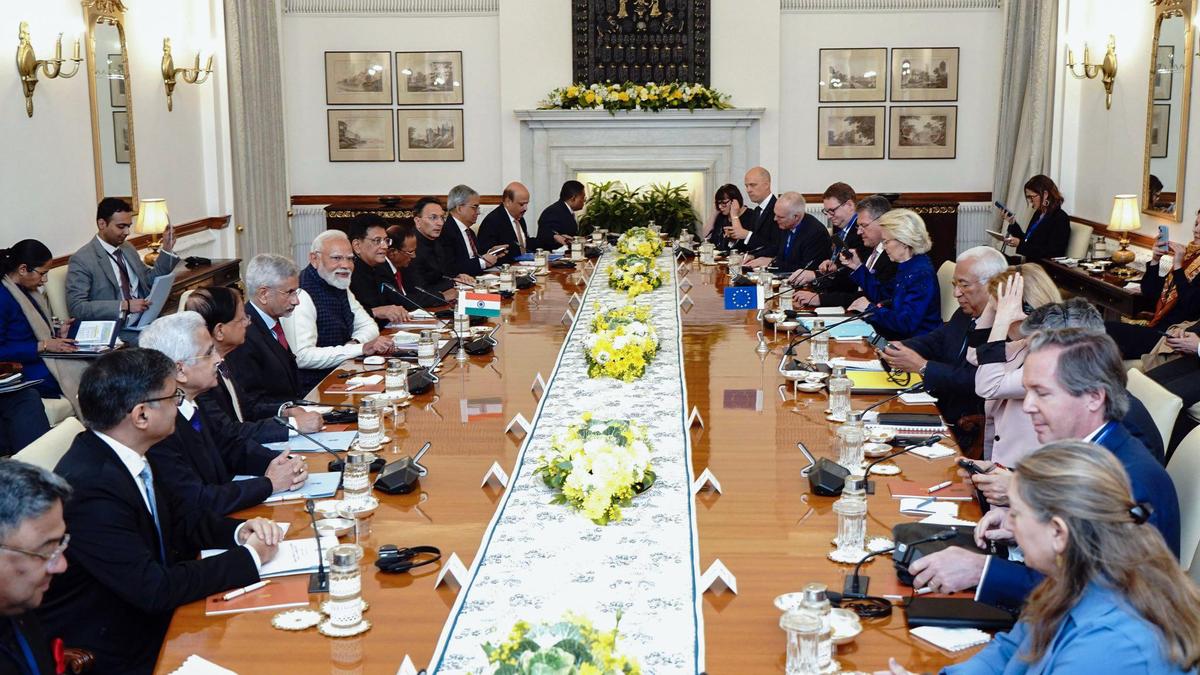

Prime Minister Narendra Modi, with European Commission President Ursula von der Leyen and President of the European Council António Luís Santos da Costa, during the 16th India-EU Summit at Hyderabad House, in New Delhi on January 27, 2026. Union Ministers S. Jaishankar, Piyush Goyal and others also present. Photo: @PiyushGoyal X/ANI Photo
The European Union (EU) and India have committed to promoting collaboration on the peaceful uses of nuclear energy under the India-Euratom agreement on research and development activities in nuclear science and technology, advanced materials for detectors, radiation safety, nuclear security, non-power applications of atomic energy, including cooperation on radio-pharmaceuticals, and strengthen cooperation in the International Thermonuclear Experimental Reactor (ITER), according to a statement from the Joint India-European Union Comprehensive Strategic Agenda on Tuesday (January 27, 2026). India and the EU signed Euratom in July 2020.
India-EU Summit updates on January 27, 2026
The statement also spoke of “deepening cooperation” under the EU research and innovation programme Horizon Europe, including in the fields of energy, water, agri food, health, semiconductors, biotech, advanced materials, particularly through mechanisms such as co-funding and coordinated calls. The Horizon programme is the European Union’s key funding programme for research.
CBAM issue
While specifics are unclear, one of the major sticking points involving the European Union and India was the Carbon Border Adjustment Mechanism (CBAM), which imposed additional tariffs on iron and steel producers, outside the EU, who emit more carbon emissions in the production of iron and steel than European producers.
“Through CBAM provisions, commitments have been secured, including a forward-looking, most-favoured nation assurance, extending flexibilities, if any, granted to third countries under the regulation, enhanced technical cooperation on recognition of carbon prices, recognition of verifiers, as well as financial assistance and targeted support to reduce greenhouse gas emissions and comply with emerging carbon requirements,” India’s Press Information Bureau said in a statement.
Published – January 27, 2026 09:37 pm IST