


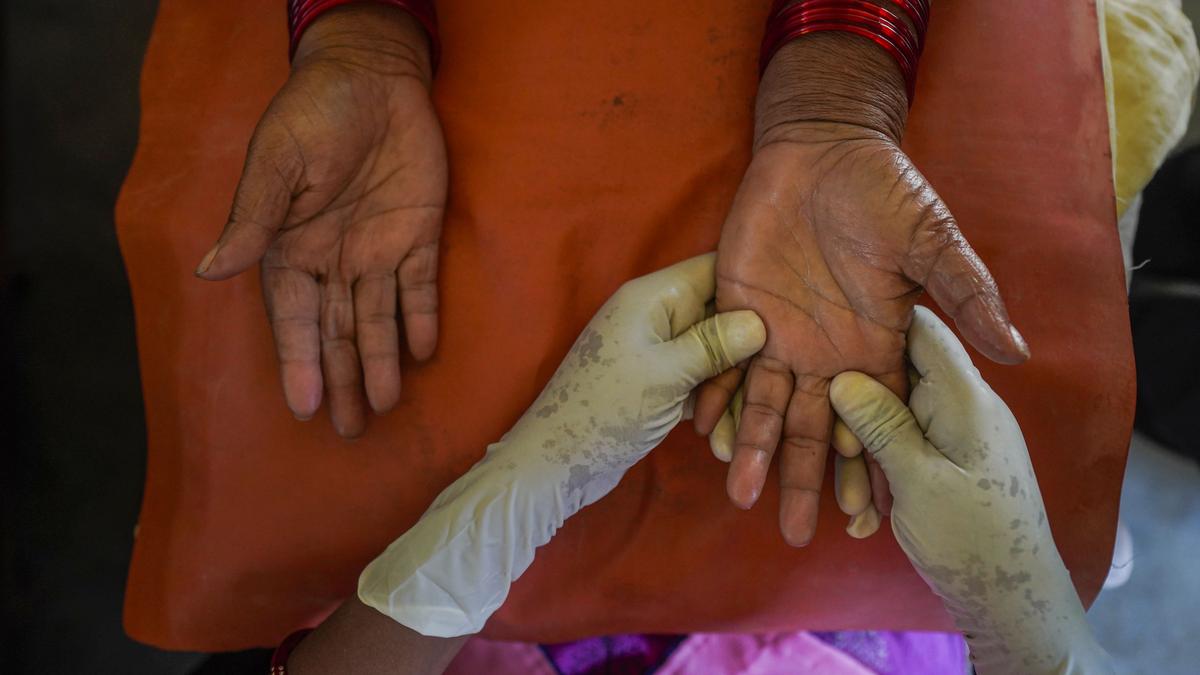

Leprosy is as old as humanity itself. The disease and those afflicted by it appear in the Bible, testament to its long and troubling presence in human history. For centuries, sufferers have been stigmatised, ostracised and pushed to the very edges of society, condemned to lives of exclusion and silence. The Nazis branded them worthless and executed them. In Tamil, the disease is known as Peruviyathi — a term that encapsulates its reputation as the most dreaded of afflictions, even though it rarely claims the lives of its victims. The fear it evokes arises not from death, but from disfigurement, isolation and the slow, relentless erosion of human dignity.
The anguish and alienation associated with leprosy have long made it a potent subject in literature, inspiring some of the modern writing in Tamil. To this tradition, a Sahitya Akademi Award–winning author has now added Noiputtru, perhaps the darkest and most unflinching literary exploration yet of a disease that has haunted civilisation for millennia.
Editorial | Taking the leap: on leprosy in India and discrimination
The writer, Imayam does not confine himself merely to depicting the squalid living conditions and loss of dignity imposed upon patients by society. In his characteristic prose — spare, relentless and unsentimental — he chronicles the disease itself with minute precision: its progression, the methods of treatment, the institutions created to contain the afflicted, and the grim resignation with which patients ultimately confront their fate.
“You will survive only if you feel the pain. Otherwise, your story is all but over. Your face itself bears witness. The hairs of your eyebrows have fallen. Your ears have thickened. Your nose has flattened. There is no doubt — it is leprosy.” Thus begins Imayam’s novel, as a doctor explains Chinnasami’s condition to him.
By juxtaposing Chinnasami’s condition with that of Ganesan, the protagonist of Pasitha Manidam, who is also afflicted by leprosy, it becomes clear that the disease respects neither social status nor privilege. Ganesan is a wealthy Brahmin, yet his suffering is no less brutal.
“The disease had transformed his body and made his face unrecognisable. Ganesan intensely observed his older body die slowly and watched a dreadful one replace it. He vowed not to ask himself the usual questions: Why me? What is the meaning of this awful new form? How long will this ‘new me’ live? Is this hellish agony retribution for my indolent pleasures and aberrations of thirty years? If pleasure is to be experienced, then pain also has to be endured, isn’t it?” writes Karichan Kunju in Pasitha Manidam.
Ganesan’s social descent is swift and merciless. “He was not respected in hotels and inns and was often denied rooms. He was not shown the courtesy of being served a decent meal, even when he offered to pay double. No one wanted him to stay in their homes, given how rapidly the disease had overtaken his body. Ganesan spent his days and nights wondering how to fix the problem,” Karichankunju records, laying bare the cruelty of everyday interactions. Ganesan, in a way, resembles, Mohan, hero of the M.R. Radha starrer Ratha Kanneer. But Mohan is unrepentant.

While Chinnasami and others are confined permanently to a leprosy home, Ganesan is condemned to a life of perpetual movement, drifting from place to place. He even leaves a home in Kumbakonam run by European missionaries, overwhelmed by guilt when the beauty of the nuns awakens sexual desire in him.
Both narratives belong to a period — Noiputtru set in the 1960s and Pasitha Manidam much earlier — when medical intervention could slow the disease through treatment and amputation, but never offer a complete cure. It was only in the 1980s that the World Health Organisation recommended Multi-Drug Therapy (MDT), a breakthrough that enabled India to bring leprosy largely under control.
In Imayam’s novel, the darker reality of the period persists: most patients never return home. Rejected by families and shunned by society, they remain in treatment centres until death. In Noiputtru, characters initially cling to the hope of recovery and reunion, only to realise their fate is lifelong confinement. Those who do leave often end up as beggars, stripped of both livelihood and identity.
“I wanted to build a big house when I was in my village. I wanted to turn ten kaanis into twenty, and my yield to surpass that of others. Do you know how many dreams I had? Now there is nothing. The land will swallow all our aspirations,” says Ponnusamy, who entered the centre expecting to leave within six months, but remained there for ten years.
There are, however, rare exceptions. Muthumeenal, supported by her family and her husband Ayyanar, manages to return to mainstream society and later writes about her experience as a patient in Mul. In Senthil Jagannathan’s Mazhikan, a family stands by a woman diagnosed with the disease, though leprosy destroys their hopes of prosperity through cotton cultivation. T. Janakiraman’s short story Manam portrays the plight of a supporting actress deceived into sleeping with a producer in exchange for a promised lead role, only to discover during a film pooja the next morning that he is a leper. In Thiruvaranga Kalambagam, a poem declares that even a person with half-rotten limbs deserves worship if he is a devotee of Lord Vishnu.
Imayam, however, offers no such consolation. His world is stripped of redemption.
“I am not angry with the disease. I am angry with myself and my body. The disease has heaped all the filth of the world on me. I came to the home with my family because I could not bear the words of the village. The disease eats the body like a termite. The termite is the henchman of Yama. It eats us as we eat food. Its hunger will be satisfied only when we die,” says Krishnamurthy, a companion of Chinnasami, capturing the devastating reality of leprosy in the 1960s.
Published – January 28, 2026 06:30 am IST