


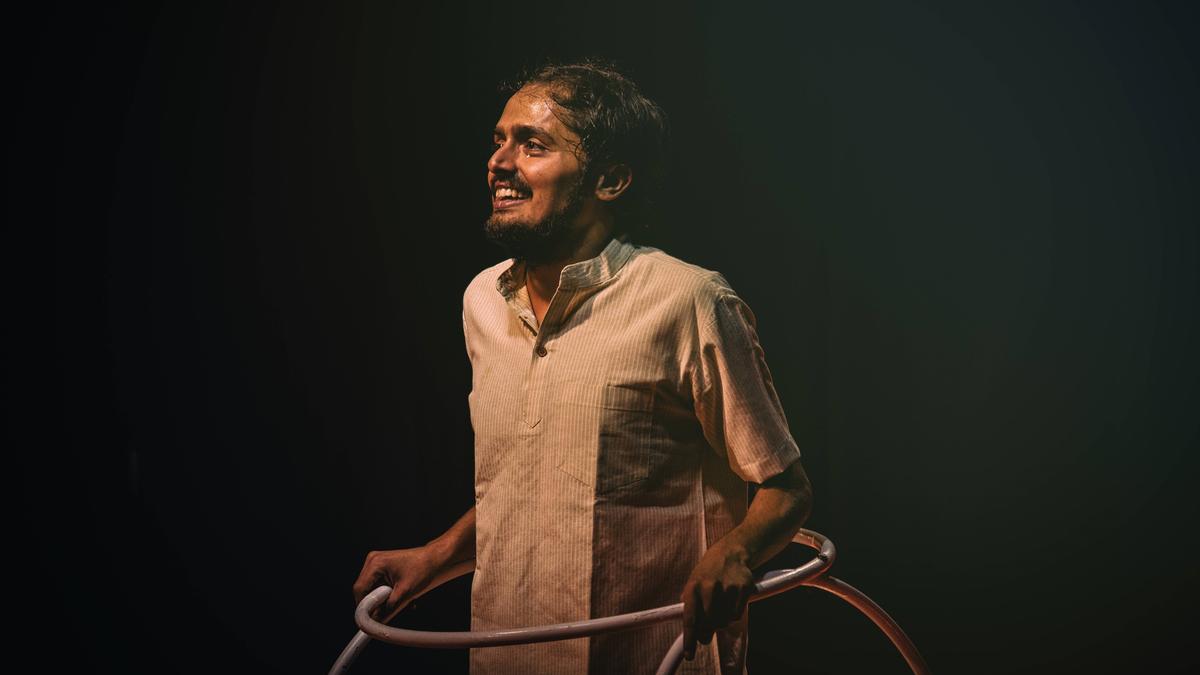

We do not come across many one-person shows in Kannada, which is why Ond Second from WeMove Theatre stands out, in more ways than just this. The play, an adaptation of a Chinese short story translated into Kannada by writer Gopalakrishna Pai, has been adapted for the theatre by playwright and director Abhishek Iyengar. Ond Second, starring Anirudh Mahesh (one of the writers of Kanthara: Chapter 1), involves introspection into an incident that happened in the character’s past and his reaction to it.
With peppy music in the background sounding like a nostalgic Kannada poem from school, the play follows a man who, on the verge of fulfilling his lofty dreams, is forced to change his future in a split second because of an accident.
What follows is his recovery in the hospital and his reaction to the incident. This is done by examining every event preceding the accident and what the man could have done to prevent it.

When the actor thanks his tote bag for keeping all his documents together, the scene is a farcical comment on the essence of a mundane human experience. Anirudh Mahesh poignantly embodies Manushya’s (man) reality, making the audience feel that he is everyone, and it could happen to anyone. The play’s universality stands out, and this is the reaction Abhishek was hoping for, he says.
“We often say, “ond second iru, ond second call madtini, ond second barthini” (wait for one second, I’ll call you in one second, I’ll be there in a second),” Abhishek said speaking from his home in Basaweshwaranagar in Bengaluru. “‘One second’ is important, but we use it casually, without fully realising its power. Mostly, it is just another second, which fades into history, but at times, it causes something so significant that it makes us repeatedly return to the moment. I wanted to show the importance of that one second, and let the audience reflect on what it means to them.”
“Many who watched the play said it resonated with them on different levels, Abhishek says.
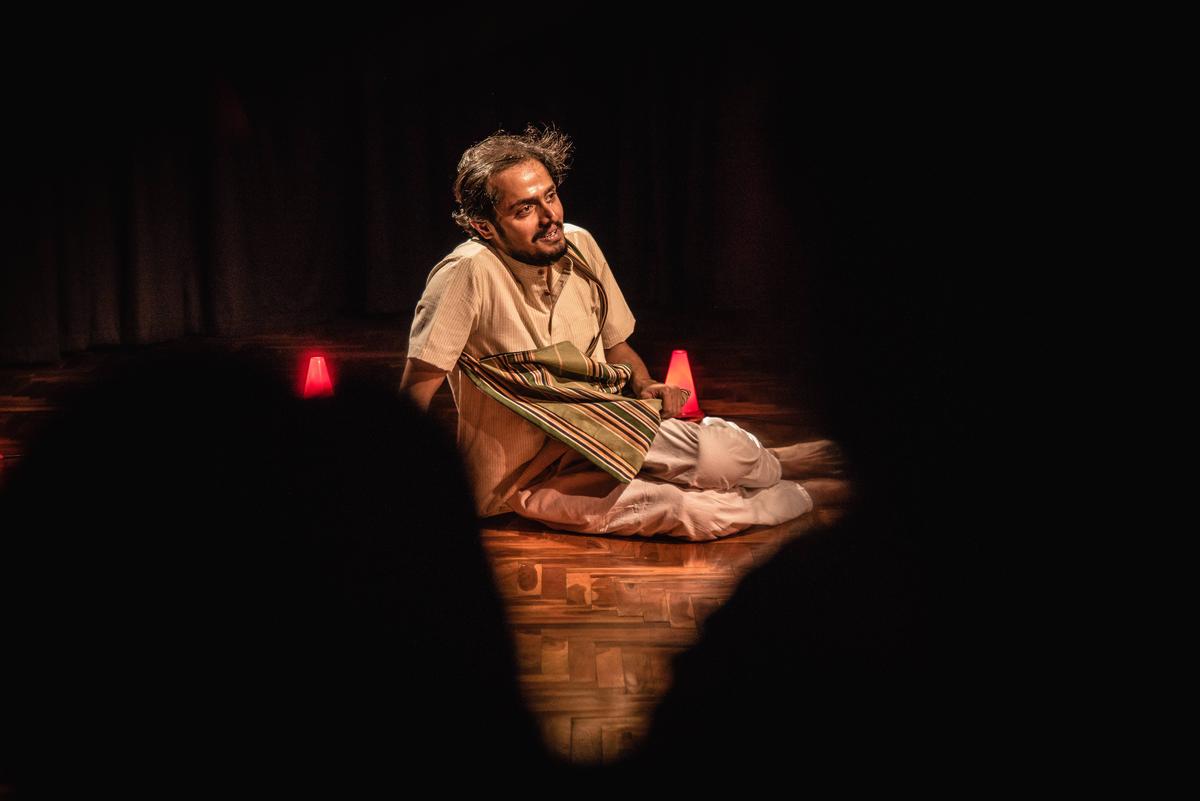
Ond Second was recently performed at the Ranga Shankara in Bengaluru.
| Photo Credit:
Special arrangement
The play has a few common characters, all played by Anirudh including a narrator, who breaks the fourth wall occasionally, the main character, a doctor, a friend and a student. “I wanted to break the monotony. That’s why we thought Anirudh could do different voices and play all characters.”
The writer-director says one more reason to experiment with this format was to direct a play, where all the props could be easily transported. However, challenges persist, he admits.
“Theatre is a collaborative art form, and being a mono-act, Ond Second conveys only one perspective. To make it multidimensional, I had to bring in the audience and work from their reactions. I have never been as experimental as this before.”
ALSO READ: WeMove Theatre’s Kannada play ‘Sambandhagala Sutta’ delves into the different relationships of women
Mono-acting is every actor’s dream, says Anirudh
Associated with theatre since 2012, Anirudh always wanted to try a mono-act, for he believes it is every actor’s dream. Speaking from WeMove’s rehearsal space in Jayanagar, he says, “When there are multiple actors, it’s easier to convey the emotion to the audience. When it’s just one actor, it’s difficult because it’s my voice alone on stage, even though there are small differences in tone and modulation.”
For Anirudh, theatre is happiness. Being associated with big projects in Kannada, including Kanthara: A Legend Chapter 1, Laughing Buddha, Avane Srimannarayana, 777 Charlie, theatre is home he returns to. “Acting on stage is akin to drinking water when parched. I can explore many facets of a theme on stage. Take this play for instance, we decided to explore this story through emotions and dialogues, shifting focus from props and sets.”
Anriudh opens up on the challenges of being the sole performer on stage. “There is nobody to cue me in to proceed to the next scene. I have to map the stage, looking at the properties and not people, and that is not easy at all. We have gone through multiple rehearsals, tried and tested what works and what doesn’t.”
With a view to staging the play again in April, both Abhishek and Anirudh say mono-acts are not easy from the economic and acting points of view. While Abhishek says it is not easy to fill the auditorium with an audience, banking on one person, Anirudh says the pressure to deliver on stage as the sole actor is high. “I think people consider it a risk and don’t do it. We wanted to break the stereotype, that’s why we did it,” Abhishek adds.
Published – January 28, 2026 07:54 am IST