






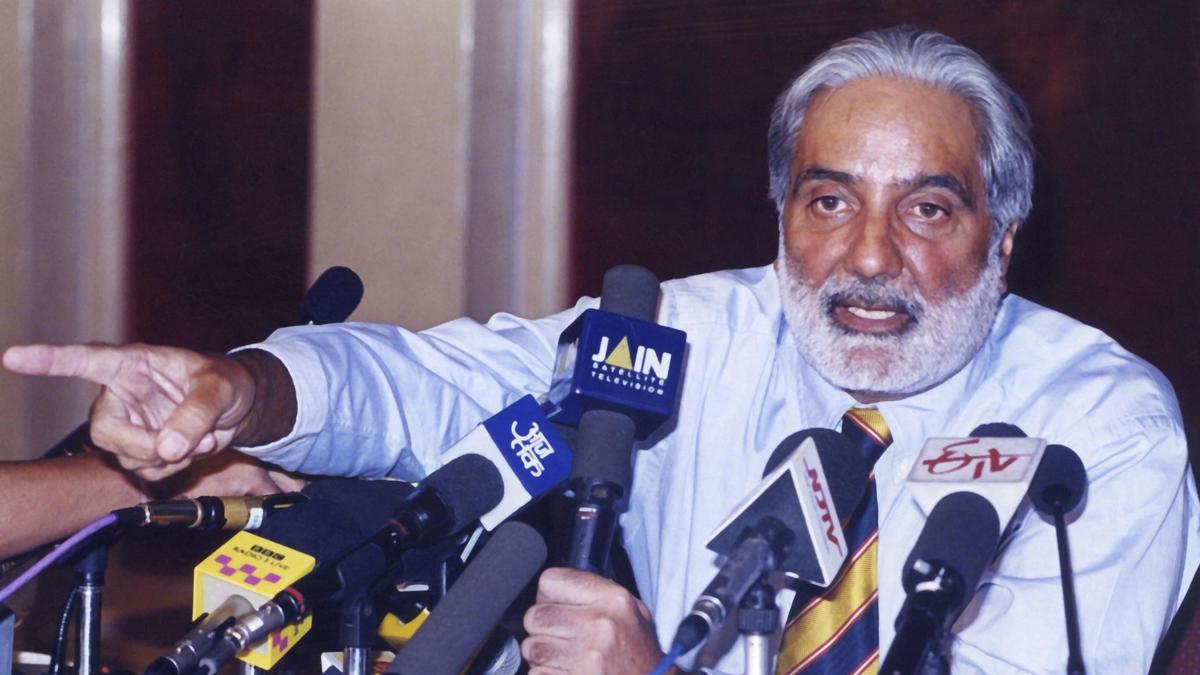

With the passing of Inderjit Singh Bindra, a link with a revolution in cricket that shifted the power base from England to India has been severed. For so long has India’s influence lasted and so profound has its impact been that it’s easy to forget their ascendancy is less than four decades old.
In the mid-1980s, N.K.P. Salve, Bindra and Jagmohan Dalmiya proposed that the World Cup, hosted thrice by England now be shifted to India and Pakistan.

The administrators dangled the carrot that the BCCI continues to dangle — money. They promised much more of it, and took advantage of the rule then that allowed associate members one vote each (Test nations had two). This meant that the 18 associate members had a big say since the full members were just seven.
Dalmiya and Bindra as a team were the spit and polish of Indian cricket, the enforcer and the planner. It was a combination that could be seen on the field of play too. Think Javed Miandad and Imran Khan, or Kapil Dev and Sunil Gavaskar. Or Ian Botham and Mike Brearley.
The 1987 World Cup was only the start. The International Cricket Council, established in 1909, was a boys’ club run from the offices of the MCC (Marylebone Cricket Club), and sharing a secretary with it.
The MCC President automatically became chairman of the ICC. With founding member Australia, England enjoyed the power of veto. Bindra and Dalmiya set about upsetting this cozy arrangement.
Revolution complete
In 1993, the revolution was complete. The veto was abolished, India co-hosted the World Cup again three years later, and the first sniffs of the enormous power of television rights were felt.
India had many advantages — a television audience in the millions, a marketplace for consumer goods that needed advertising between overs, companies willing to spend on advertising, and a team or great players who drew the eyeballs. The economy had opened, bringing all these elements together to India’s advantage.
Where India now miss the presence of a diplomat and persuader (in the gentler sense of the term, not as in Hollywood) like Bindra is obvious with the Bangladesh fracas. Whatever that country’s political reasons for pulling out of the T20 World Cup in India next month, Bindra would not have allowed things to come to this pass. One telephone call would have made the difference.
Brinkmanship is useful when you have less to lose, and in this case Bangladesh had more, both financially and cricket-wise. Pakistan’s current stance in support isn’t likely to end well for them either.
The 1996 situation where India, Pakistan and Sri Lanka hosted the World Cup is unimaginable now. In 1986, when India’s Operation Brasstacks, mobilised troops along the border, and Pakistan mobilised too, it was Bindra who persuaded Pakistan’s military dictator General Zia-ul-Haq to visit India to ease tension. Sometimes those ruling cricket (Bindra was a bureaucrat, not a politician) can do good too!
The Los Angeles Times reported: “as the air bristled with tough talk, the Pakistani cricket team arrived for its scheduled, months-long, series of matches with the Indian team.
And almost as quickly as a fast bowler gets the ball to the stumps, the war-talk evaporated. Diplomats quickly signed an agreement under which both sides would pull back troops from their shared frontier. The tension eased measurably.”
Self-image
A cricket team reflects its nation’s self-image. And this self-image can be a treacherous thing, wanting to assert itself in all situations, grave as well as inconsequential, and everything in between.
The self-image changes according to circumstance too. We seem to be currently a muscle-flexing, imperious people, especially when faced with those patently weaker. Bangladesh are being taught a lesson which they knew all along.

Then there’s the International Cricket Council which says shifting the Bangladesh matches out of India “could set a precedent that would jeopardise the sanctity of future ICC events and undermine its neutrality as a global governing body.” This is rich, considering that the Chairman of the ICC is the son of India’s Home Minister, and venues have been shifted before — the so-called ‘hybrid’ model — to suit India.
Indian cricket misses an administrator like Bindra, the man who saw the big picture.
Published – January 28, 2026 12:30 am IST