







‘We welcome more Indian enterprises to leverage platforms such as the China International Import Expo to bring more premium Indian products to the Chinese market, transforming trade deficits into cooperative surpluses.’
| Photo Credit: Reuters
As the global economic and trade order suffers a severe blow, the giant ship of the Chinese economy once again demonstrates its strong resilience, with its GDP exceeding 140 trillion yuan (approximately $20 trillion) in 2025. This represents a year-on-year increase of 5%. China’s contribution to global economic growth is expected to reach around 30%. This hard-won achievement has drawn significant global attention. I would like to share some views on several specific issues that Indian friends are concerned about.
What drives China’s economic growth?
In 2025, China’s economy moved forward, driven by consumption, exports, and investment, but its internal structure is undergoing a profound and positive transformation.
Domestic demand is the primary engine of China’s growth. In 2025, final consumption expenditure contributed 52% to economic growth. Some people may conclude that China has “insufficient consumption” simply because the prices of Chinese goods and services are significantly lower than the global average. In fact, measured by internationally accepted standards of physical consumption, China ranks among the world’s top countries in terms of total basic consumption. Among these, the average number of mobile phones owned per person is 1.28, which is among the world’s leading levels. The average daily protein intake is 124.6 grams, which is higher than that of the U.S. and Japan. The average annual vegetable consumption is 109.8 kilogrammes, the highest in the world.
China’s exports of goods and services demonstrated strong resilience, contributing 32.7% to economic growth and becoming a key booster. Despite an unfavourable international trade environment, ‘Made in China’, especially high-tech products, were widely popular thanks to its complete industrial chain and continuously improving innovation capabilities, with high-tech product exports growing by as much as 13.2% throughout the year. Exports to major markets such as ASEAN and the European Union maintained stable growth, effectively offsetting market fluctuations in other regions.
In contrast, gross capital formation contributed 15.3% to growth, which reveals that the Chinese economy is undergoing a difficult but necessary transformation of growth engines: from relying on investment and exports to a better model in which domestic consumption takes the lead, while export and innovation add impetus. Amid this transition, breakthroughs have been consistently achieved in cutting-edge fields such as AI, quantum technology, and brain-computer interfaces. The output of high-end manufacturing, including servers and industrial robots, has maintained rapid growth. Green industries such as renewable electricity and clean energy have flourished. These emerging drivers are clearly outlining the future course of the Chinese economy.
Why export production capacity?
China is not exporting “overcapacity,” but rather high-quality production capacity and advanced solutions that are widely welcomed by developing countries. From the supply side, there is no “overcapacity” in China. In 2025, the capacity utilisation rate of China’s above-designated-size industry stood at 74.4%, equivalent to that of the U.S. and the EU across all sectors. The global competitiveness of Chinese products stems from long-term, high-intensity R&D investment, robust domestic competition, and the most comprehensive industrial system, rather than subsidies or dumping.
From the demand side, the fundamental driving force behind the booming development of China’s production capacity is the real demand from the global market. Many developing countries have enhanced their infrastructure, achieved energy transition and embarked on industrialisation by introducing high-quality Chinese equipment and technology. As the American economist, Jeffrey Sachs, pointed out, the Western labeling of Chinese manufacturing as “overcapacity” is out of “jealousy.”
Mitigating India’s trade deficit with China
According to data from General Administration of Customs of China, China-India trade reached a historic high of $155.6 billion in 2025. Many of the goods imported from China are raw materials and components that are much needed in India and that are conducive to India’s economic development. This fully demonstrates the strong economic complementarity and great potential for cooperation between the two countries.
Meanwhile, India’s exports to China have shown positive momentum, reaching $19.7 billion in 2025 and marking a year-on-year increase of 9.7%. Notably, growth rates in the last two months of 2025 were particularly strong, reaching 90% and 67% respectively. China has never deliberately pursued a trade surplus and is willing not only to be the world’s factory but also the world’s market. China’s tariff level remains low by international standards at 7.3%. The negative list for foreign investment access has been continuously shortened, and China’s visa-free policy keeps expanding. In particular, the Central Economic Work Conference identified “expanding domestic demand” as the top priority for economic work in 2026. With a population of over 1.4 billion, including more than 400 million in the middle-income group, China offers huge opportunities for high-quality Indian products.
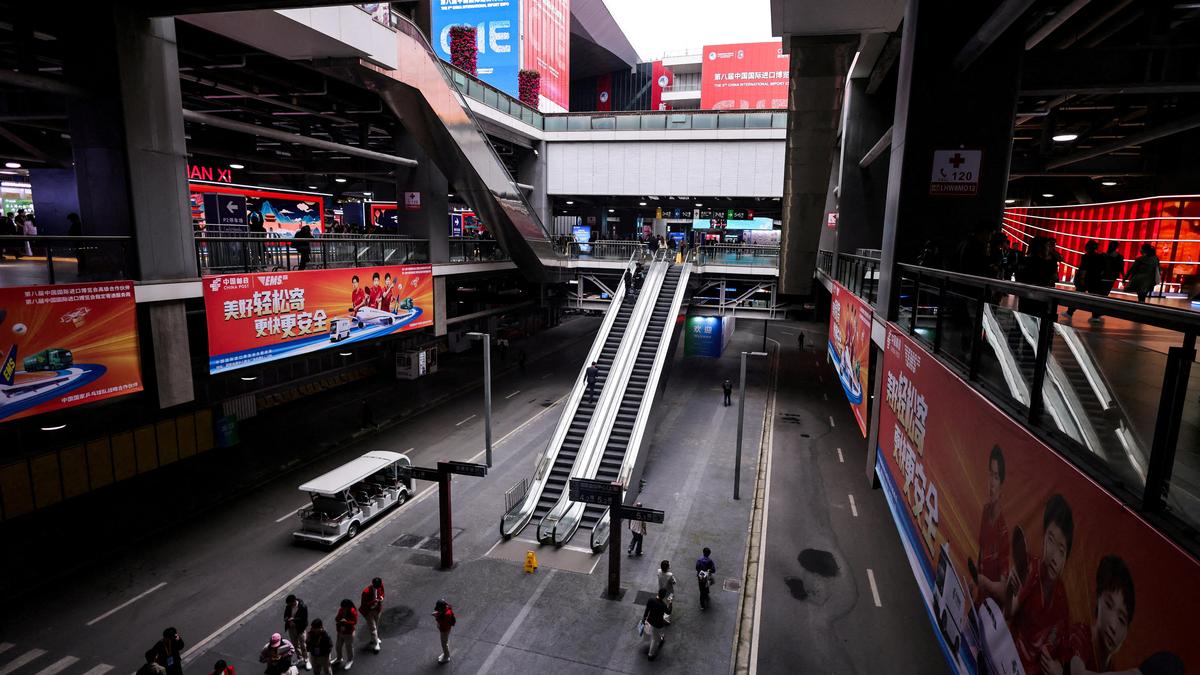
We welcome more Indian enterprises to leverage platforms such as the China International Import Expo to bring more premium Indian products to the Chinese market, transforming trade deficits into cooperative surpluses. By moving towards each other, we can share dividends of development and jointly create a brighter future for Asia.
Xu Feihong, Chinese Ambassador to India
Published – January 29, 2026 01:04 am IST