




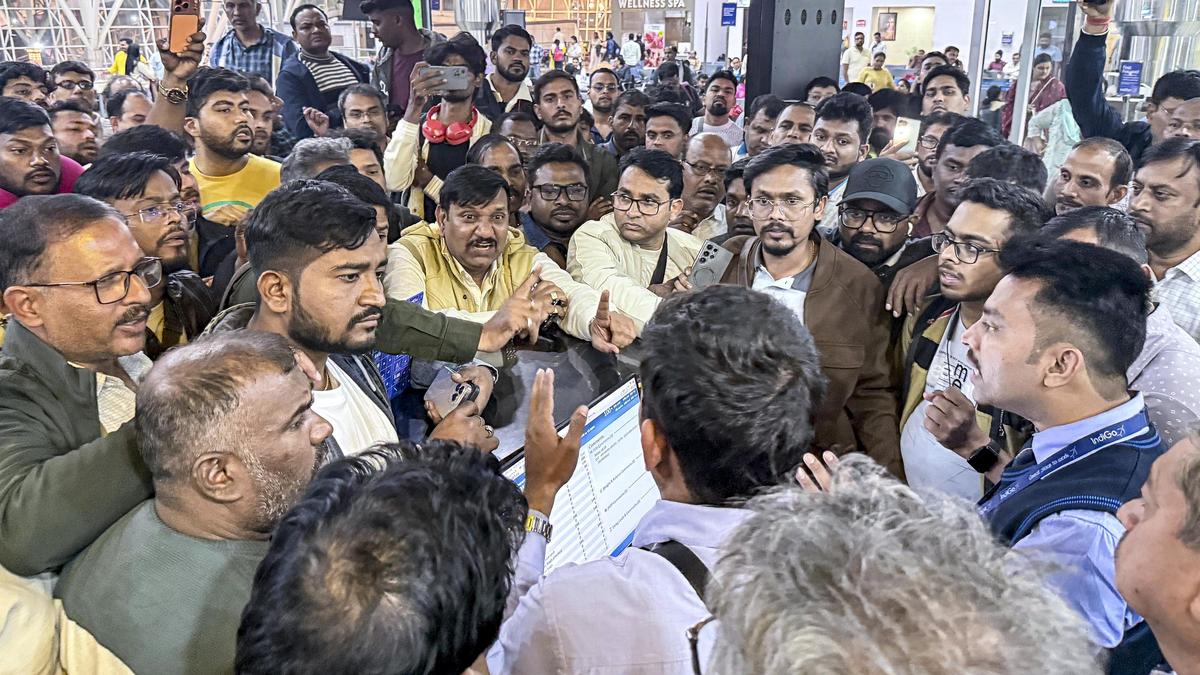
‘The commercial interests of an airline have taken priority over crew fatigue and the safety of passengers’
| Photo Credit: PTI
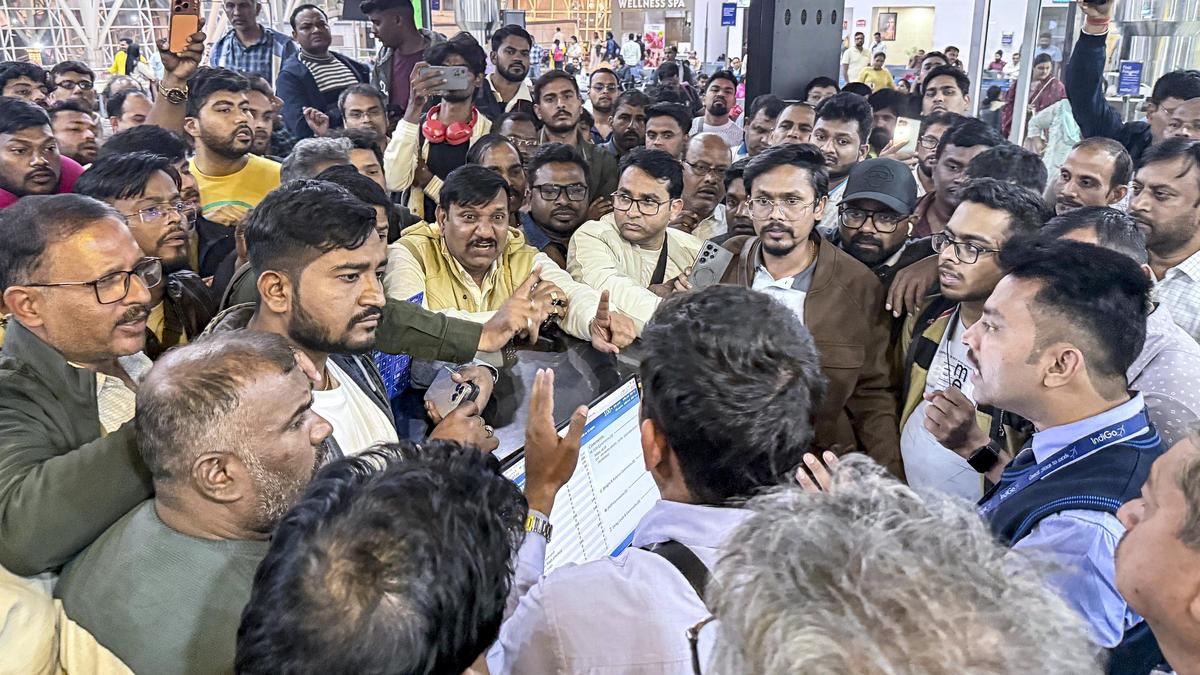
In the aftermath of the crisis in India’s aviation after private airline Indigo cancelled flights, the Minister of Civil Aviation posted on X, the following: “The FDTL [Flight Duty Time Limitations] orders issued by [the] DGCA have been placed under abeyance with immediate effect for now to stabilize operations and prioritise relief for affected passengers.” Prior to this, the Directorate General of Civil Aviation (DGCA) had issued an appeal to pilots’ associations and pilots to cooperate and ensure that flights were back without delays, with a subtle direction to dilute the FDTL (a Civil Aviation Requirement (CAR) to comply with a High Court order). These acts, by the Minister and the DGCA, make a mockery of flight safety and make India the laughing stock as far as aviation safety is concerned. The commercial interests of Indigo have taken priority over crew fatigue and the safety of passengers. CARs have been modified to suit commercial aviation’s requirements. Safety be damned.
The dilution of a good safety measure
In 2007, the DGCA issued a very good CAR, addressing the issue of fatigue and the rest period of operating crew. But airline owners complained to the Minister, who issued orders to the DGCA to keep the CAR in abeyance In an order dated May 29, 2008, the DGCA wrote: “The competent authority in the Ministry of Civil Aviation has decided to keep CAR Section 7, Flight Crew Standards, Series J, Part III dated 27th July, 2007 in abeyance”. In 18 years, the mindset continues to favour the commercial interests of airlines and ignoring the dangers of fatigue and inadequate rest periods of crew.
The pilots association filed a writ in the Bombay High Court (Writ petition 1687 of 2008) against this order. The High Court granted interim relief and slammed the aviation authority for putting the lives of pilots and passengers at risk. The Court pulled up the Aviation Ministry and the DGCA for arbitrarily and irrationally playing with the duty hours (flying hours) of pilots. “To overcome the acute shortage of pilots, the authorities and airlines should decrease the number of flights and not increase the pilots’ duty hours,” the High Court observed. It said, “It is apparent that [the] safety of flights has been overlooked for protecting the financial interests of a few airline operators. The ministry in charge is duty-bound to protect the safety of pilots and passengers.” Strangely, it was the same High Court that reversed the order and upheld the action of the Civil Aviation Ministry.
The owner of Indigo knew, for more than a year, that the new regulations would kick in from November 1, 2025. The DGCA was also aware of this deadline. Yet, both were in deep slumber that resulted in chaos across India with thousands of passengers stranded. They may get refunds for cancelled flights but who will compensate them for the losses incurred on expenses such as hotels and transportation arrangements?
The malaise can be directly connected with the DGCA’s CAR Series ‘C’ Part II Section 3 Air Transport dated April 19, 2022. It says: “The applicant shall have on his regular employment sufficient number of flight crew and cabin crew but not less than three sets of crew per aircraft. The flight crew should hold current licences issued by [the] DGCA with appropriate endorsements of the type of aircraft operated. The cabin crew should have appropriate authorization/endorsements as per the requirements of [the] DGCA”.
No accountability
Even with the existing, but unsafe, FDTL and rest period rules that were in existence, one needs a minimum of six sets of pilots an aircraft for domestic operation and not less than 12 sets of pilots an aircraft for widebody, long haul operations. Airlines appear to have taken advantage of the CAR and, deliberately, underemployed qualified sets of crew. Indigo appears to be a major player in this misuse. The judiciary has shown a total disregard for aviation safety and has been playing second fiddle to the government for more than 20 years.
In 2006, the International Civil Aviation Organization (ICAO) had identified in its audit report the need for India to have an independent civil aviation authority and not a puppet regime under the control of the government. Almost 20 years later, this has been proved right with the complete lack of safety oversight by the DGCA over the past few years and the arrogance of airline owners to flout safety norms, knowing well that the government and the DGCA will look the other way. On December 5, 2025, there was graphic proof of this. As referred to earlier, the DGCA issued an appeal for “… full cooperation of all pilot bodies, associations and pilots across India.” A few hours later, the Aviation Ministry issues an order keeping in abeyance the CAR on FDTL and rest period, mandated by the High Court. Even third world countries would not dilute safety norms to this extent. The order even mentions February 10, 2026 as the outer limit. Indigo has not complied with even one clause of the earlier CAR enforced by the High Court, for more than a year. One has to be naive to believe that the airline will follow the rules in two months. We can expect further extensions and a compromise as far as safety is concerned.
No lessons learnt
There have been three major aircraft accidents in India since 2010 (Mangaluru, Kozhikode and Ahmedabad). The findings of the Air India AI 171 crash in Ahmedabad are being delayed by the Ministry for reasons it knows best. The CEO of Indigo says that operations should become normal in 10 to 15 days. Meanwhile, safety is plummeting to its nadir. The saying, “on a wing and prayer”, will be the dominant factor in the Indian skies. The Minister, the DGCA and airline owners will repeat, ad nauseum, that safety is paramount. But the actions on December 5, 2025 prove that aviation safety is still a myth in India.
Captain A. (Mohan) Ranganathan is a former airline instructor pilot and aviation safety adviser. He is also a former member of the Civil Aviation Safety Advisory Council (CASAC), India
Published – December 08, 2025 12:08 am IST