




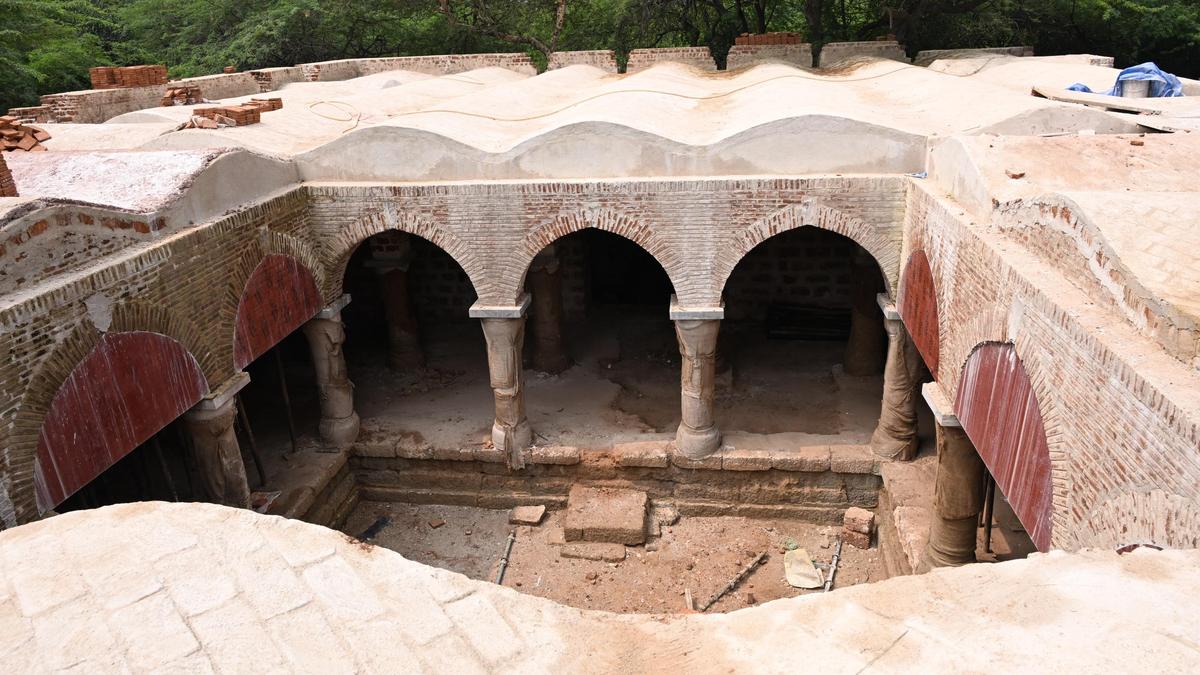

Built to be a secret training ground for cavalry and elephants, the 16th Century Sankarapathi Fort has kept many secrets. In the early 1700s, King Chellamuthu Vijayaragunatha Sethupathy of Ramanathapuram was gifted 200 horses by a Muslim businessman from Thondi. Equestrian power, combined with guerrilla warfare, was a necessity for the rulers as they had to quell upstarts within their own kingdoms and keep an eye on the East India Company, an unknown entity then in the political landscape.
King Vijayaragunatha, apart from his palatial palace at Ramanathapuram, had built a fort in the midst of a dense tropical thorn forest, about 70 km from Ramanathapuram and near Devakottai. Built in the Indo-Islamic or Indo-Saracenic architecture, it blends elements such as arches, domes, and basic stucco work.
A home to rest
This 10,000-square foot palace, away from the hustle and bustle of the royal household and the nitty-gritty of running a kingdom, was a home for the king to rest in solitude. To train the horses gifted to him, he decided to make use of this fort. He approached Hyder Ali, the ruler of Mysore, a friend and a foresighted military strategist, who had transformed the military of Mysore. Ali had adopted a European-style training and a modern artillery corps and improved his cavalry with well-trained horses. Ali sent Sankarapathi, one of the commandants in his army, known for his acumen in training horses.
Thus, in the fort built for King Vijayaragunatha’s pleasure, Sankarapathi began training these horses. Part of the training was in building a trust between the horse and its handler and getting the horses accustomed to loud noises such as drum beats and sounds of artillery firing. Just near the fort is an amphitheatre of sorts, which may have turned into a waterbody during the rains. But on other days, this arena bustled with activity. Sloping steps were hewn in the rocks leading to the amphitheatre so that it was easy for the horses and the elephants to enter the training ground. Among the muted cacophony of a pulsating jungle, the horses, the elephants, and the men would have been put through their paces. Impressed by the tutelage, the king named the fort after Sankarapathi.
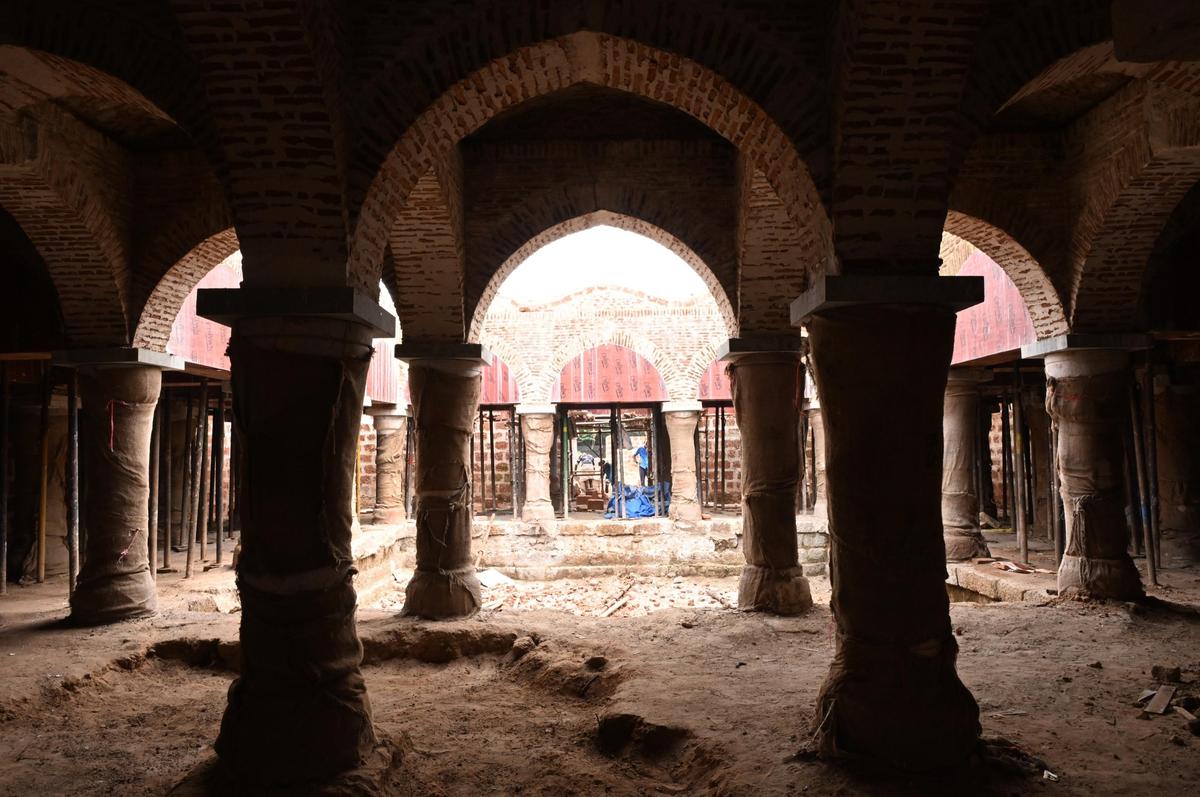
In 2001, Chief Minister Jayalalithaa announced in the Assembly that the fort would be made into a tourist destination. But it was only in 2024 that steps were initiated to rejuvenate the fort.
| Photo Credit:
L. BALACHANDAR
When the dappled afternoon sun seared through the canopy, these men and animals would retreat to the fort. In the cool confines, as the shadows lengthened and a pale moon rose, even if a spy had infiltrated the area, he would have heard a muffled shuffle or a snort that would have dissipated in the loud barks of deer or howls of a jackal or frenzied flutter of birds disturbed by the intruder. It was the perfect place to train an army for covert operations.
A place to form alliances
When the king’s daughter Velu Nachiyar was married to the scion of the Sivaganga dynasty, the Sankarapathi Fort passed on to her. For this warrior queen, this was the secluded spot where she would form alliances to buttress her military strategies against the East India Company. It was also said that there are secret passages from the fort to the Kalieswarar Temple in Kalayarkoil and the Thirumayam Fort. It was here that the Marudhu brothers, too, sought shelter from the Britishers. But the fort fell into ruin when the Britishers blew up the front facade while hunting for the Marudhu brothers.
V. Rajaguru, president, Ramanathapuram Archaeological Research Foundation, points out that as the fort began to disintegrate, warriors who stayed in the fort and lost their lives in various wars began to be deified by the local people. The presence of a Muniswara temple near the fort is the paradigm of worshipping deceased warriors as village guardians. He adds that true to its origin, not many records regarding the fort are available to date.
For about 300 years, the forest grew in and around the fort, and the only ground that was cleared was where the temple stands. Later, a road from Devakottai to Karaikudi would pass through the jungle, and yet the fort remained hidden under the thick foliage.
In 2001, Chief Minister Jayalalithaa announced in the Assembly that the fort would be made into a tourist destination. But it was only in 2024 that steps were initiated to rejuvenate the fort. A staff member working for a private contractor engaged in the restoration of the heritage structure says that once the thick undergrowth was cleared, what they found was a crumbling fort, disintegrating under the burden of banyan and other trees growing from cracks and crevices. Yet some parts of the building precariously stood entwined among the aerial roots.
“It took almost three months for us to clear this. As laterite stones, known in local parlance as ‘chemburan’, have been used in the foundation, it had withstood the ravages of time. But the superstructure is being dismantled in phases. It is being rebuilt with slim-fired bricks known as ‘sithu kal’ sourced from Dhalavaipuram in Virudhunagar district. The outer wall is being constructed with laterite stones. As there are restrictions on quarrying the stone in Tamil Nadu, it is being sourced from Kasaragod in Kerala,” he says.
Eco-tourism, deer park on the cards
No cement has been used, and the binding agent is a concoction of sand, limestone, ‘kadukkai juice’, and palm jaggery. ‘Kadukkai’ is a rich source of tannic acid, and it helps bind the lime and increases its tensile strength. Jaggery increases the solubility of lime in water. All these products were used by masons 300 years ago to build this fort, and today the workers are recreating the same work of art.
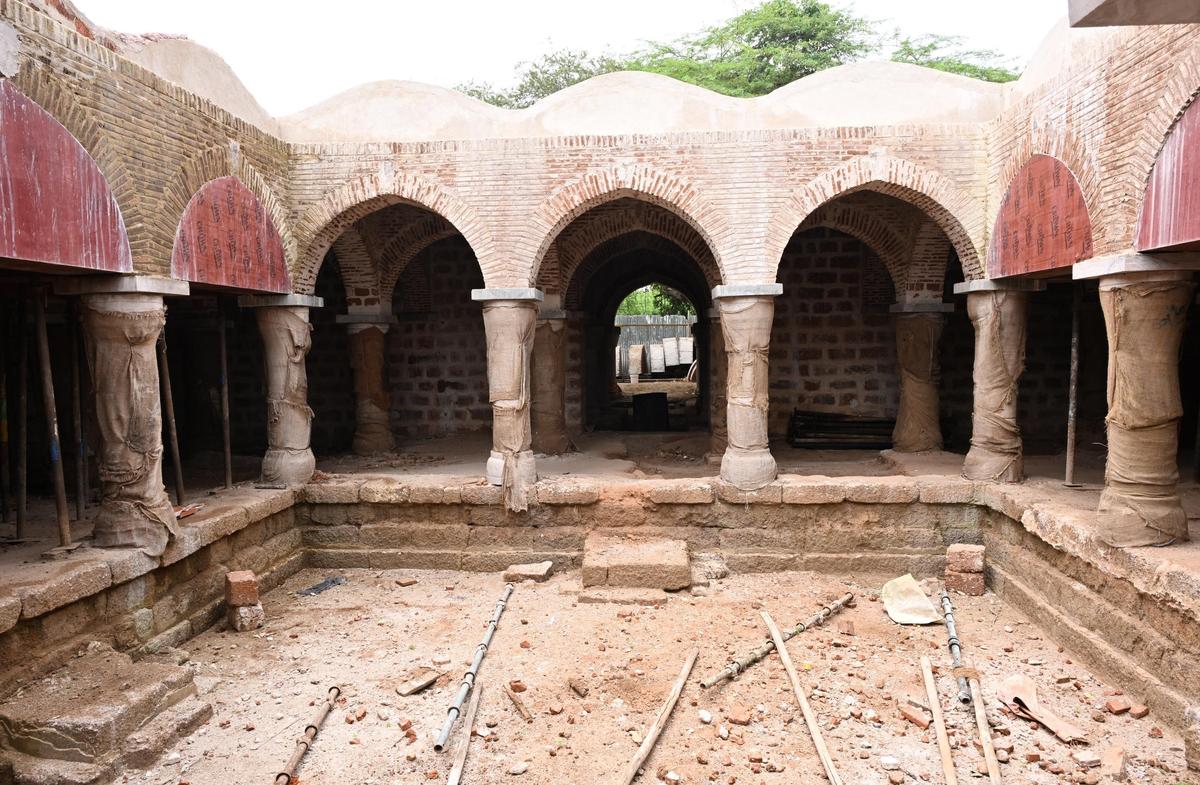
After renovation, the fort will be handed over to the Forest Department as it lies within the department’s jurisdiction. The Forest Department has plans to open this area for eco-tourism and create a deer park.
| Photo Credit:
L. BALACHANDAR
“We are hoping to finish the renovation by March 2026,” says P. S. Nancy, Assistant Executive Engineer, PWD (Heritage), Madurai. After renovation, it will be handed over to the Forest Department as it lies within the department’s jurisdiction. The Forest Department has plans to open this area for eco-tourism and create a deer park. Yet, today, underneath the clutter and clatter of an excavator at work, the Sankarapathi Fort and the jungle around still conceal in musty nooks and dark corners some annals of history, proving that it truly was a secret training ground.
Published – December 05, 2025 05:30 am IST