



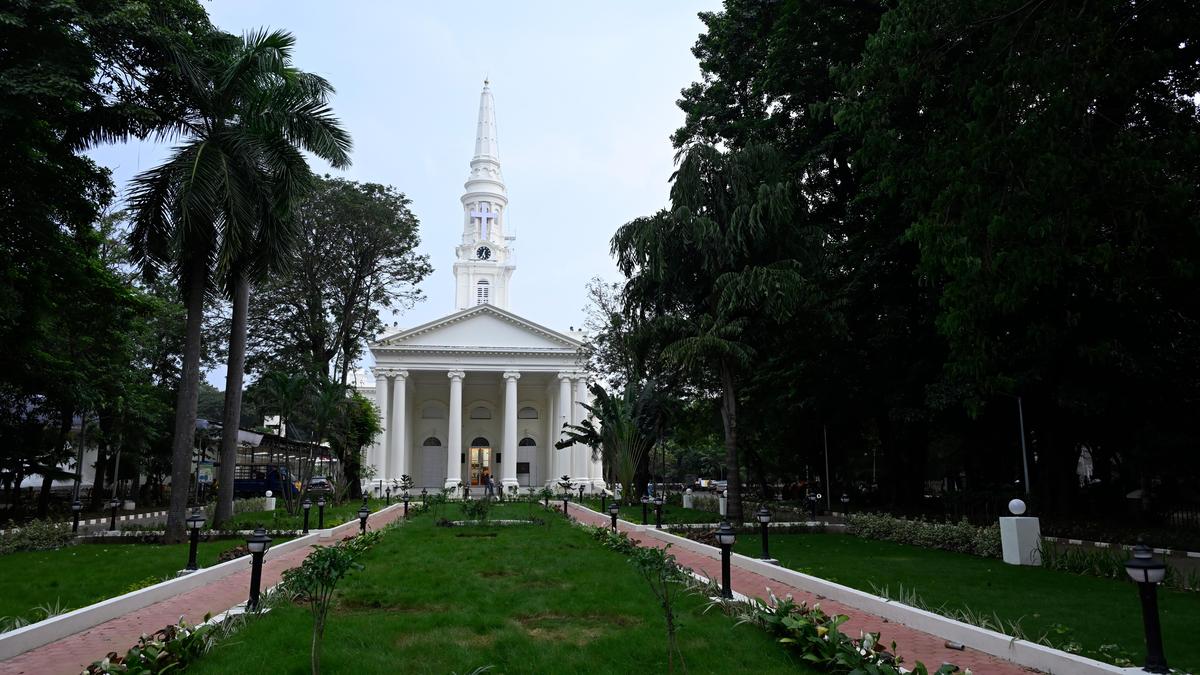

Having lent its name to the road it is situated on, the tall off-white building of St. George’s Cathedral, established in 1816 in Madras, has quite an effect on visitors, even the regular ones. This oasis of peace and quiet, a landscaped space away from the bustle on Cathedral Road, was recently rededicated after a 10-month-long renovation under the supervision of a team of the IIT Madras. It was sometime after 1763, when the European officials and merchants began building houses outside the Fort, that the need for the church was felt in the neighbourhood where the people lived. A request was raised by Rev. Richard Hall Kerr in 1807, or perhaps earlier, to the Governor to build a church on the Choultry Plain, donated by the Nawab of Arcot.
According to the coffee table book, Restoration of the St.George’s Cathedral, the money to build it was raised through a lottery fund. The construction cost 41,709 Pagodas. A further 57,225 Pagodas was spent on furniture, the organ, and the architect’s commission. It was contributed by both the Europeans and the locals, some of whom were non-Christians. To ensure that the non-Christians also benefited from the fund, a portion of it was allotted for the upkeep of the roads.
First Bishop of Madras
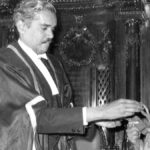
The cathedral was designed by Colonel J.L. Caldwell, the senior engineer of the Presidency, with assistance from Captain De Havilland. The church was completed in 1815. Bishop of Calcutta Rev. Thomas Fanshaw Middleton consecrated the building to the service of God on January 8, 1816. St. George’s Church became the Cathedral of the Diocese of Madras in 1835 when Bishop Daniel Corrie was consecrated as the first Bishop of Madras. With age, the cathedral with its altar, beautiful stained glass windows, wooden pews, tiled floor, tall spire, and bells that chime before weddings and Sunday morning services, had developed cracks on the roof. The restoration was taken up with the permission of the Chennai Metropolitan Development Authority’s Heritage Committee. The Centre for Urbanization, Building and Environment was the project management consultant. A temporary place of worship was created for the community to use during the time of repairs.
According to Arun David Ambrose, honorary secretary of St. George’s Cathedral, the Burma teak wooden rafters in the ceiling had been damaged by water seepage and cement had peeled off from the spots where it had been used for repairing the lime plaster. “We got Sthapathis to do the stucco work on top of the large pillars. It took seven days to remake each of these scrolls — like stucco works. The entire plastering was redone after scrapping the old layers. We had installed a lime mortar unit on the premises. The stained glass windows, too, were repaired and restored,” he said. The entire electrical system was upgraded to meet the current safety standards and a state-of-the-art audio system was installed based on the acoustic studies done by sound engineering experts.
Arun Menon, Professor of Structural Engineering, IIT Madras, said the institution’s connection with the cathedral began in the 1990s and continued through with the latest phase of restoration in 2024-25. The entire process was photographed. “Our challenges included keeping original materials and maintaining authenticity when the interiors were being refurbished and services upgraded and ensuring that the restoration happened without hampering the church’s daily activities.”
Colonel David Devasahayam, convenor of the building committee responsible for the restoration, said they had planned to take up the restoration before the bi-centenary celebrations, but it could not be done. “We were able to take it up after 13 years.”
Organ is to be restored soon
The church has a giant organ obtained from Hills & Sons, London, in 1857. Eminent organist Dr. Garret was appointed as the organist, who later became a Professor of Music at Cambridge. Originally, a gallery was built at the west end for the choir, and the organ was placed in a chamber under the spire. In 1887, the organ was moved from the west end to the east end. At present, the organ is in a state of repair, and the cathedral plans to take up its restoration soon.
The cathedral houses 38 memorials, primarily statues and plaques, made of marble, ceramic, and alabaster. The altar piece, made of alabaster, depicts the Ascension of Jesus Christ holding a sickle, flanked by two angels. A smaller black statue of St. George is seen slaying a dragon above. Despite regular cleaning, they had accumulated dirt on them owing to moisture, dust, paint spills, and oil deposits. A team of archaeologists, epigraphists, and technicians, trained under V. Jeyaraj, a former curator at the Government Museum, Chennai, took up the restoration of these treasured antiques.
Colonel Devasahayam added that the restoration was a new beginning for a cathedral that also played a significant role in church history — the inauguration of the Church of South India (CSI) occurred here on September 27, 1947. It is the mother church for the whole of the CSI and the Diocese of Madras. It has also hosted the coronation services of Governors, memorial services for soldiers, and diverse gatherings that speak to the pluralistic spirit of our great nation, he added.
Published – November 21, 2025 05:30 am IST