





This year marks the centenary year of Guru Dutt. Though a lot has been written and spoken about him, none have been able to weigh the man, his many loves, and how he struck a balance between empirical research and emotional charge. Master storyteller and dastango, Mahmood Farooqui, has tried to unravel the enigma that is Guru Dutt through Dastan-e-Guru Dutt. The 140-minute evocative performance opened recently at Delhi’s Habitat Centre and will be staged in Mumbai next. Spread over 250 pages, the dastan will soon be published as a book with talks on for a film screenplay too.
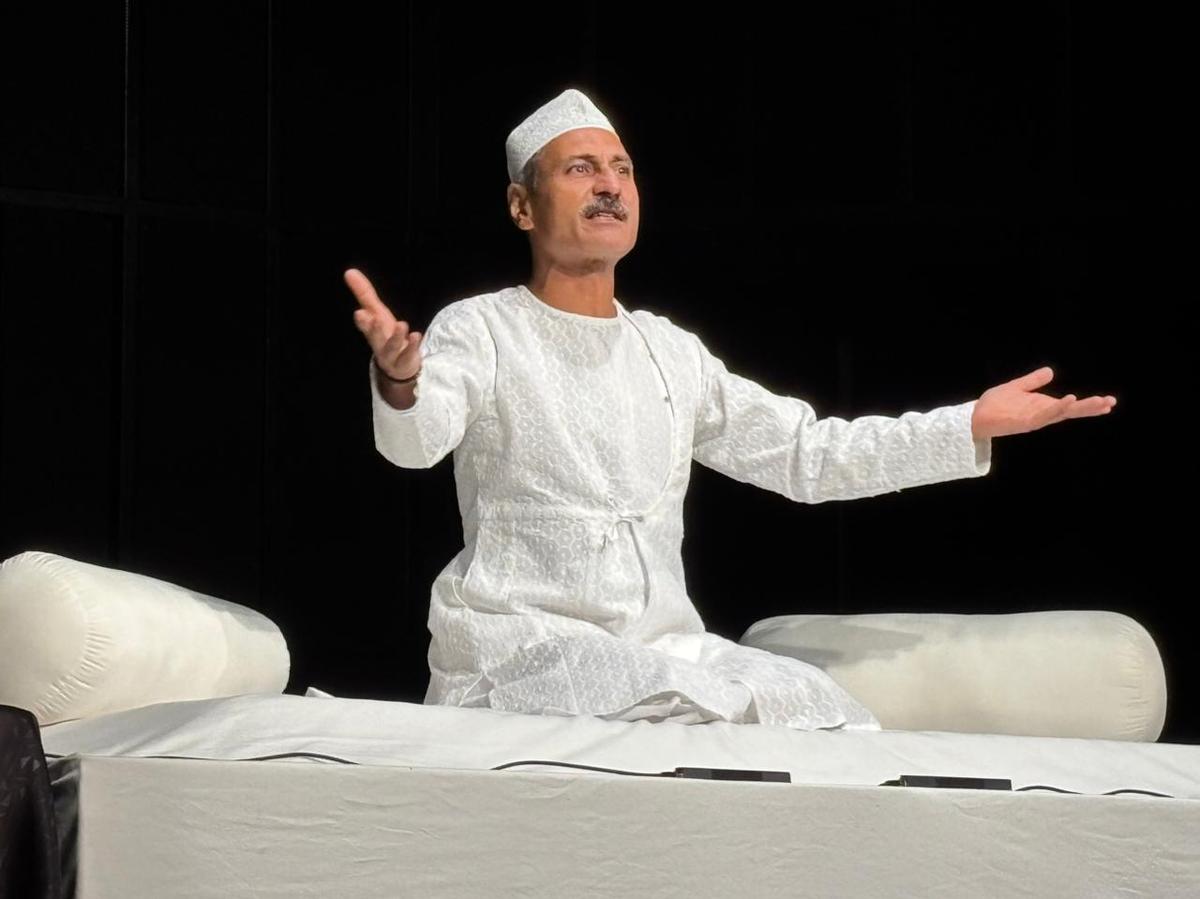
Mahmood Farooqui’s Dastan-e-Guru Dutt
| Photo Credit:
Special Arrangement
It begins with a tribute to Guru Dutt’s subversive tone that still resonates, as Farooqui urges the youth to stay vigilant and rise against injustice with ‘Ae watan ke naujawan jaag aur jaga ke chal’ (from Baaz, 1951), and concludes with a poignant celebration of the pain that Guru Dutt came to embody.
Farooqui has divided the performance into four parts. It talks of the making of Guru Dutt, delving into the psychological influences of his parents and the atmosphere of deprivation that shaped his early years, before he pursued his artistic dreams under the mentorship of the inimitable dancer-choreographer Anand Shankar. Farooqui then explores the backdrop of the ‘bloody bazaar of Bombay’— as P.C. Barua, one of Dutt’s inspirations, described the heart of Hindi cinema — where Dutt found his voice. The narrative also touches upon his tumultuous relationship with Geeta Roy, and celebrates his cinematic masterpieces.
Everyone is a product of their time, and in Guru Dutt’s case, time was pivotal,” Farooqui observes. In his essay Classics and Cash, Guru Dutt critiques a certain kind of neorealism —perhaps a reference to Satyajit Ray — who behave as if there was no Indian cinema before them. He instead talks about P.C. Barua and Devaki Bose, who made realistic films in the 1930s without concern for box office returns.
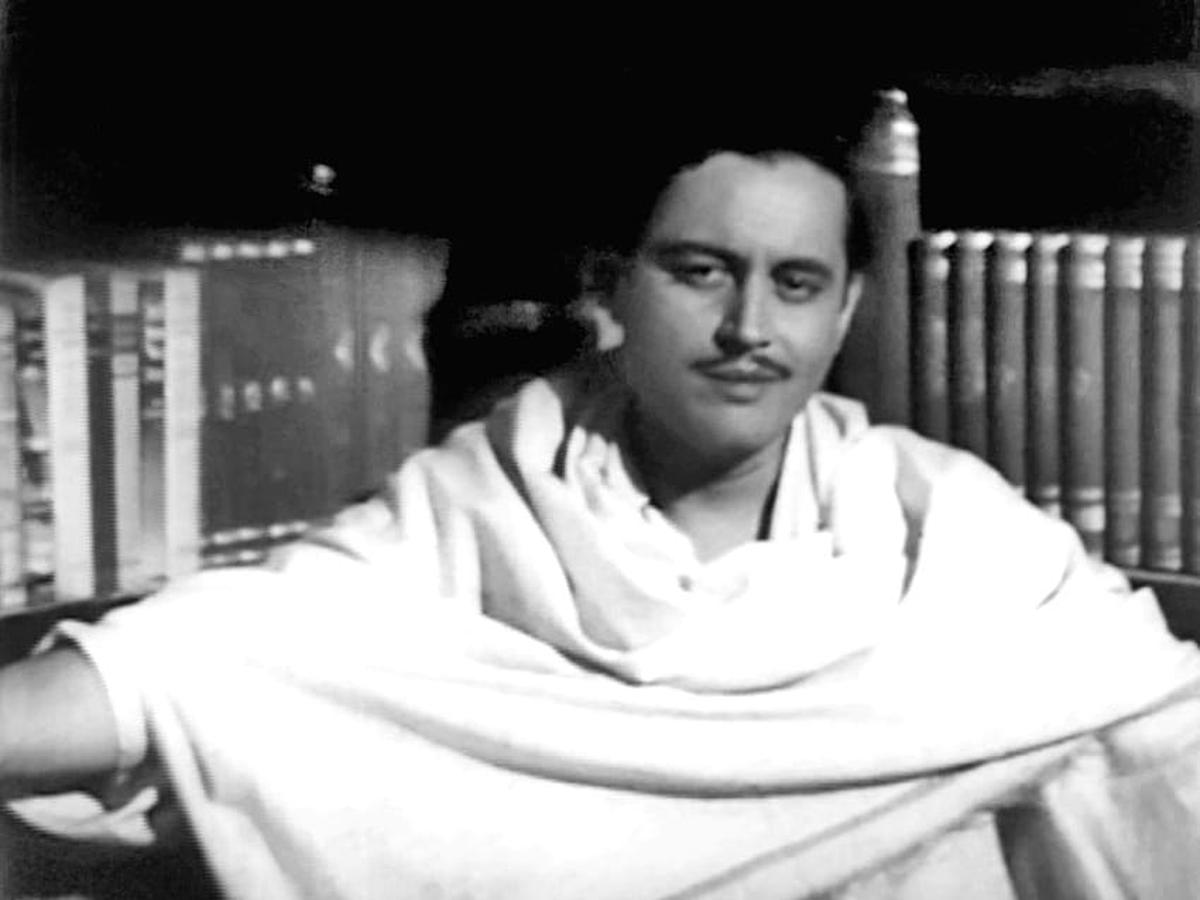
Guru Dutt in Pyaasa
| Photo Credit:
Special Arrangement
The cinema of the 1950s was a product of the progressive writers’ movement. “Through IPTA, film creatives learnt how to tackle serious issues in popular idioms. There cannot be a Raj Kapoor without Shailendra and Khwaja Ahmad Abbas, and there cannot be Guru Dutt without S.D. Burman, Sahir Ludhianvi, and Majrooh Sultanpuri,” says Farooqui.
However, at the cusp of the 1950s, the landscape was far golden as it now appears to be in retrospect. The studio system was crumbling, and the ‘film star’ culture was finding its roots. The film industry was becoming a means to turn black money into white for those who saw it as a business. Stories were written around songs of union and separation, and there was little scope to talk about poverty, hoarding, black marketeering, unemployment, and social mores.
Guru Dutt saw it as a period of decline, attributing the shift to changes in the cinema-going audience. He grew up on films such as V. Shantaram’s Duniya Na Mane (1937), which talks of women’s emancipation, and Gyan Mukherjee’s early template for a Bollywood blockbuster, Kismet (1943).
Impressed by the oriental style of storytelling in Akira Kurosawa’s Rashomon, Guru Dutt didn’t want to pander to European taste. When Sahib Bibi Aur Ghulam got a tepid response at the Berlin Festival, he took it on his chin.
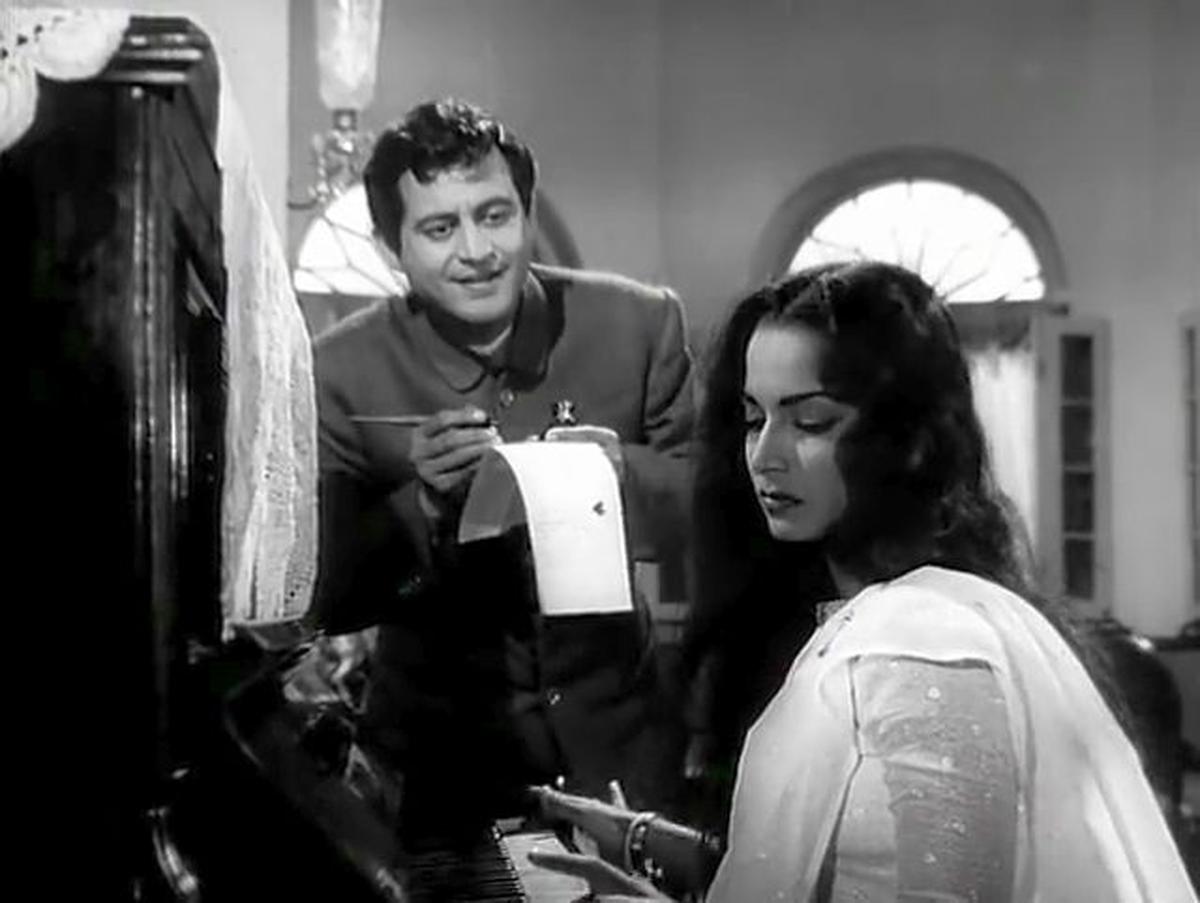
Guru Dutt with Waheeda Rahman in Sahib Bibi Aur Ghulam
| Photo Credit:
Special Arrangement
Guru Dutt’s career can be divided into two parts — first, when he sharpened his technique and song picturisation skills with Jaal, Baazi, Aar Paar, and C.I.D (produced by him), and socially-aware romantic comedy Mr & Mrs ‘55. His trusted cinematographer, V.K. Murthy, once said: “in his films, songs were never extra. They were the film. The dialogues would lead into songs”.
In the second phase, he expressed his personal pain and anguish as cinematic poetry — Pyaasa, Kagaz Ke Phool, and Sahib Bibi Aur Ghulam. The amalgamation of self-pity and melodrama created a new syntax. Farooqui sees a link between the protagonists of both phases. The character traits of the protagonists of Baazi, Aar Paar, and Mr & Mrs ‘55 are also found in the characters of Vijay in Pyaasa, Suresh Sinha of Kagaz Ke Phool, and Chhoti Bahu of Sahib Bibi Aur Ghulam. “They are not happy with their present situation and are seeking a better future without compromising on their principles — a reflection of Guru Dutt’s personality.”
Alongside this, Guru Dutt followed the formula of making a critically acclaimed film after a popular one. Pyaasa was preceded by C.I.D; Kagaz Ke Phool was followed by Chaudhvin Ka Chand; and Sahib Bibi aur Ghulam was followed by Baharen Phir Bhi Ayengi (which released posthumously).
“What Guru Dutt could not do was to make small budget films like Ritwik Ghatak and Satyajit Ray. He tried to make Gauri in Bangla, but it never released. Box office was a kind of trap for Guru Dutt,” shares Farooqui.
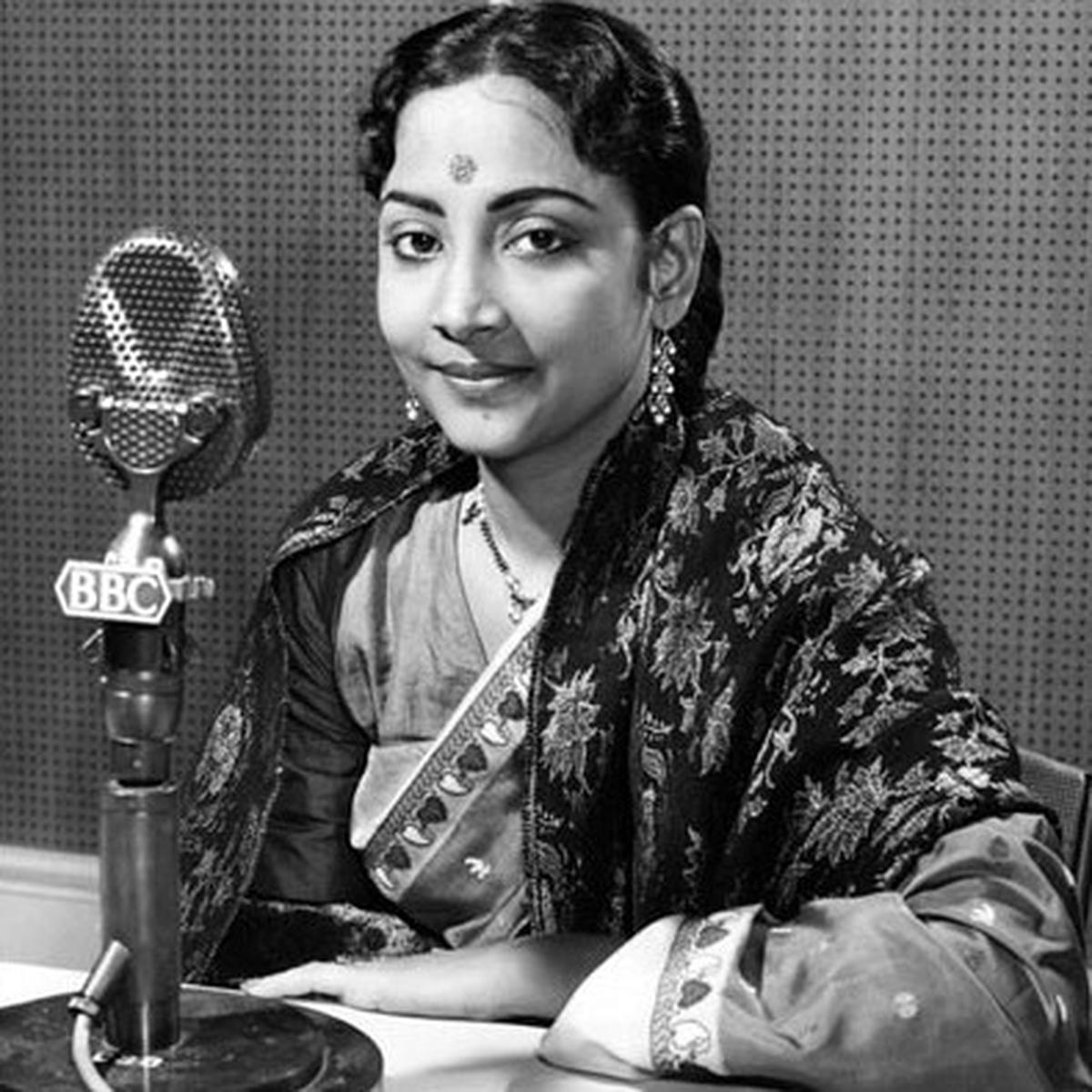
Singer Geeta Dutt
| Photo Credit:
Courtesy: Wikipedia
Satyajit Ray loved Sahib Bibi Aur Ghulam as it was his kind of film, but Farooqui feels a classical filmmaker could not have made Pyaasa that transcended a niche audience to reach the layman. “The recklessness that is there in Pyaasa’s protagonist, the way he infused personal torment into a universal narrative, only Ritwik Ghatak could have done it. In that sense, I see parallels between Guru Dutt and Ritwik Ghatak.” Born in the same year, both tried to express their lives through their films. At the same time, Farooqui adds, we have to acknowledge that Guru Dutt had the support of a star, his friend Dev Anand, and gradually he too became popular.
Farooqui has based his portrait of the master on multiple sources, all of which are not adulatory. While Bimal Mitra’s reflection in Bichde Sabhi Bari Bari is idolatrous, granting Guru Dutt almost a saintly status, Ismat Chughtai’s dissection of his personality in her novel Ajeeb Aadmi assumes a critical tone. “The reality lies somewhere in between,” says Farooqui. He also draws on Firoz Rangoonwala’s monograph on Guru Dutt, in which the film historian described his films as cultural touchstones, and on Nasreen Munni Kabir’s extensive study of the master.
Farooqui questions Guru Dutt’s choices, particularly the gap between the progressive ideas in his films and his conservative stance towards his wife’s (Geeta Dutt) career. Geeta’s growing affinity for the bottle and suspicion of Guru Dutt’s relationship with Waheeda Rehman also don’t go unquestioned. Singing for Guru Dutt’s films meant singing for Waheeda, something Geeta could not live with, leading to cracks in the relationship so much that Guru Dutt razed the bungalow he built to the ground. All along, Guru Dutt kept his gaze inwards, holding himself responsible for the chaos within. Always in a hurry to get things done on the sets, Farooqui says, he seemed to be in a rush to start a new life as well. “Only the man of goodwill carries always in his heart this capacity for damnation and despair — this line from Graham Greene applies to Guru Dutt well,” he says.
Published – October 29, 2025 07:53 pm IST