




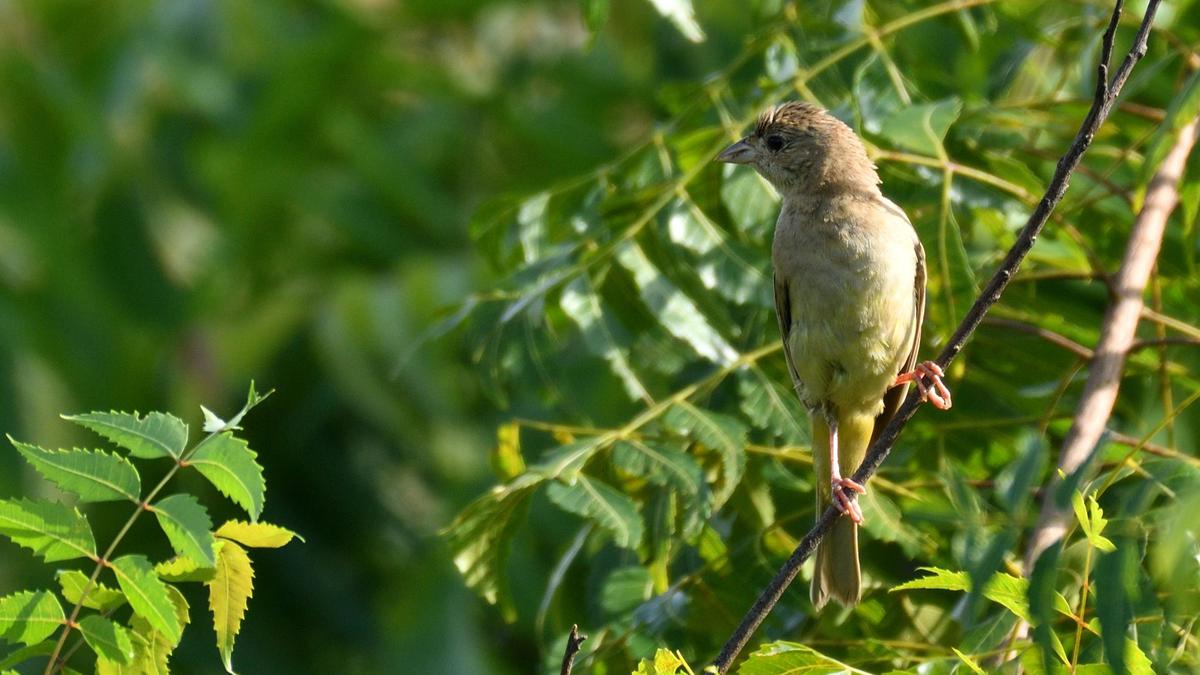

A red headed bunting photographed by birder Kumaresan Chandrabose at Adyar Estuary on October 29, 2025.
If a red-headed bunting had not shown up at the Adyar estuary on October 29, 2025, the following paragraph would have been unnecessary. And if nobody had seen the bird, that would have made the following paragraph unnecessary as well. It showed up and was seen; not just seen, but documented on citizen science platforms. Hence this paragraph, seemingly on a tangential course.
Here goes. At college, this writer sat in the class of a German master who had a standard introductory remark for new learners of the language. “Bad English is good German.” That statement was meant to ease the nerves of students still uncertain if signing up for German was a great idea. The master was obviously not entirely right, and not entirely wrong either. English and German are cousins, similar in structure and sharing linguistic roots. English words with forbears from old English and old German are aplenty. Bunting, the word germane to this report, is in that league.
Bunting is used in at least three contexts; and the one involving birds is based on two old root words, one from Old German and the other from Old English. Without getting bogged down in etymological details (as that is not the purpose of this report), between them those two root words contribute the ideas of stout and colourful, which is what buntings are. They are stout; and the male birds among buntings (Emberiza) are colourful.
On October 29, at the Adyar estuary, a bunting was sighted by birder Kumaresan Chandrabose; as it was a female bunting, some confusion about its identify prevailed.
Initially thought to be a female black-headed bunting, it was later re-identified as red-headed bunting, said to a first for Chennai. The corrected identification came from members of three groups focussed on bird identification.
These three groups operating in Facebook are: Birds of India; Ask IDs of Indian birds; and Identification of Birds from Indian Subcontinent. This bird is likely a vagrant, having flown off course from its regular wintering patch due to cyclonic winds. Kumaresan explains: “I saw this female red-headed bunting at the Adyar Estuary in the morning and evening of October 29; and it was not to be found on October 30; nor on any of the other subsequent days.”
Published – November 01, 2025 05:36 pm IST