



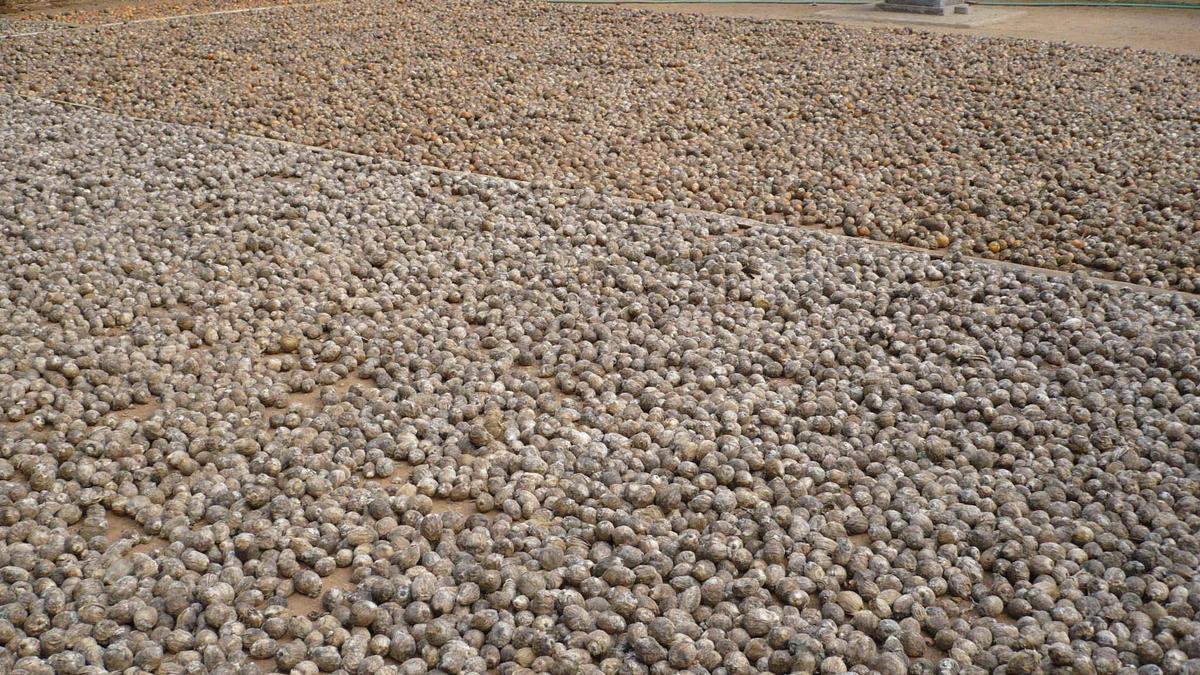


A file photo of raw arecanut being dried near Vitla in Dakshina Kannada district.
Arecanut imports to India which had fallen in 2023-24 shot up again in the last financial year.
Union Minister for Commerce and Industry Piyush Goyal told the Lok Sabha on Tuesday that India imported 42,236.02 tonnes (valued at ₹1,208.34 crore) of arecanut in the last financial year when compared to 40,386.48 tonnes (valued at ₹1,225.70 crore) imported in 2023-24. The arecanut imported during 2022-23 stood at 78,233.66 tonnes (valued at ₹2182.33 crore).
The Minister said India imported 12,155.40 tonnes of arecanut valued ₹447.76 crore from Bangladesh in 2024-25, followed by 11,589.56 tonnes valued at ₹129.35 crore from Indonesia, 8,353.70 tonnes valued at ₹303.70 crore from Sri Lanka, 7,569.03 tonnes valued at ₹278.24 crore from Myanmar, and 1436.47 tonnes valued at ₹3.89 crore from Bhutan.
The Minister’s reply was to a question by B.Y. Raghavendra, Shivamogga MP.
Mr. Goyal said India imported arecanut from other countries such as UAE, Malaysia, Oman, Singapore, and Thailand.
Flagging the issue of arecanut import to India from least developed countries (LDCs) in the Lok Sabha on Monday, Capt. Brijesh Chowta, Dakshina Kannada MP, said that large-scale imports from Bhutan, Myanmar, and Sri Lanka have been adversely affecting India’s domestic arecanut market, severely impacting farmers in key producing regions, including the coastal and Malnad belts of Karnataka.
Capt. Chowta said that those countries currently enjoy zero customs duty under India’s Duty-Free Quota-Free (DFQF) preferential trade scheme — a provision originally intended to support LDC economies and now being misused in a way that harms Indian farmers.
The zero-duty window has resulted in low-cost, inferior-quality arecanut flooding the Indian market, destabilising prices and pushing cultivators into distress. Between September 2023 and August 2024, Bhutan accounted for 57% of all arecanut import shipments, followed by Myanmar at 39%, and Sri Lanka at around 2%.
Large volumes of zero-duty imports continue to enter the country, creating a steep and unfair price disparity that erodes the competitiveness of farmers in major growing regions, he said.
Capt. Chowta pointed out that normal arecanut imports attract 100% basic customs duty, but the DFQF exemption nullifies this protection entirely. This loophole has led to price crashes, market instability and deep economic anxiety among lakhs of cultivators whose livelihoods depend on the crop.
Published – December 03, 2025 08:42 pm IST