




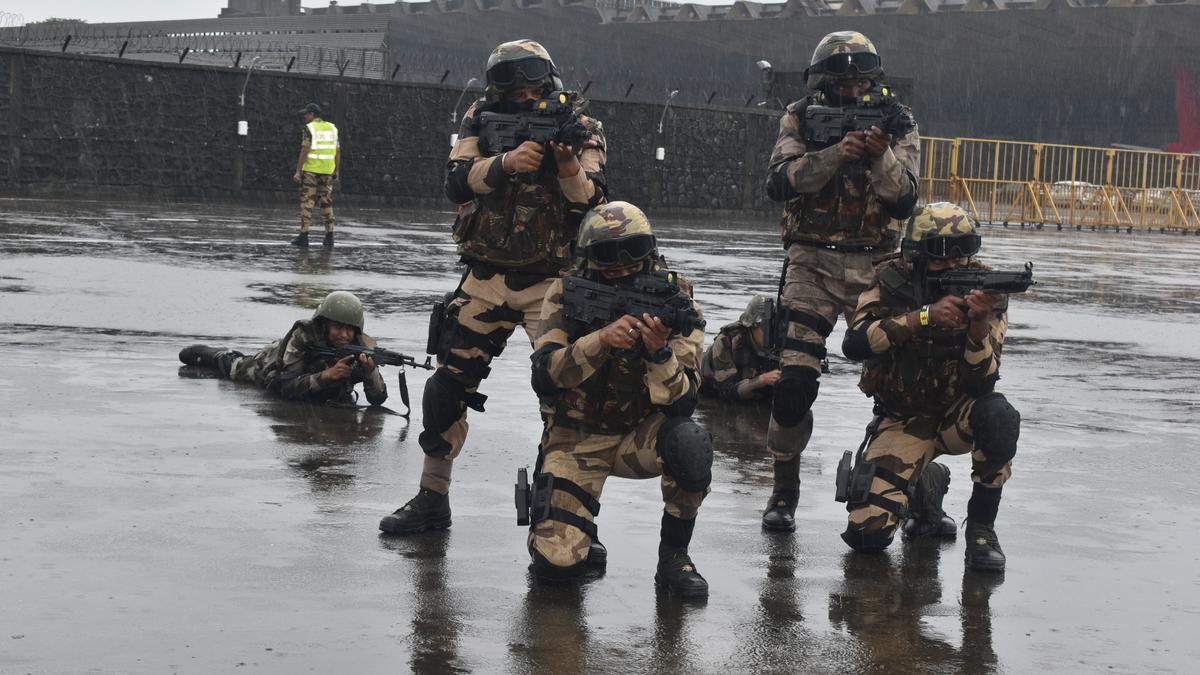

The Central Industrial Security Force (CISF) has revised the tenure of its personnel deployed at Parliament to a minimum of four years. At present, they are posted for three years. Personnel with a clean service record and only those who clear psychological assessment tests will be deployed, a CISF official said.
The revised policy comes in the wake of complaints by several Members of Parliament who were stopped or questioned by CISF personnel while entering the premises.
The extended tenure will make CISF personnel more familiar with MPs and their movement patterns in Parliament, which is critical for ensuring accurate identification, secure access protocols, layered threat detection and response, the official said.
Also Read | Parliament Monsoon Session: Deputy Chairman rejects Opposition’s claim of CISF deployment in Rajya Sabha
After a security breach in the new Parliament building on December 13, 2023, the Union Home Ministry approved CISF deployment at the complex. The duties were earlier assigned to the Parliament Security Service, posted since 1950 and specially trained to recognise and interact with MPs.
Lok Sabha Speaker is the overall in-charge of security at the Parliament complex, which houses several buildings. CISF functions under the Home Ministry.
In June 2024, DMK MP M.M. Abdulla wrote a letter to then Vice-President Jagdeep Dhankhar, the former Chairman of the Rajya Sabha, and complained about CISF personnel questioning him on the purpose of his visit to the Parliament complex. In his letter, Mr. Abdulla said he was stopped and asked where “[he] was headed inside the premises”.
Also Read | Kharge writes to Rajya Sabha deputy chairman condemning security personnel presence in well of House
In a phased takeover completed on May 20, 2024, CISF assumed charge of all core security layers at Parliament – including access control, perimeter and internal security, counter-terror and counter-sabotage response, bomb threat management, and fire and disaster preparedness.
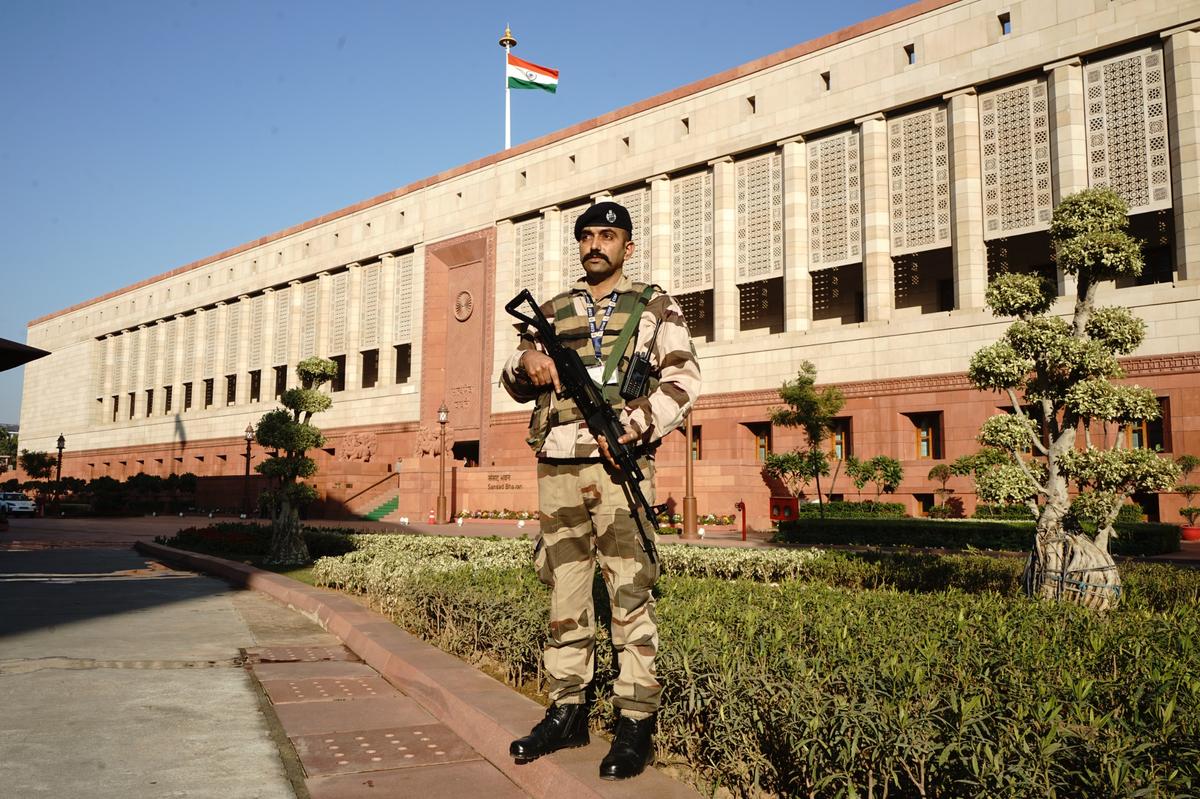
CISF personnel at Parliament building.
| Photo Credit:
Special arrangement
A contingent of over 3,300 personnel, including more than 200 fire and disaster management specialists, were deployed to introduce airport-style security protocols such as advanced frisking, X-ray baggage checks and multi-level access verification. Around 300 personnel are women.
“CISF has introduced a revised posting policy specific to Parliament security duties. Under the new framework, the tenure of personnel has been extended from the existing three years to four years, with a possible extension of one additional year based on suitability. To ensure operational continuity while ensuring optimum rotation for steady infusion of new blood, a fixed proportion of the sanctioned strength will be changed every year,” the CISF official said.
The new policy includes tighter eligibility norms and multi-stage screening.
Also Read | Security breach at Parliament as man tries to scale boundary wall
“Personnel selected for Parliament duty must possess a clean service record, be in SHAPE-I medical category, have no disciplinary or vigilance concerns, should have completed at least two specialised courses and meet rank-specific age requirements,” the official said.
CISF has instituted a mandatory multi-stage screening process such as psychological assessment, battle physical efficiency test (BPET), Parliament-specific induction training and comprehensive security clearance.
“Only those qualifying all stages will be deployed for Parliament duties. Personnel deployed at Parliament are regularly undergoing on-site and off-site training sessions during inter-session periods,” the official said.
Also Read | CISF trains with Army to combat security threats
The training includes National Security Guard-customised training and counter-terror training with Indian Army.
“To maintain high readiness levels, CISF is conducting regular scenario-based mock drills simulating bio-terror incidents, terrorist attacks, drone threats, cyber-attacks, bomb threats, evacuation operations and air-contamination situations. Fire contingency elements are integrated into all exercises. Night-firing exercises are also conducted to sharpen accuracy and precision in low-light conditions,” the official said.
Annual psychological tests and BPET will be conducted for all personnel, while BPET for Quick Response Team personnel will continue on a monthly basis.
Published – November 27, 2025 08:06 pm IST