









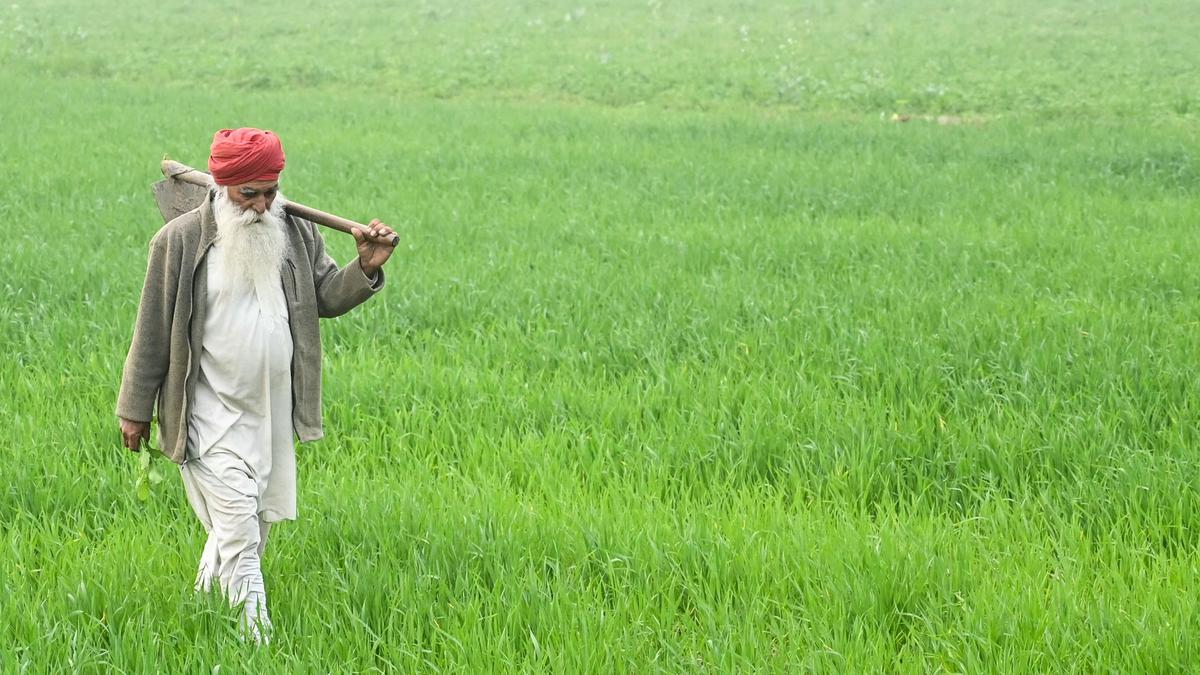
A farmer walks across a wheat field on the outskirts of Amritsar.
| Photo Credit: AFP
A Budget is the response of a government to the challenges in the economy. The effort in the Economic Survey 2024-25 was to spin a positive narrative on the state of Indian agriculture. It claimed that Indian agriculture remained remarkably resilient owing to a rise in productivity, an expansion of crop diversification, and an increase in farmers’ income. These claims were either suspect or highly exaggerated.
To begin with, there is no significant jump in crop productivity. A simple analysis based on index numbers shows that growth rates of yield between 2014-15 and 2022-23 were marginally lower in food grain crops and non-food grain crops than between 2004-05 and 2013-14. Second, there is no major evidence of crop diversification in India, other than marginal shifts in a few States in favour of pulses. If at all diversification is real, it took place outside the crop sector in the spheres of livestock and fisheries. But the share of households involved in the livestock and fisheries sectors is dwarfed by the corresponding share of households in the crop sector. Third, while the government continues to claim a rise in farmers’ income, data show the opposite — there is either a stagnation or fall in farmers’ real incomes in recent years.
The “resilience” of Indian agriculture, a la the Economic Survey, was not policy-induced but owing to a set of fortuitous factors, including the hardening of international prices and favourable weather conditions in the post-Covid years. At the same time, the more deep-seated problems, as evidenced by low productivity, slow growth of prices, shrinkage of profitability, falling real incomes and rural real wages, have continued to create conditions that militate against any growth stimulus emerging from agriculture.
Reduced allocations
From the commentaries prior to the Budget, one expected that the government would reverse its past fiscal neglect of agriculture, which was in large part seen as a penal action for the farmers’ agitations after 2020. The rude shock that the rural electorate delivered to the BJP in June 2024 was also cited as a motivation for course correction. But the Budget belies these optimistic expectations. The fiscal neglect of agriculture continues.
Let us begin with agricultural research, which must be the centre of investment for efforts to raise crop yields alongside the development of climate resilience. The overall increase in spending on agricultural research and education between 2023-24 and 2025-26 is just ₹21 crore. Compare this with the pseudoscientific National Mission on Natural Farming, for which allocation was ₹30 crore in 2023-24 but is ₹616 crore for 2025-26. This is not just a reflection of inverted priorities, but also a shocking embrace of irrationality.
If we consider crop husbandry, which is an umbrella category for expenditures on schemes and institutions in agriculture, the allocation has fallen by ₹5,195 crore between 2023-24 and 2025-26. There has also been a drastic reduction in allocation by ₹3,622 crore for the Pradhan Mantri Fasal Bima Yojana, from which many States have withdrawn due to design failures, between 2024-25 and 2025-26. The allocations for most other central sector schemes are also either stagnant or have fallen.
Much was said in the Budget speech on the new crop-based missions, but the allocations for these are paltry. The allocation for the Cotton Technology Mission is ₹500 crore, the Mission for Pulses is ₹1,000 crore, the Mission for Vegetables and Fruits is ₹500 crore, and the National Mission on Hybrid Seeds is ₹100 crore. A new Makhana Board, with an allocation of ₹100 crore, has been announced for Bihar. But the already existing commodity boards are cash strapped. For example, between 2024-25 and 2025-26, allocation for the Coffee Board has remained unchanged, the Rubber Board’s allocation has risen by just ₹40 crore, and allocation for the Spices Board has risen by just ₹24 crore. Allocation for the Coconut Development Board has been cut from ₹39 crore in 2023-24 to ₹35 crore in 2025-26.
Fiscally ignored sectors
Despite the claims in the Economic Survey on diversification into livestock and fisheries, these sectors also remain fiscally ignored. The total expenditure on fisheries would rise by just ₹87 crore between 2024-25 and 2025-26. Between 2024-25 and 2025-26, the expenditure on animal husbandry is set to fall by ₹407 crore while that on dairy is set to rise by just ₹321 crore. Considered together, the overall expenditure on all budget items in animal husbandry and dairy are to rise by a paltry ₹319 crore between 2024-25 and 2025-26. The Budget portrays these sectors as growth engines, but fiscally squeezes them.
A new scheme called Prime Minister Dhan-Dhaanya Krishi Yojana has been announced. This aims to target 100 districts with low productivity, moderate crop intensity, and below-average credit parameters – much in the model of the Aspirational Districts Programme. But agriculture is a State subject. While the Budget speech mentioned “partnership with States” in the description of this Yojana, it remains to be seen if its governance would be designed to be centralised, of a one-size-fits-all variety, and one that ends up fiscally burdening the States.
While the Budget speech mentioned agriculture several times, these were hardly matched by financial allocations. The schemes and programmes are starved of resources, and the real issues that confront the farmers and the sector remain sidelined.
R. Ramakumar, Professor at the Tata Institute of Social Sciences, Mumbai
Published – February 02, 2025 01:47 am IST


