



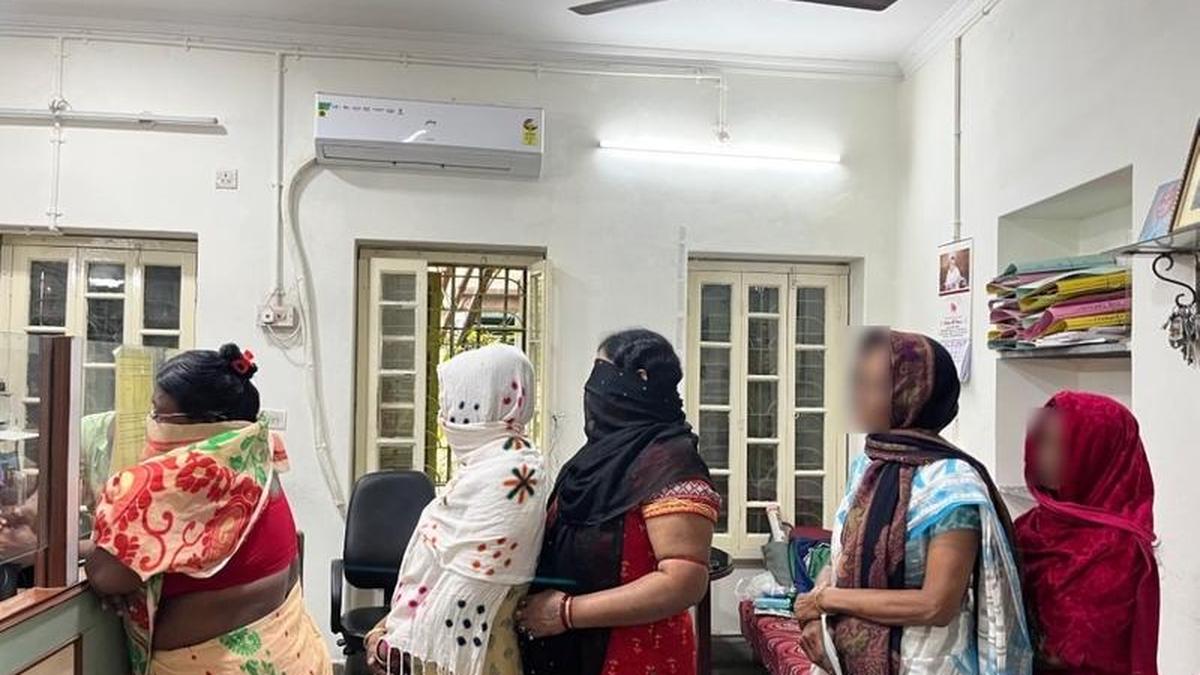

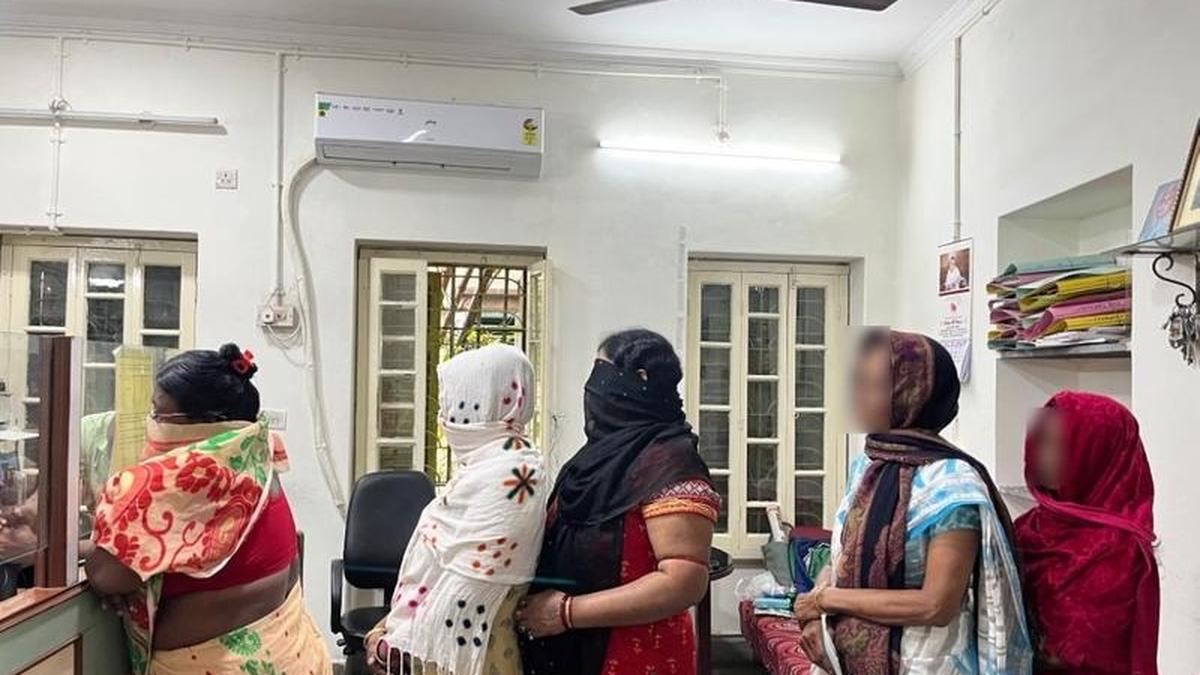
Sex workers line up at the office of Usha Multipurpose Cooperative Society at Sonagachi to deposit their savings.
| Photo Credit: Moyurie Som
Anita Das, now 47, was lured from her home in West Bengal’s Nadia district in her 20s with the promise of a job. Like many other women, she was trafficked to the red light area of north Kolkata’s Sonagachi in the same clothes that she left home in, no identification documents or money in hand.
“I left home over 15 years back and never returned. I work here, I have birthed and raised children here. Suddenly, I am being asked about my parents, where they were and where I was in 2002. I am being asked for identification documents by a society that did not consider me worthy of recognition or respect,” Ms. Das said, referring to the ongoing special intensive revision (SIR) of West Bengal’s electoral rolls.
Ms. Das described SIR as a “crisis equivalent to the COVID pandemic”.
“We are not against SIR. But most of us are uneducated and don’t know what to write in the form, how to fill it, or how to trace ourselves or our parents from the 2002 list. The Booth Level Officer (BLO) is filling it on our behalf but we don’t know what he is writing. Some of us do not even know where we were born, let alone have birth certificates or other such documents. We have been disowned by our families,” she said.
On November 21, three welfare organisations from Sonagachi, one of Asia’s largest red light areas, wrote to Chief Electoral Officer (CEO) of West Bengal Manoj Kumar Agarwal seeking special considerations and assistance during SIR for the sex worker community.
Soon after, Mr. Agarwal announced special camps for sex workers and their families and assured them that he would try to visit the SIR camp and personally ensure that Sonagachi’s nearly 15,000-strong community of sex workers do not face difficulties during the exercise.
Shivani Giri, a sex worker and the secretary of Society for Human Development and Social Action, said help from the CEO’s office is of utmost importance.
“We cannot risk being considered illegitimate and invalid by our country’s top officials after years of being treated as untouchable by society,” she said.
“In 2007, we had written to then Chief Electoral Officer of West Bengal Debasish Sen to help us get government IDs and be recognised as voters. He acknowledged the Usha Cooperative passbook that most sex workers here have, and helped hundreds of us get voter ID cards,” said Tutul Singh, a former sex worker and secretary of the Usha Multipurpose Cooperative Society (UMCS).
This organisation, registered as a cooperative society in 1995, helps sex workers and their families build monetary reserves, take loans, etc in a setting where they would often be robbed, defrauded, or extorted in the face of violence.
Mr. Sen said that at that time, there was some confusion around the issuance of EPIC cards to sex workers, and that a request had been put up by welfare organisation Durbar Mahila Samanwaya Committee and UMCS for the voter registration of Sonagachi’s sex workers and their ID photos being discreetly photographed in a separate registration booth.
Kohinoor Begum, 53, who recalled coming to Sonagachi on February 17, 1994 from her home in Murshidabad’s Behrampore, asked agitatedly if sex workers should work or spend their time “running around to make sense of the form”.
‘No same rules’
Satabdi Saha, 48, daughter of a sex worker and secretary of Amra Padatik, a welfare body, pointed out that patrilineal identification is impossible for any child born in the red light area.
She said that when sex workers have always been ‘othered’ from society and discriminated against, the rules that apply to the rest of society should not be implemented identically on them.
Published – November 27, 2025 01:31 am IST