



West Bengal Chief Minister Mamata Banerjee will visit Thakurnagar, the spiritual headquarters of the Matua community in Bongaon subdivision of North 24 Parganas district bordering Bangladesh, on Tuesday and take out a 3-km roadshow before addressing a public meeting.
This will be the second time Ms. Banerjee will be taking to the streets against the ongoing special intensive revision (SIR) of electoral rolls since the exercise was rolled out in the State on November 4.
The Chief Minister’s visit assumes significance as the community, comprising Hindu Namasudras with roots in Bangladesh, is among groups of people apprehensive about the SIR in the State. Ahead of the 2026 Assembly election, the ruling Trinamool Congress (TMC) is trying to reach out to the minority community that voted for the BJP in the past two Lok Sabha polls. The TMC has recently gained ground in the region by defeating the BJP in the 2024 bypolls.
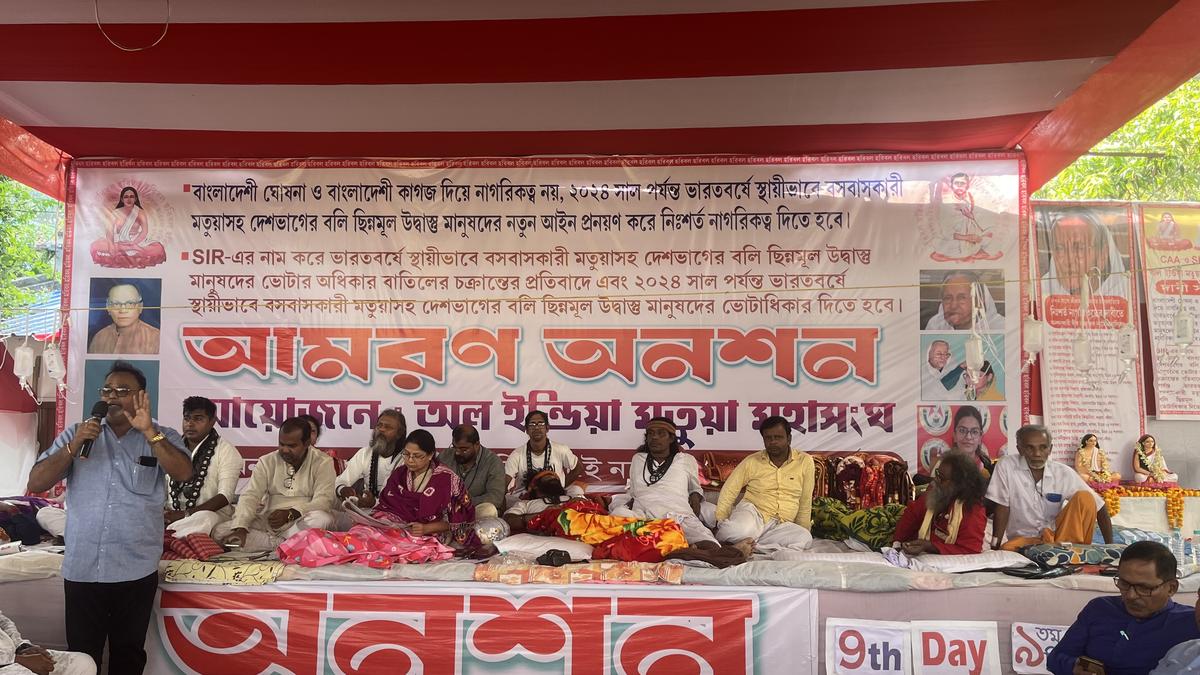
Since November 5, a section of members of the Matua community led by TMC Rajya Sabha member Mamata Bala Thakur has been staging a hunger strike at Thakurnagar. According to Ms. Mamata Bala, members of the community are concerned as the Election Commission is using the 2002 voters’ list as the base for the SIR.
‘Dying of fear’
“There are many of us who have all the documents, but do not have our names on the 2002 voters’ list. We are dying of fear. Many of us came from Bangladesh at a time of distress; we had nothing but the clothes on our body,” she told The Hindu.
The TMC lawmaker also asked how people without families will produce documents of parents to prove their citizenship. The SIR has pushed several people from the community to apply for citizenship under the Citizenship (Amendment) Act, 2019 (CAA).
Not far from the protest site, BJP lawmaker from Bongaon and Union Minister Santanu Thakur has set up a camp for Matuas to apply for citizenship under the CAA. Mr. Santanu and Ms. Mamata Bala hail from the family of Harichand Thakur and Guruchand Thakur, who founded the Matua sect at Orakandi in present-day Bangladesh in the late 19th century.
The Matuas began migrating from Bangladesh in 1947 and continued to arrive in India both before and after the war in 1971 that liberated what was then East Pakistan from West Pakistan. In West Bengal, the community has a considerable presence in border districts such as North 24 Parganas, Nadia, Howrah, Cooch Behar, and Malda, and are the State’s second largest Scheduled Caste community.
The CAA, which was passed by Parliament on December 11, 2019, facilitates citizenship to undocumented migrants belonging to six non-Muslim communities – Hindu, Sikh, Buddhist, Jain, Parsi or Christian – from Afghanistan, Bangladesh, and Pakistan, who entered India on or before December 31, 2014. The CAA Rules were notified on March 11, 2024, coinciding with the birth anniversary of the founder of the Matua sect.
The rules specify several documents that are to be uploaded on an online portal (indiancitizenshiponline.nic.in/) in order to process the application.
A sworn affidavit declaring the country of origin and date of entry into India along with an eligibility certificate to be issued by a locally reputed community institution certifying that a person follows one of the six faiths are mandatory.
“We will appeal to the Election Commission not to remove from the new electoral roll the names of those who do not figure in the 2002 voters’ list,” Mr. Santanu said, assuring members of his section of the community that their voting rights will not be snatched away by the SIR.
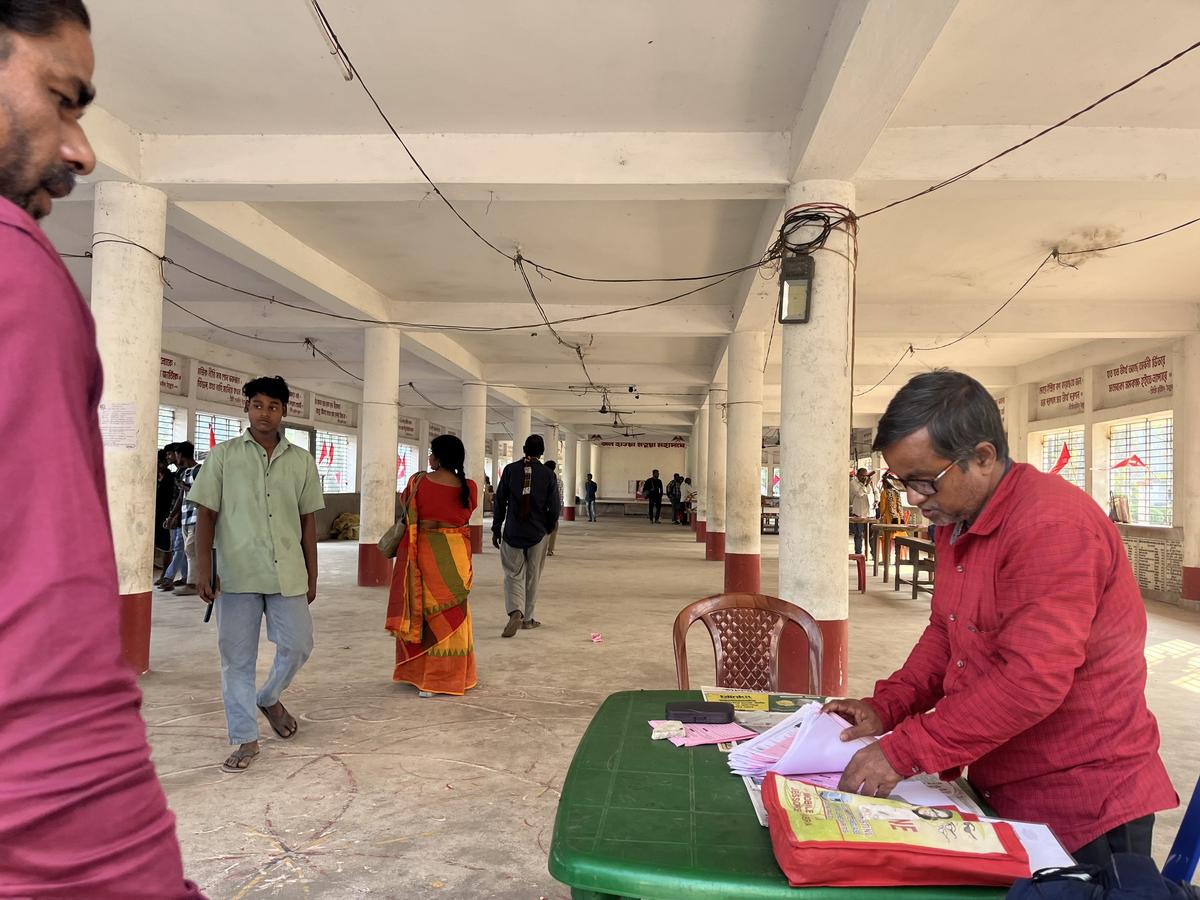
At up by the BJP in Thakurnagar for Matuas to apply for citizenship under the CAA.
| Photo Credit:
Shrabana Chatterjee
‘Taking advantage’
At the camp set up by Mr. Santanu, people are paying ₹800 to register themselves under the CAA, sparking accusations from the ruling party that the BJP is “making money from the plight of Matuas”.
However, those running the camp defended the fee. “There are lawyers here who help make the affidavits for ₹300. We charge ₹250 for filling up the online form. The online application itself costs ₹50. Additionally, since the CAA is a provision for non-Muslim immigrants, we also issue a Hindu certificate for ₹100 and a Matua card for ₹100,” said a data entry operator at the camp.
For the online application, mandatory documents include proof of address in Bangladesh and a Bangladeshi identity document, while a photostat copy of the Aadhaar card is required for the Hindu certificate and Matua card, the data entry operator said.
Gouranga Biswas, 33, who is supporting the hunger strike, expressed scepticism. “How can we trust this process when it begins with Matuas declaring themselves as Bangladeshi citizens first?”
Krishnapada Das, 47, in the queue at the camp for registering under the CAA, said, “My forefathers migrated in the 1970s and the names of my parents are on the 2002 voters’ list. However, we do not know what might happen during the SIR, so we thought of getting Hindu certificates and Matua cards.”
Published – November 25, 2025 01:14 am IST