





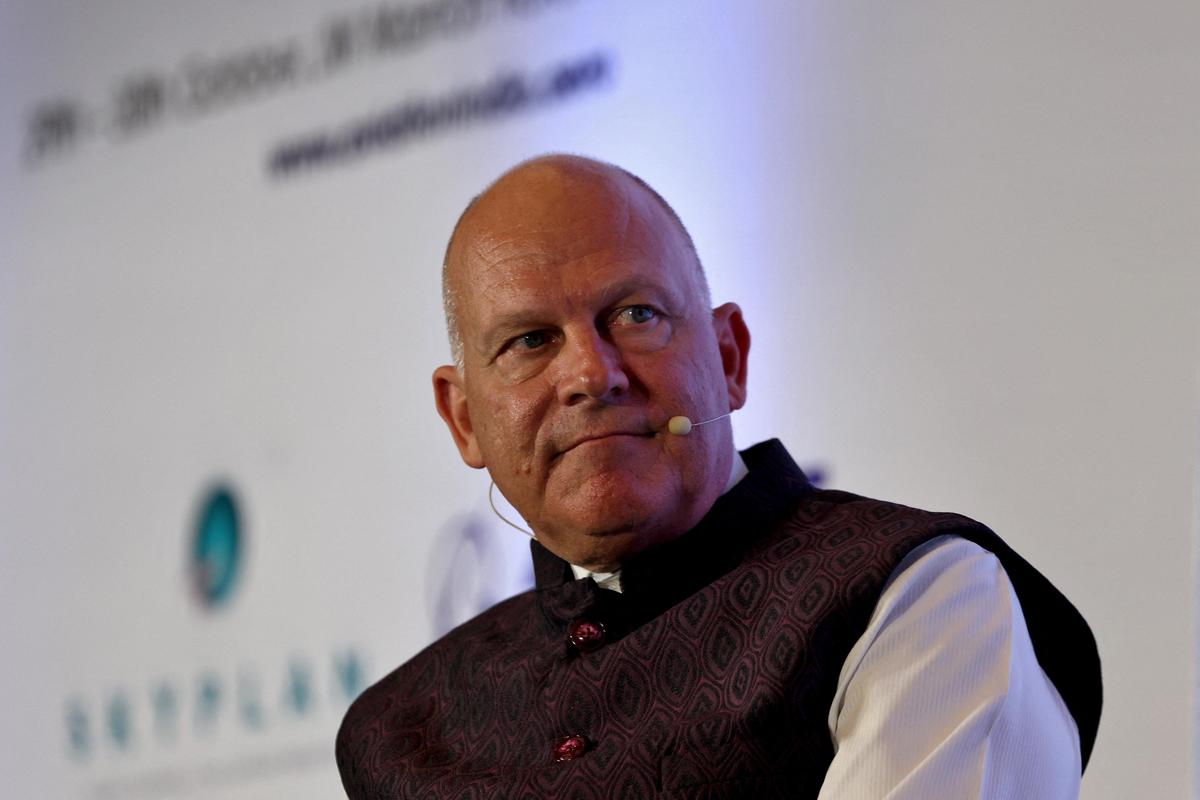
Air India CEO Campbell Wilson
| Photo Credit:
BHAWIKA CHHABRA
Policies that support pilot retention and prevent their poaching by foreign carriers is in “national interest” as aviation is a catalyst for economic development and the country’s “soft power”, Air India CEO Campbell Wilson said.
“It is not just a turnaround of Air India. It’s an investment being made in critical, economic, and catalytic infrastructure. And, anything from a policy perspective that can facilitate this, I think is in the national interest,” Mr. Wilson said in response to a question from The Hindu on whether the airline supported measures such as a six-month notice period to be served by pilots to prevent them from joining international players at a time of hectic expansion in regions like Saudi Arabia and the UAE that lure pilots with tax free salaries, and free accommodation.
“The more aircraft that can be based in India, the more maintenance is done in India, the more suppliers want to supply support in India, the more ecosystem exists to do third party for other people. The more crew we employ, the more connectivity we can build between India and other parts of the world for business connectivity, the more transit traffic can come across India, which is another multiplier effect. This is a huge development catalyst for economically, but also socially. It’s a soft power catalyst as well,” he spoke about the large investments the airline is making.
Recently, IndiGo CEO Pieter Elbers said it would be “disturbing” to lose Indian pilots to foreign airlines while explaining why the industry appealed to the government to present a Working Paper before UN aviation safety watchdog International Civil Aviation Organisation (ICAO) calling for a “mechanism” to curb poaching of skilled Indian aviation personnel, including pilots and engineers, by foreign players. The Paper did not find support before ICAO, which said it violated the core principles of labour market competition. ICAO advised that the focus should be on dialogue, retention and collaboration between stakeholders.
While the paper doesn’t specify what should be this mechanism, the industry is gravitating towards imposing a six-month notice period for pilots. But a DGCA rule in 2017 that mandated six months notice period for first officers and six months for first officers was contested by pilot unions before the Delhi High Court which then put a stay on it in 2018.
On the airline’s make-over exercise, Mr. Wilson said that a vast majority of international routes next year would see either new aircraft or those that have received a complete interior face-lift.
The airline’s two legacy Boeing 787s are presently in Victorville, California, receiving an interior makeover, which includes new seats, carpeting, side panels and seat back entertainment screens, as well as WiFi connectivity. Following which, every month two to three aircraft will rejoin the fleet after a retrofit exercise. “By the end of 2026, about two thirds of the Boeing 787 fleet will have been upgraded,” Mr. Wilson said. The airline has 32 787s. He further explained that as most of these aircraft operate routes to mainland Europe, Australasia, and key Southeast Asian, an increasing number of these flights will be served by the revamped aircraft in 2026.
The retrofit of 22 old Boeing 777s that are used for ultra long haul flights to Canada and the US, is delayed and is now expected to start in end 2026.
The airline plans to add six brand-new widebody aircraft, including Boeing 787s and Airbus A350s. However, the overall widebody fleet capacity will remain unchanged as eight aircraft have be returned. This includes five Boeing 777s leased from Delta, which were committed to a freight company and are pending conversion into freighters, along with three legacy Boeing 777s from Air India that also need to be returned under the same agreement. Like many airlines worldwide, Air India has been severely affected by aircraft delivery delays. The CEO disclosed that, according to the original plan, the airline expected to receive 28 aircraft in 2025, but so far, none have been delivered.
Published – November 24, 2025 09:10 pm IST