




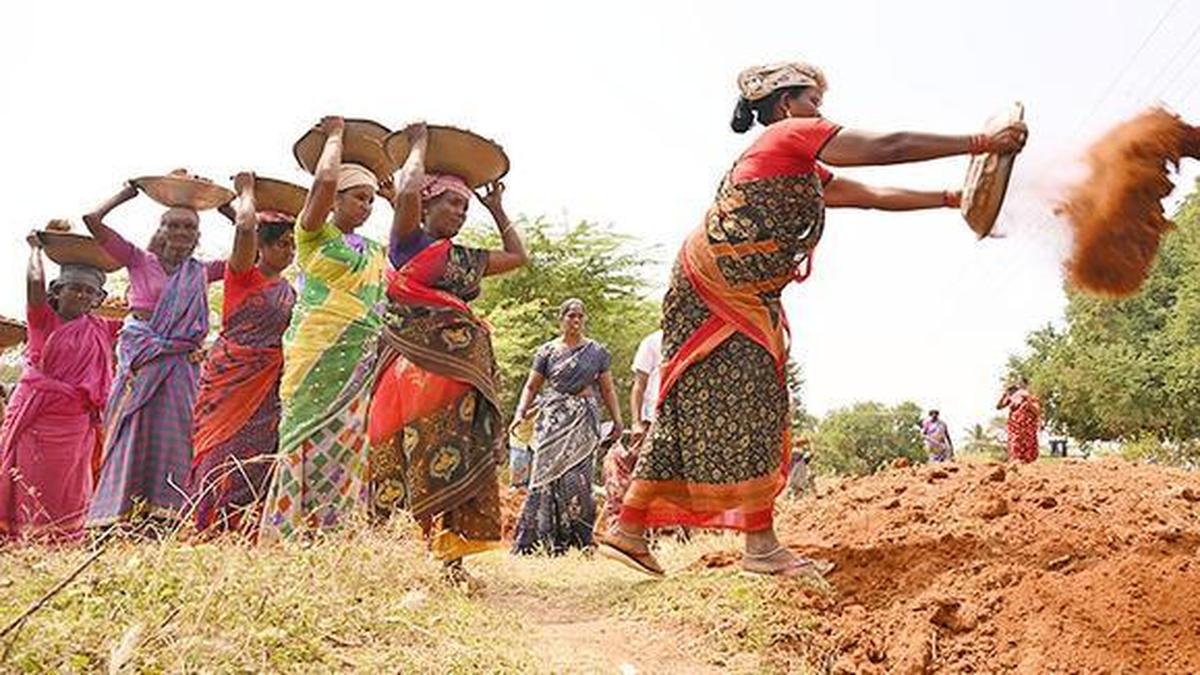

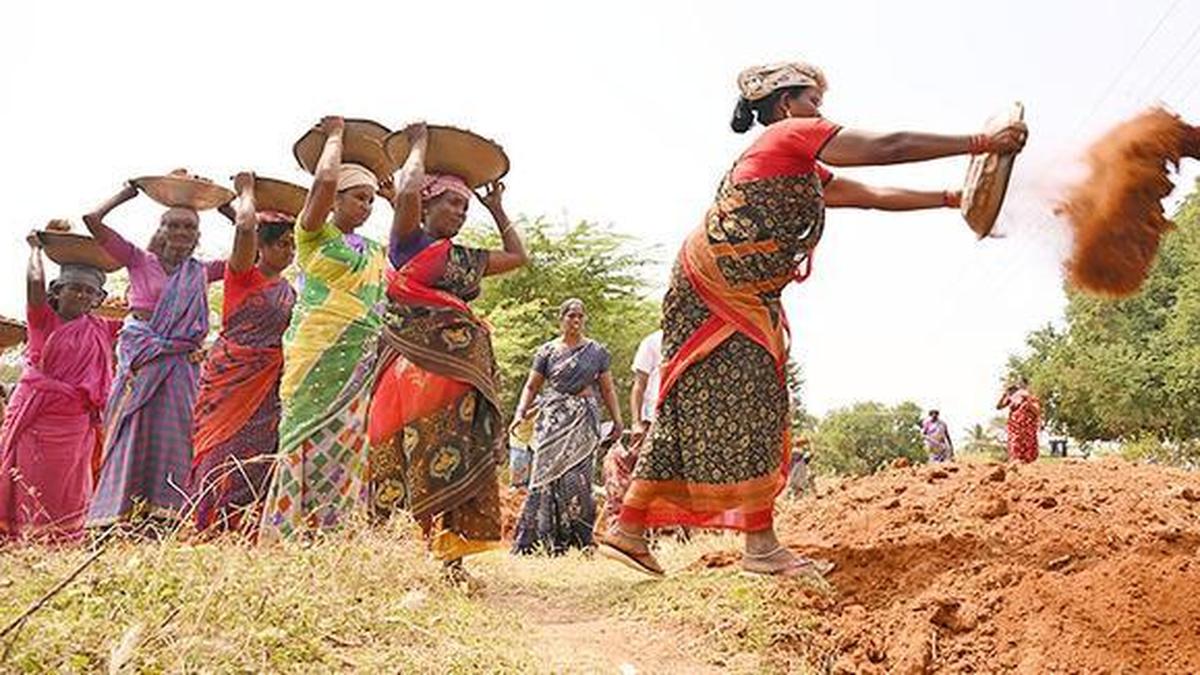
Madurai : TAMIL NADU; 01/03/2025.. Beneficiary-workers of the Mahatma Gandhi National Rural Employment Guarantee Scheme engaged in the widening of a supply channel in Melamangalam village panchayat, Kalayarkoil block in Sivaganga district. Photo : Moorthy. G / The Hindu
| Photo Credit: G. Moorthy
The story so far: The Mahatma Gandhi National Rural Employment Guarantee Act (MNREGA) covers 26 crore registered workers across 2.69 lakh gram panchayats. Over the last six months, about 15 lakh workers were deleted. But in just one month, between October 10 and November 14 this year, they shot up to 27 lakh — nearly double the six-month total. This far exceeds the 10.5 lakh additions during the same period. The spike in deletions coincides with the Union government’s push to conduct e-KYC (know your customer) verification of workers, to weed out ineligible workers.
What are the government’s reasons?
The Union Ministry of Rural Development in a statement on Friday said that verification of MGNREGA workers is a continuous process. The e-KYC is another step towards this. “It will strengthen transparency, efficiency, and ease of service delivery under MGNREGA,” the statement said. As per the statement, till date over 56% of active workers have completed their e-KYC verification across States.
How were workers verified before?
From time-to-time, the government has introduced several means of verification to ensure that no ineligible person draws any benefits from MNREGA. To this end the government, after running a pilot for nearly a year, from May 2022, made it mandatory that the attendance of workers is captured digitally using a mobile based application —the National Mobile Monitoring System (NMMS). The government directed that the mate or supervisor on each MNREGA worksite should click and upload geotagged pictures of the workers twice a day. In January 2023, the government made the Aadhaar Based Payment System (ABPS) mandatory. The ABPS uses the worker’s unique 12-digit Aadhaar number as their financial address. For the ABPS to work, a worker’s Aadhaar details must be seeded to her job card and her bank account. The worker’s Aadhaar must also be mapped with the National Payments Corporation of India (NPCI) database. Moreover, the bank’s Institutional Identification Number (IIN) must itself be mapped with the NPCI database.
How does e-KYC work?
As stated above, the attendance of MNREGA workers has been marked on the NMMS since May 2022 on all worksites. This application also has an e-KYC feature, whereby the mate or supervisor clicks a picture of the worker which is verified against the worker’s picture in the Aadhaar database.
Is there any correlation between the e-KYC drive and deletion of MNREGA workers?
This is not the first time that there is a surge in the deletion of MNREGA workers. Both the introduction of the NMMS and ABPS were aimed at bringing greater transparency but also contributed to exclusion. In the case of NMMS, there have been recurrent complaints of patchy network connectivity, especially in remote areas and little to no technological know-how among the workers. There have been complaints that work could not be recorded because of these issues which led to loss of wages.
Aadhaar seeding of job cards is the foundational step towards ABPS. But this has thrown several challenges. Often the demographic details of Aadhaar have been found to be different from that of the job card. In many cases it was found that a change in a letter here or there, between the way the name is spelled out in the two documents, led to workers’ exclusion. Deletions rose by 247% between 2021-22 and 2022-23 during the roll out of the ABPS.
NMMS has also failed in achieving its intended goal of “transparency.” It was discovered that irrelevant or unrelated photographs were being uploaded. In many cases, “photo-to-photo capturing instead of live work images” was being done. There was also “mismatch in actual versus recorded count.” In July this year, the Ministry issued a circular directing States to ensure that photographs and attendance of workers are verified at the gram panchayat, block, district and State level. The circular introduced a system wherein the percentage of physical verification of the uploaded photographs of workers would reduce at different levels. At the gram panchayat level, there would be 100% verification of the present workers. At block level, 20% of photos at random would need to be verified, at district level this number comes down to 10% and at the State level 5%. One of the reasons to introduce e-KYC for workers was the failure of the NMMS.
The government has refuted the claim that e-KYC has led to deletions. The Ministry said that a detailed Standard Operating Procedure (SOP) was issued in January this year on deletion of job cards/workers. “This SOP provides clear, uniform, and transparent guidelines for States to follow, ensuring fairness, accountability, and protection of workers’ interests in the management of job card records. Adequate safeguards have been made part of the SOP to prevent arbitrary/wrongful deletion,” the ministry said. These safeguards include publication of the names of workers who are intended to be deleted from the system, and giving them adequate time to file appeals. However, the government failed to explain why States with high e-KYC completion rates are leading in deletions. Andhra Pradesh, where 78.4% of workers have completed e-KYC, recorded 15.92 lakh deletions. Tamil Nadu (67.6%) saw 30,529 deletions, and Chhattisgarh (66.6%) reported 1.04 lakh.
Published – November 23, 2025 01:51 am IST