



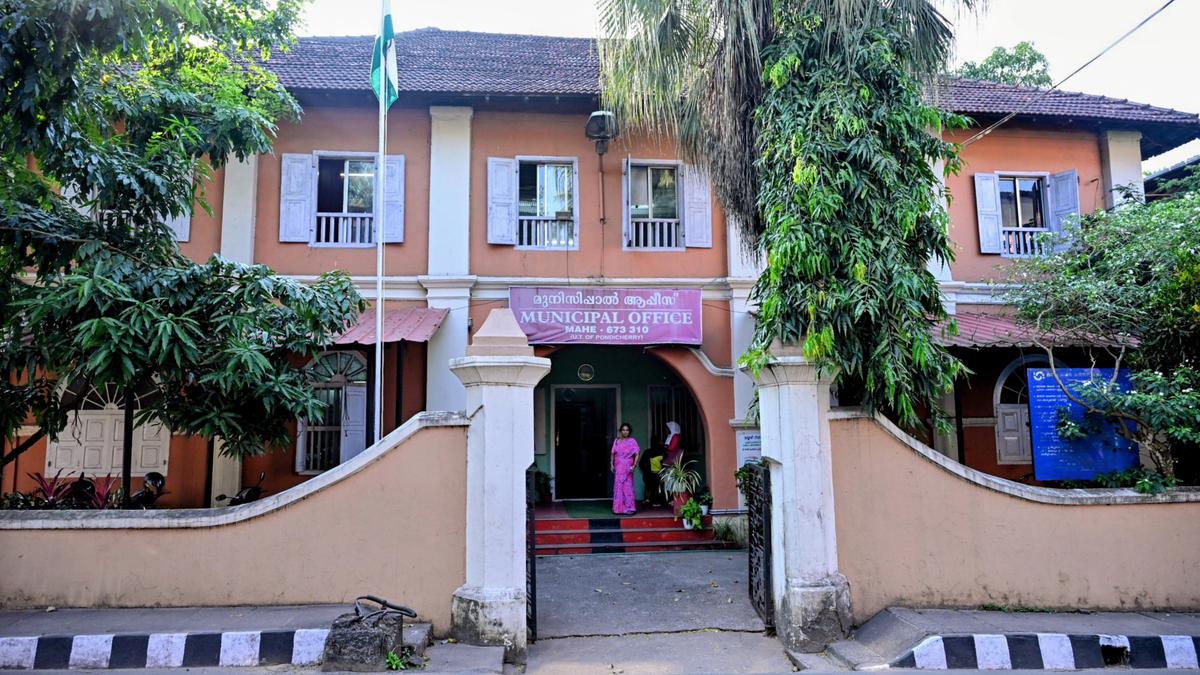

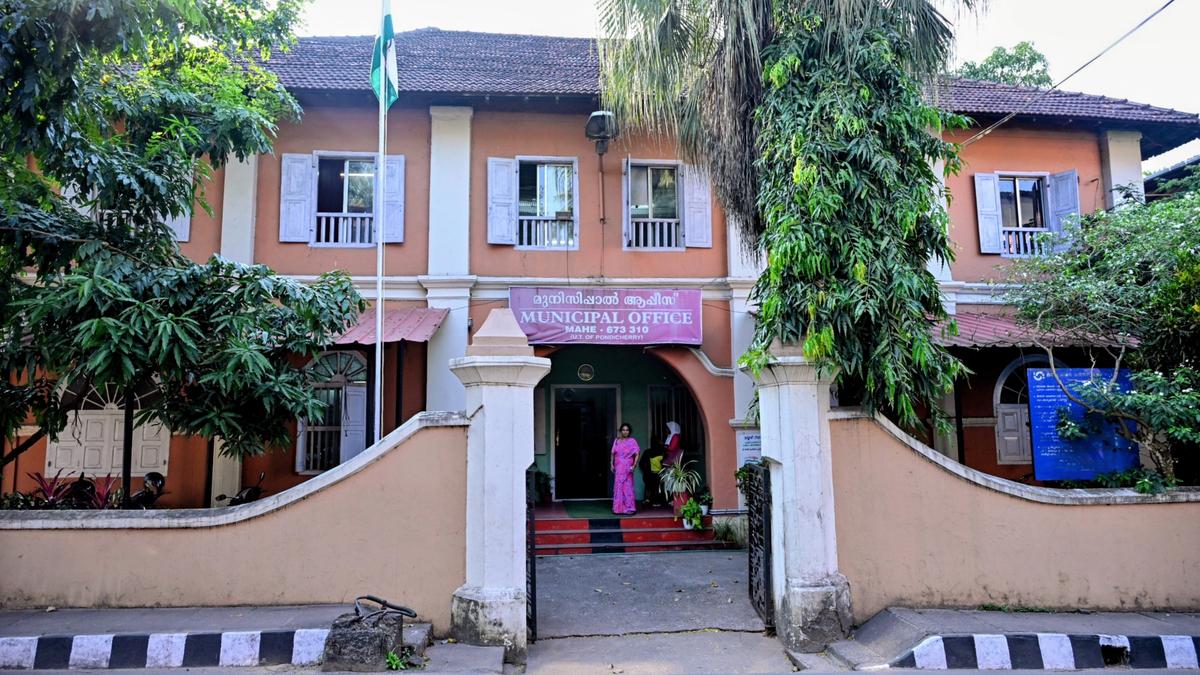
The municipal office at Mahe. Mahe has remained under administrative rule for 14 years, with local body elections still pending.
| Photo Credit: Special Arrangement
While Kerala votes for its three-tier local body elections this week, the Puducherry territory of Mahe, sandwiched between Kozhikode and Kannur districts, has remained under administrative rule for the past 14 years.
Having gone without an elected municipal council since 2011, local organisations argue that the absence of grassroots democracy is directly and adversely affecting civic life in the small town, also known as Mayyazhi. One of India’s oldest municipalities, Mahe gained freedom from French rule in 1954, but its first municipal elections were held only in 1968, followed by the next in 2006 after a 38-year gap prompted by a Madras High Court directive.
The long intervals have often been attributed to administrative neglect and the region’s slow post-Independence revival, which left its local governance underdeveloped. In 2011, T. Ashok Kumar, a lawyer, approached the Supreme Court seeking the immediate conduct of elections.
The court directed the government in 2018 to proceed with the polls, but the process remained stalled. When the administration showed no progress even by 2021, Mr. Ashok Kumar filed a contempt petition, following which elections were announced twice, but never held.
Initially, the matter reached the Madras High Court on the grounds that ward reorganisation had not been completed. Once the reorganisation was finalised, a fresh case challenged the process on the grounds that backward class reservations had not been secured. Following this, a single-member commission, led by Justice K.K. Sasidharan, was appointed by the Puducherry government in December 2021 to assess backward class populations. Despite a six-month deadline, the report remains pending to date, delaying the polls indefinitely.
A community leader, Siddhique Shalimar, said successive governments hesitate to decentralise authority because legislators fear losing influence once elected local representatives take charge. Activists argue that Puducherry’s dependence on Central grants has strengthened a political culture that resists sharing power, thereby weakening local autonomy.
“Yet development work has continued,” said Congress activist Jaseema Mustafa. She pointed to the renovated railway station, upgraded hospitals and schools, and approved road works. “Local MLA Ramesh Parambath has kept things moving despite the absence of a municipal council,” she said, adding that Mahe is keenly watching the elections happening around it.
However, retired Chief Education Officer Uthamaraj, a native of Mahe for 60 years now, argued that unresolved issues such as poor street lighting, delays in the Mahe walkway project, and the neglected Tagore Park require close oversight that only an elected local body can provide. He believes legislators resist elections, fearing the “division of power when a third representative enters between the people and the MLA.”
The Mahe Joint Forum of Residents’ Associations will stage a protest at the Mahe Civil Station on December 9, calling for immediate local body elections, the establishment of a Supreme Court–directed stray dog shelter, repairs to deteriorating roads, efficient waste management, and a responsible civic administration.
Association president Shaji Pinnakkat said the agitation stems from years of unmet democratic and civic needs. “When Kerala echoes with the sounds of democracy, all we hear here is silence,” he said.
Published – December 08, 2025 07:49 pm IST