




With the Election Commission of India (ECI) in the midst of a new phase of the Special Intensive Revision (SIR) across multiple States, after its Bihar pilot project, the key allegation that the Opposition has levelled against the ECI has been that the poll body seeks to conduct a “backdoor NRC” — a reference to the National Register of Citizens (NRC) that was prepared in Assam and demanded in other States as well by certain groups.
In a press conference on October 27, 2025, the ECI had clarified that the second phase of the nationwide SIR would not extend to Assam, which would be going to the polls next year. The Chief Election Commissioner (CEC) said that while the Citizenship Act, 1955, makes separate provisions for Assam, the citizenship ascertainment under the Supreme Court of India’s monitoring is “about to be completed” — a claim which needs to be contextualised and that gives rise to a fundamental question about the ECI’s jurisdiction.
Issue of jurisdiction
It does not require any reiteration to state that one of the key criticisms of the Bihar SIR was the ECI asking for proof of citizenship on the basis of limited documents for anyone who was not on the electoral rolls in 2003. This is so because the ECI’s own guidelines require anyone whose citizenship is found to be doubtful to be referred to the competent authority under the Citizenship Act.
In the Assam exception and its subtle explanation, however, the ECI has swept the biggest doubts under the carpet on its jurisdiction in ascertaining citizenship, as conducting any such exercise in Assam would have presented a novel legal hurdle — that of the NRC already prepared in Assam under the constant monitoring by the Court and, ultimately, the legal necessity to put the residents of the State through another rigorous exercise regarding their citizenship despite not being the empowered authority under the Citizenship Act.
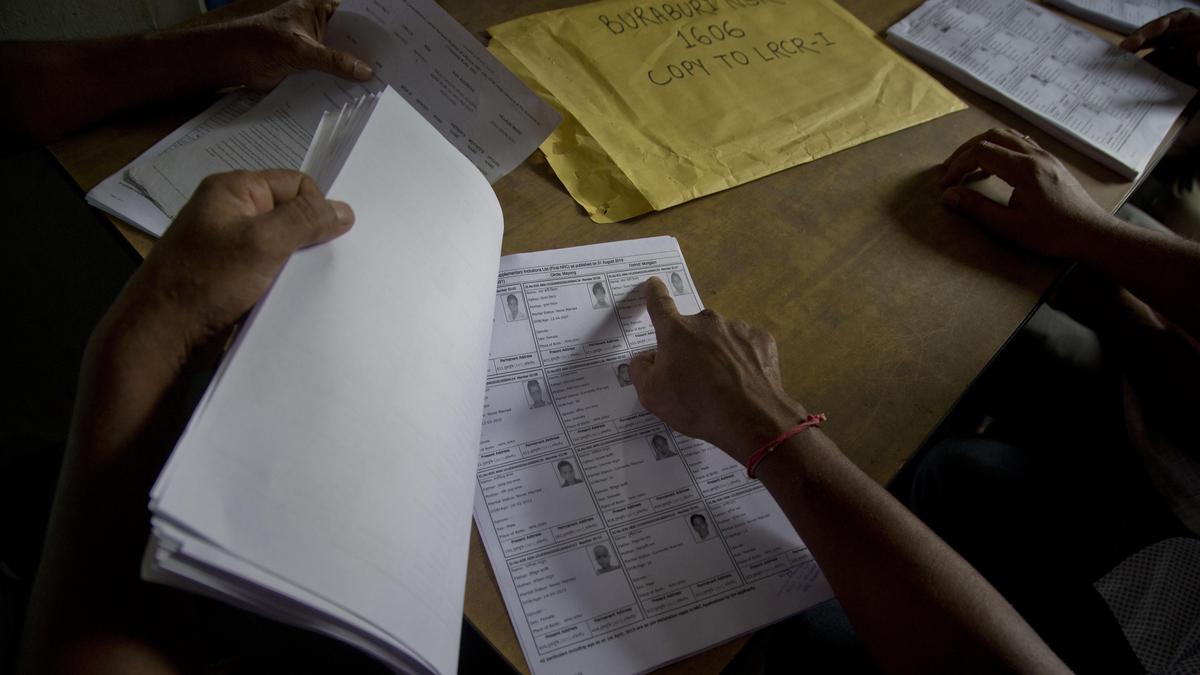
Why the CEC’s explanation that the citizenship ascertainment for Assam is about to be completed is a smokescreen is because the NRC in Assam had already been prepared under the Supreme Court’s monitoring over five years ago. On August 31, 2019, the Office of the State Co-Ordinator, NRC, Assam issued a press release titled “Publication of Final NRC on 31st August, 2019”, thereby notifying that the process of updating the NRC in Assam had concluded. This was a watershed moment for Assam and India, making Assam the only State after Independence to have conducted, and concluded, an exercise on such a large scale and under the monitoring of the top court of the land.
According to the State Coordinator’s press release, a total of 3.30 crore people had applied through 68.38 lakh applications. After years of deliberation and consultation with the stakeholders, a meticulous legal architecture was developed to scrutiny and verify citizenship documents. The gigantic exercise was carried out with the involvement of nearly 52,000 State officials and under the constant monitoring and supervision of the Court. The exercise concluded with 3,11,21,004 people found eligible for inclusion in the final NRC, while 19,06,657 people were excluded. This massive exercise was conducted at the cost of over ₹1,600 crore.
If the NRC is allowed to stand, as it constitutionally and legally should, the ECI must focus on its primary role of conducting free and fair elections, and not assume the mantle of a parallel citizenship tribunal. Assam already carries the burden of being the only State where a full-scale citizenship verification has been conducted under the Supreme Court’s watch, and its residents deserve to be spared from another round of uncertainty and bureaucratic scrutiny. Anything less would have the possibility of unsettling the fragile social fabric and diminishing trust in India’s institutions.
Section 6A, a unique regime for Assam
In the background of the NRC was a key issue central to the debate on citizenship in Assam — Section 6A of the Citizenship Act, 1955. Introduced in 1985 as part of the Assam Accord, this provision created a distinct legal regime of citizenship applicable only to Assam, prescribing cut-off dates for the detection and deportation of foreigners that was different from the rest of the country.
In October 2024, a five-judge Bench of the Supreme Court in In Re: Section 6A of the Citizenship Act, 1955, upheld the constitutional validity of Section 6A, reaffirming the framework as a special measure for Assam and stressing its compatibility with the preambular value of fraternity. This judgment reinforced the idea that Assam’s citizenship question cannot be approached in the same way as other States, and that its historical, political, and legal uniqueness must be preserved and respected.
In perspective
Unlike other States, the legal issues settled and unsettled with regard to citizenship and migration have been unique in Assam for at least the past half a century. Judgment after judgment with regard to the legal position of citizenship in Assam reinforces this uniqueness. Thus, any attempt by the ECI to conduct an SIR in Assam on the same path of an inquiry on citizenship, despite the peculiar legal landscape, would require it to negotiate the curves carefully.
One may also argue that if the NRC-Assam has already been prepared, what stops the ECI from using that data and completing the exercise in Assam reasonably sooner than in other States?
What is also remarkable is that in the NRC, Assam was not prepared to meet an election deadline; it was finalised after wide and inclusive consultations with all stakeholders in the State. The NRC’s culmination, therefore, on August 31, 2019, was through a wide consultative process, monitored at every stage by a special Bench of the Supreme Court. It would certainly be difficult for the ECI to ignore that exercise and the likelihood of people included in the NRC, finding themselves excluded from voters’ lists, which would place the ECI in an uncomfortable position.
Fuzail Ahmad Ayyubi is an Advocate-on-Record before the Supreme Court of India
Published – November 07, 2025 12:08 am IST