


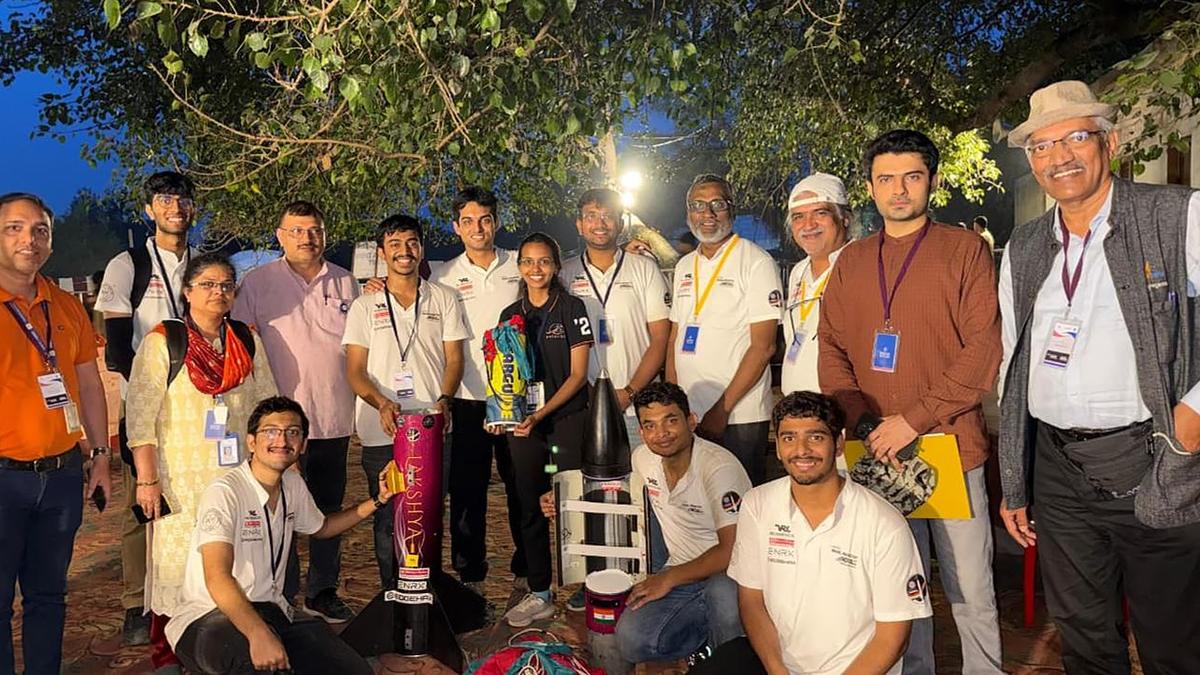

Team Antariksh, comprising eight students and two faculty members of R.V. College of Engineering.
| Photo Credit: SPECIAL ARRANGEMENT
Lakshya, a student rocket developed by R.V. College of Engineering (RVCE), has emerged as the winner in IN-SPACe’s Model Rocketry Competition.
At the IN-SPACe Model Rocketry and CANSAT India Student Competition 2024–25 held at Tamkuhiraj, Kushinagar in Uttar Pradesh recently, RVCE’s Team Antariksh which developed the Lakshya rocket edged out 31 teams to emerge as the winner of the competition.
The competition involved designing, developing and launching a Model Rocket carrying a CAN-Size Satellite of one kg mass to an altitude of 1000 meter above the launch site, along with safe ejection of the CANSAT and safe landing of the rocket.
A ten-member team comprising eight students and two faculty members from Team Antariksh, who participated in the competition said that they were able to accomplish the feat without any glitch.
“The team was preparing for more than a year for this competition, and during the launch everything went as per plan as they were able to successfully launch the rocket with the CANSAT to an one km Apogee and safely recover both the rocket and the satellite intact,” Prof. Ravindra S. Kulkarni, head of department, Department of Aerospace Engineering told The Hindu.
Prof. Kulkarni said that the team also developed their own CANSAT for the launch.
“The entire launch sequence was like a typical rocket launch like one would witness in a spaceport like Sriharikota which was a great learning experience for the students,” Prof. Kulkarni said.
The IN-SPACe Model Rocketry and CANSAT India Student Competition 2024–25 was held on the banks of the Narayani River at Tamkuhiraj.
The four-day national finale witnessed participation from 67 student teams — 31 teams in the Model Rocketry and 36 teams in the CANSAT category.
A total of 37 launches (13 in Model Rocketry and 24 in CANSAT) were successfully conducted over the course of the competition.
IN-SPACe said that the teams were evaluated by a distinguished jury comprising scientists from ISRO and IN-SPACe on a comprehensive set of technical parameters designed to assess both precision and innovation.
Siddharth Satish, a student member of Team Antariksh, said that over 30 students worked on the project for over a year, and the rocket and CANSAT were designed and fabricated in-house by the students themselves.
Published – November 05, 2025 09:29 pm IST