




The story of an election in Bihar carries the burden of a polity facing decades of destitution. As the State with India’s lowest per capita income and highest rate of multidimensional poverty, the public anticipation for warranting change and a political churn seems immense. For an eagerly awaiting electorate, this contest appears as a definitive test of India’s democratic-form asking a critical question — will the election seek to perpetuate a status-quo of welfare-dependency for the poor, or can the verdict deliver the structural transformation needed to pull millions out of poverty?
Bihar’s electoral map, spanning two decades from 2005 to the current election reveals a dynamic landscape of social shifts and political realignment between the National Democratic Alliance (NDA) and the Mahagathbandhan (MGB). The dominant pattern is one of constant flux, punctuated by razor-thin margins, such as the NDA’s narrow 125-to-110 seat victory in the 2020 Assembly polls.
Women, youth and new entrants
The changing dynamics of voter turnout has significantly altered Bihar’s political landscape. The State has long been seen as a stronghold of entrenched caste-based and coalition politics.
Between 2015 and 2020, electoral data underscores a notable gender gap in participation that has worked in favour of women: female turnout rose to 60.48% in 2015 compared to 53.32% for men, and although it slightly declined in 2020, women (59.6%) still outvoted men (54.7%). This consistent engagement points to the emergence of women as a decisive electoral constituency, capable of overriding patterns dictated by patriarchal voting norms and caste loyalties. There are several factors contributing to this transformation such as targeted welfare schemes like the Bicycle and Ujjwala Yojana as well as reforms within the public distribution system. These have tangibly improved women’s social and economic agency, encouraging them to vote independently rather than as extensions of male family preferences. Political parties, particularly the Janata Dal (United) (JD(U)) under Chief Minister Nitish Kumar, have framed women-centric governance narratives, linking gender empowerment to governance credibility. This has strengthened their appeal among women.
Additionally, the urbanising youth electorate, especially in districts like Patna, Muzaffarpur, and Gaya, has increasingly become issue-oriented — prioritising employment, education, and governance performance over community-based loyalty. This has led to fragmented votes and anti-incumbency swings, as younger voters are less tethered to traditional coalition bases.
The combined effect of high female participation and assertive youth voting has thus made Bihar’s elections more volatile and competitive. It has diluted the predictability of caste arithmetic, weakened the hold of legacy coalitions, and pushed political actors to reimagine their outreach placing social welfare, education, and governance efficiency at the forefront of their campaigns.
While caste coalitions have consolidated in pockets of rural Bihar, they are actively fragmenting in peri-urban, migrant-labour districts. This dissolution of old patterns is being accelerated by new entrants like Prashant Kishor’s Jan Suraaj movement.
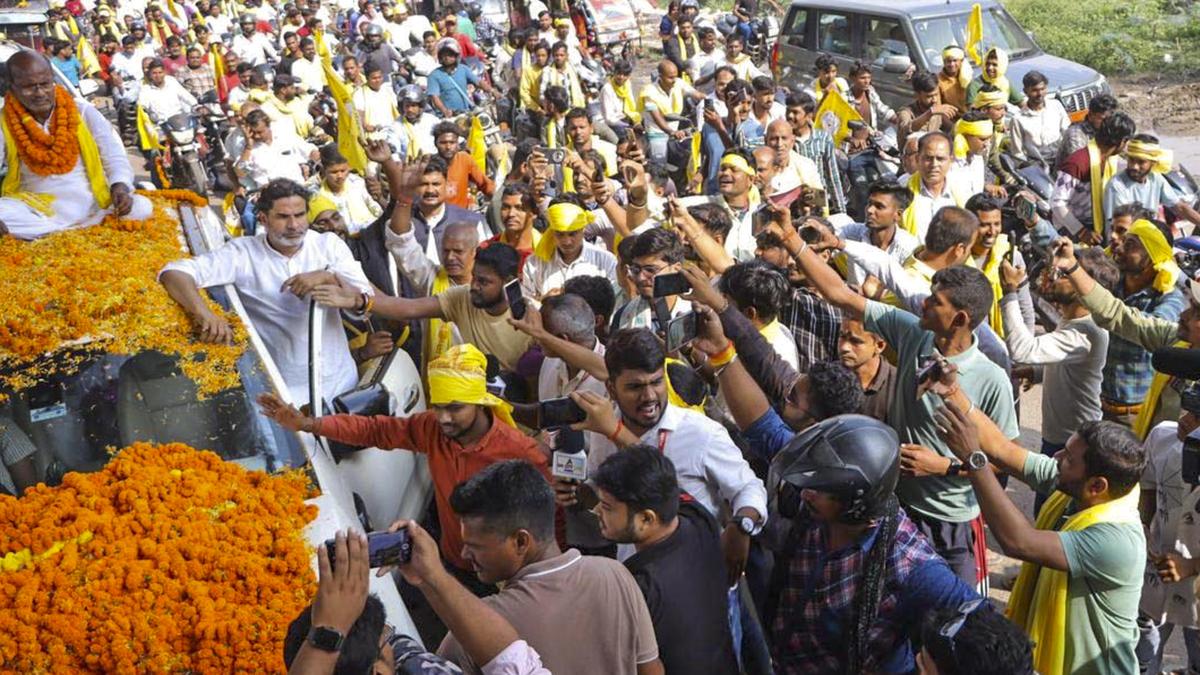
Mr. Kishor’s political strategy and voter messaging cuts directly across traditional loyalties. He is mobilising across caste among the youth in western districts like Muzaffarpur and West Champaran, emphasising on a “governance-first narrative” focused on education, healthcare, and anti-corruption. His core message appeals to the youth who are angry about high unemployment and forced migration. As Jan Suraaj contests the elections, political commentary cites the party as positioning itself as a new third-front alternative to the enduring caste-centric politics of Bihar.
The development question
Bihar’s electoral geography reveals a clear economic divide that mirrors its political alignments. Urban consolidation has steadily favoured the NDA. In rapidly urbanising districts such as Patna and Gaya, voter trends have remained remarkably stable, reflecting enduring support for the alliance. These areas, benefiting from visible infrastructure and welfare initiatives, have repeatedly rewarded the incumbents. Between 2005 and 2015, NDA vote shares in such constituencies rose steadily, underscoring the persistence of development-based voting in Bihar’s urban centres. Yet, beneath this surface of stability lies a deeper paradox.
The NDA’s urban dominance rests on a “development-oriented” narrative that conceals significant contradictions. While its support stems from visible gains such as roads, bridges, electricity, and metro projects, these largely represent symbolic progress rather than transformative growth. Persistent structural issues, especially the absence of industrial employment, reveal a widening gap between the optics of development and the substance of economic change. Infrastructure has become synonymous with progress, even as job creation and industrial diversification lag behind. The Patna Metro, for instance, strengthens the incumbent’s image but does little to address the underlying employment deficit. Meanwhile, victory margins have steadily narrowed, with winners now representing barely 20% of registered voters. Bihar’s urban paradox, therefore, is one of stability amid discontent: a sustained incumbency built on visible governance, yet underpinned by a shrinking representational base and unfulfilled structural transformation.
Ideology versus patronage
Bihar’s political divide today is shaped by two distinct but competing logics — the NDA’s performance-driven governance model and the MGB’s populist, patronage-based mobilisation. Out of power for nearly two decades, the MGB has relied on redistributive assurances rather than a record of governance. Its manifesto, ‘Tejashwi ka Prann’, exemplifies this approach, promising free electricity, ₹2,500 monthly transfers, job guarantees, and expanded livelihood schemes to appeal to those excluded from Bihar’s uneven growth. While the NDA projects the optics of visible development, the MGB seeks to convert economic vulnerability into electoral support through welfare-based outreach. These competing strategies show how deprivation and aspiration are transformed into political legitimacy in a State still negotiating its path to economic transformation.
This divide becomes even sharper when viewed through the lens of Bihar’s uneven development map. The NITI Aayog’s Multidimensional Poverty Index (MPI), despite some of its methodological limitations, shows how Bihar’s composite poverty score improved from 0.265 in 2015-16 (NFHS-4) to 0.160 in 2019-21 (NFHS-5), with progress being spatially asymmetric. District-level disparities in health, education, and living standards interact closely with constituency-level political representation, shaping how development translates into democracy.
In the Seemanchal belt, deprivation remains deeply entrenched. Madhepura records some of the highest multidimensional poverty in the State and is also among its most politically contested areas. The Association for Democratic Reforms (ADR) 2020 analysis of the assembly constituencies in the belt shows that while winners secured 49-55% of valid votes, their representativeness (the share of total registered voters they actually spoke for) stood at only around 30-33%. In the Araria and Purnia Assembly constituencies, Congress’s Abidur Rahman won 55% of the votes but represented just 33% of the electorate, while the BJP’s Vijay Khemka held 53%, translating to 32%. This suggests that even where voter mobilisation is high, much of the electorate remains outside the ambit of effective representation. Seemanchal’s politics thus thrives not on mass consensus but on targeted mobilisation, where parties like the Rashtriya Janata Dal (RJD) and the All India Majlis-e-Ittehadul Muslimeen (AIMIM) channel deprivation into political visibility through welfare networks and community brokers.
Patna has an MPI of 0.107, with only 23.09% of residents multidimensionally poor, the lowest in Bihar. Yet ADR data shows that the average representativeness of Patna’s MLAs from Kumhrar, Bankipur, and Digha remains between 19% and 22%, despite high vote shares ranging from 54-59%. These are among the least representative constituencies in the State, reflecting not apathy but fragmentation within an urbanised electorate. The BJP continues to dominate, but shrinking margins and lower representational depth indicate that voters now evaluate governance through performance-based criteria rather than patronage.
Nalanda offers a midpoint on this continuum. With an MPI of 0.142 and roughly 30% poverty headcount, its constituencies like Nalanda and Rajgir show vote shares around 39-43% and representativeness near 23%. These consistent figures reflect a more stable form of developmental politics, where citizens participate not to claim welfare, but to preserve a governance model centred on infrastructure, electrification, and women’s empowerment. This intermediate zone represents an electorate negotiating between old-style welfare mobilisation and newer governance-based appeals.
Further west, Bhojpur and Begusarai illustrate how development can recalibrate democratic meaning. MPI values have declined sharply — Bhojpur from 0.188 to 0.121 and Begusarai from 0.259 to 0.128, while ADR data shows winners securing 39-46% of votes and representing 23-27% of the electorate. Here, legitimacy derives less from numerical majority and more from administrative performance.
Ultimately, Bihar’s district and constituency patterns together trace a development-to-democracy curve. Welfare politics, however, continues to retain symbolic power: with nutrition deprivation above 50% and maternal health deficits near 37%, central schemes remain electorally salient.
Two Bihars
The Bihar election thus emerges as a decisive ideological contest between the “two Bihars.” The ruling alliances still continue to rely on clientelism, targeting high-poverty regions where deprivation-driven mobilisation ensures turnout, but stifles competitiveness, treating welfare as a recurring political performance. In contrast, a newly anchored Jan Suraaj seeks to fracture this old order by mobilising around a “governance-first” narrative. It challenges the transactional model sustained by cash transfers and symbolic schemes. The assembly verdict will determine whether Bihar remains anchored to dependency or transitions toward a new politics of evaluative scrutiny, one, where poverty no longer guarantees loyalty, but, demands accountability.
Deepanshu Mohan is Professor and Dean, O.P. Jindal Global University, visiting professor, LSE, and Academic Research Fellow, University of Oxford. With inputs from Ankur Singh, Saksham Singh, Aditi Lazarus and Nagappan Arun from JGU.