



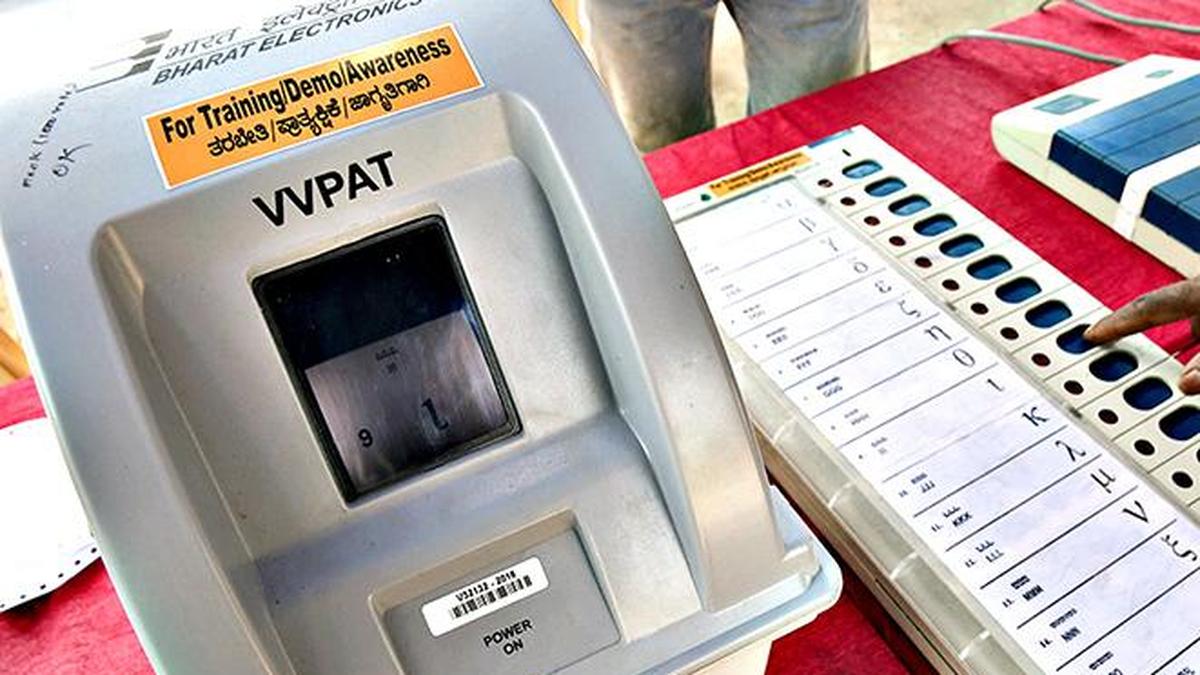

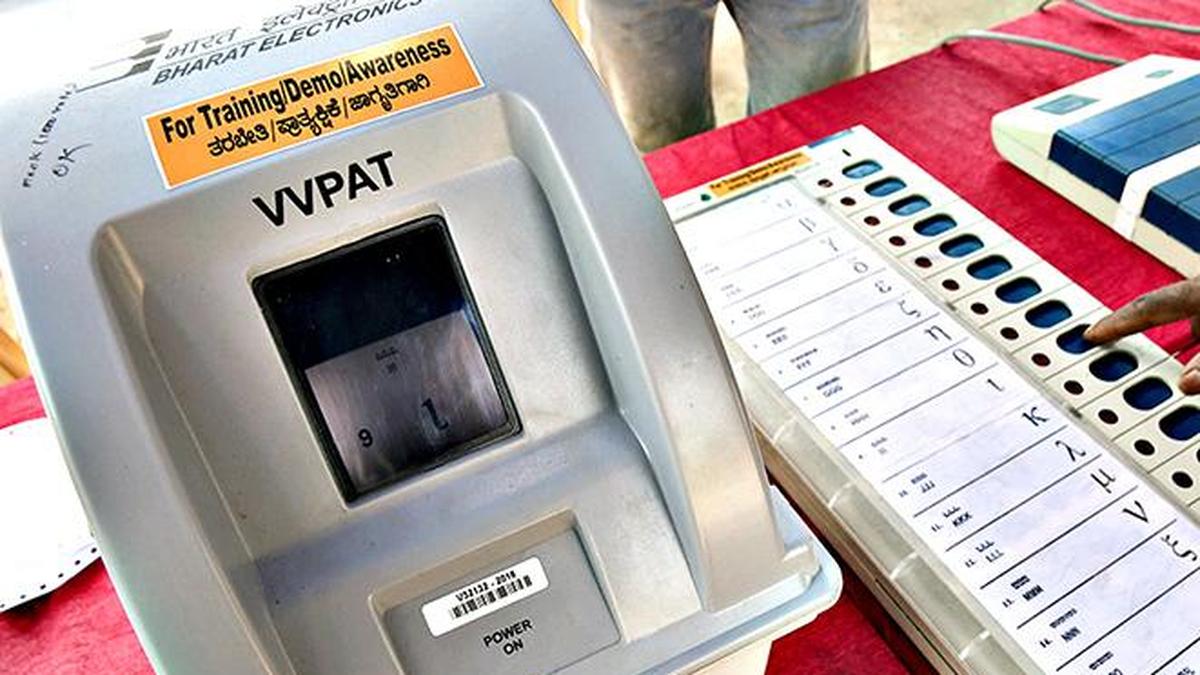
Without VVPAT, the petitioner argued, EVMs become “unverifiable,” leaving voters with no mechanism to confirm their choice. File
| Photo Credit: The Hindu
The Nagpur Bench of the Bombay High Court on Friday (November 7, 2025) issued a notice to the Maharashtra State Election Commission (SEC) on a petition challenging its decision to conduct local body polls in the State without Voter Verifiable Paper Audit Trail (VVPAT) machines. The High Court has directed the SEC to file its response by next week.
The petition, filed by Congress leader Prafulla Vinodrao Gudadhe through advocates Pawan Dahat and Nihal Singh Rathod, called the SEC’s oral announcement on August 5 “arbitrary, illegal and beyond its authority.” It seeks either deployment of VVPATs with every Electronic Voting Machine (EVM) or a return to ballot papers, citing constitutional guarantees and Supreme Court precedent.

“The right to vote is not merely the right to cast a ballot but also the right to know whether that vote has been correctly recorded,” the petition said. “Right to vote itself being a constitutional right, he has every right to know if the right he exercised has been rightly executed.”

Without VVPAT, the petitioner argued, EVMs become “unverifiable,” leaving voters with no mechanism to confirm their choice.
Poll delay
The petition traces the controversy to the SEC’s failure to hold local body elections for over four years, despite constitutional mandates under Articles 243K and 243-ZC. It said that although the law requires elections to be held before the expiry of the term of local bodies, the SEC cited a partial stay by the Supreme Court in December 2021 to justify the delay. It was only after the top court, in May 2025, directed that polls be completed within four months that the SEC began preparations, it added. Later, on September 16, the deadline was extended to January 31, 2026, as a one-time concession, with specific directions to make necessary arrangements.
Despite these directions, the SEC announced at a Nashik press conference on August 5 that VVPAT machines would not be deployed in the upcoming polls, citing logistical constraints. The petitioner alleges that this decision was never issued in writing and remains opaque.
Through an RTI application, the petitioner sought a copy of the SEC’s order but was informed on September 24 that no such document exists. A formal representation dated October 6 urging the SEC to recall its oral decision and deploy VVPAT machines also went unanswered. “Respondent is hell bent on using a non-transparent, unreliable system at the cost of fairness of the elections,” the petition alleged.
On October 15, an all-party delegation met with the SEC and raised concerns over the non-use of VVPAT. The Commission assured them that a “positive decision” would be announced soon, but no such decision has been made public. Meanwhile, the formal announcement of elections is expected at any time.
Unverifiable votes
Central to the petitioner’s argument is the Supreme Court’s 2013 judgment in Subramanian Swamy vs Election Commission of India, which held that VVPAT is an “indispensable requirement of free and fair elections.”
The petition argued that without VVPAT, there is no way to ascertain whether a vote has been recorded in favour of the chosen candidate. “EVMs recording votes become unverifiable,” it stated.
The petitioner pointed out that while State laws enable the use of EVMs, no election conduct rules have been framed for their deployment in local body polls. Existing rules provide detailed procedures for ballot paper voting, not for EVMs. “Respondent cannot disregard the will of legislators and force a method of voting, process of which has not been approved by the house,” the petition said. If VVPAT machines are unavailable, elections should revert to ballot papers as per existing rules.
The petitioner has urged the court to direct the SEC to conduct elections through ballot papers or, alternatively, to deploy VVPAT with every EVM. It also asked for an interim order restraining the SEC from using EVMs without VVPAT and requested that litigation costs be imposed on the Commission.
Published – November 07, 2025 10:38 pm IST