


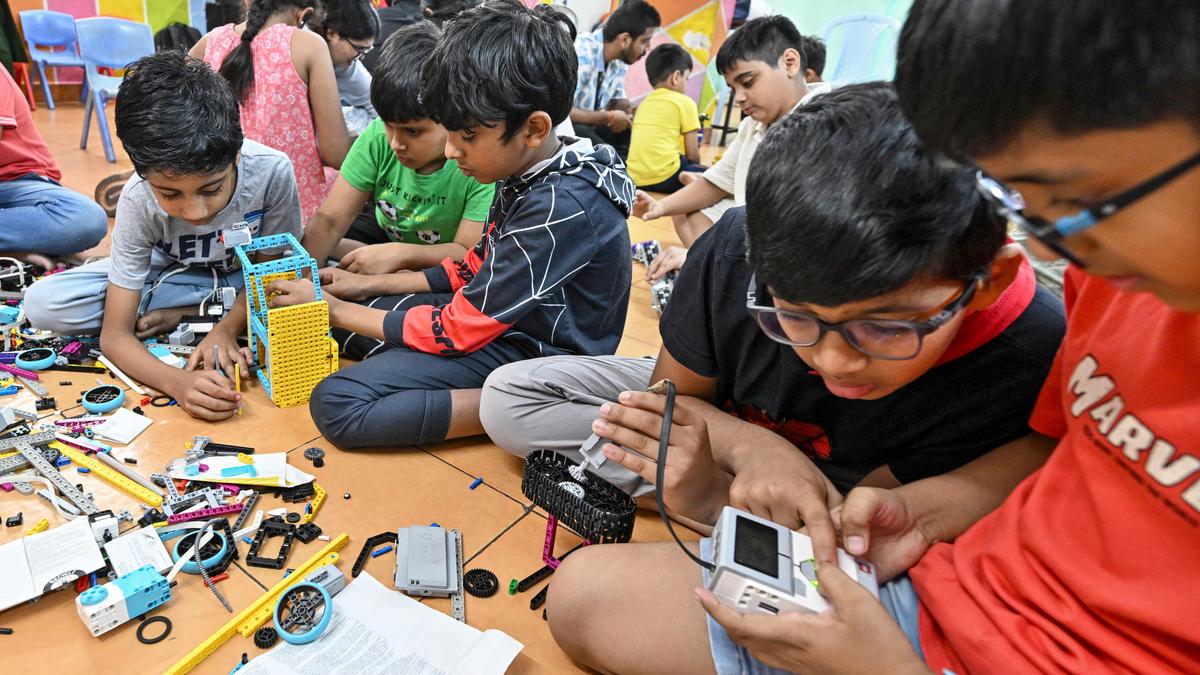

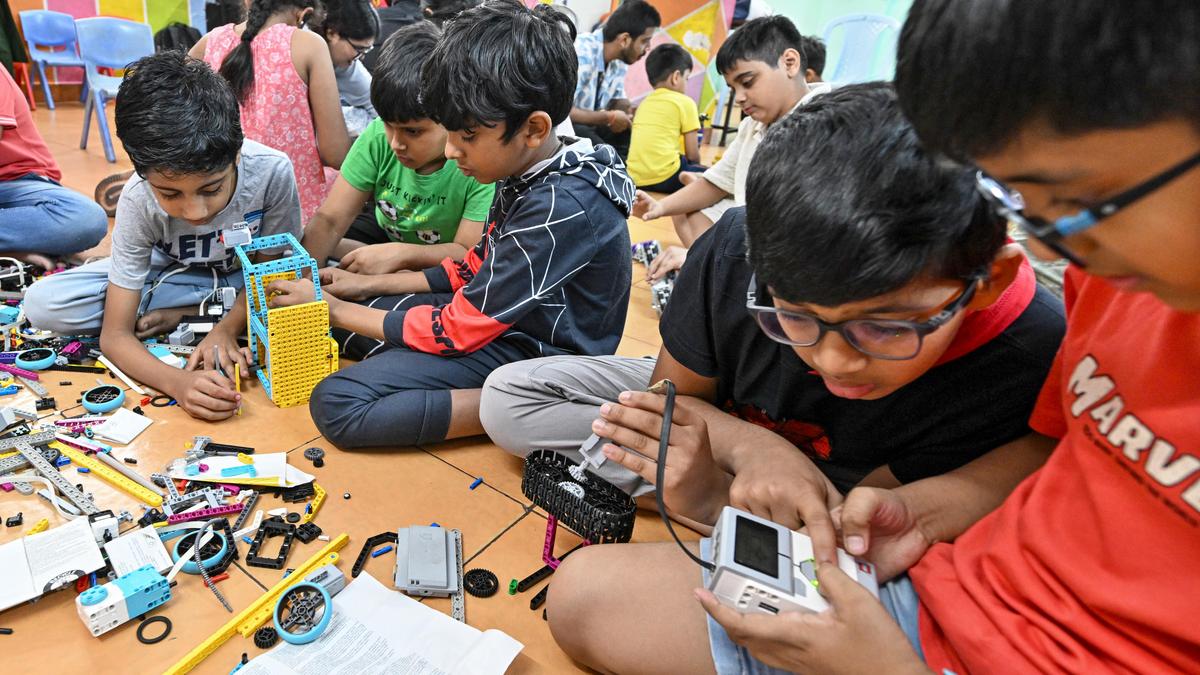
Children engrossed in making models during the STEM and Robotics Club session of Brainybotz, an organisation that aimes to introduce young minds to robotics and STEM through hands-on learning experience, in Visakhapatnam.
| Photo Credit: KR Deepak
The soft whirr of motors blends with sudden bursts of excited chatter and the occasional cheer when a robot finally moves as planned. Saturdays at the Robotics and STEM Club of Brainybotz in Lawsons Bay Colony in Visakhapatnam brim with energy and discovery. Mentors drift between teams, offering guidance while letting curiosity lead the way. From coding simple circuits to building clever machines out of sensors, wires and endless questions, the sessions feel less like a structured class and more like a joyful laboratory where ideas take shape.
On these evenings, Nagashilpa Seethamraju and Gayathri Vadavalli, the co-founders and directors of Brainybotz Edtech Pvt. Ltd., and their team of mentors remain occupied with a lively group of children between seven and 14 years of age. Many arrive with a readiness to build, while others prefer to observe quietly until something in the room draws them in. The team makes space for both approaches. Children who hesitate at first are encouraged to watch freely, handle components when they feel comfortable and take small steps towards participation. “An unpressured environment often allows the reluctant learners to find their own pace,” says Nagashilpa. Over several sessions, they shift gradually from merely watching their classmates to trying ideas themselves, aided by the unstructured and exploratory nature of the club.
The origins of Brainybotz goes back to 2017, when Nagashilpa returned to Visakhapatnam after 17 years in the United States. Her elder son was then in Grade 4. She recalls noticing immediately that his American school had emphasised practical science, while most Indian classrooms prioritised theoretical study. “I wanted to bridge this gap,” says Nagashilpa, who holds a Master’s degree from the University of Hartford, Connecticut, is certified in Lego EV3 by Carnegie Mellon University’s Robotics Academy and is also a Raspberry Pi certified educator. She began by teaching robotics to a few friends’ children, using hands-on activities to help them translate textbook concepts into real-world understanding.
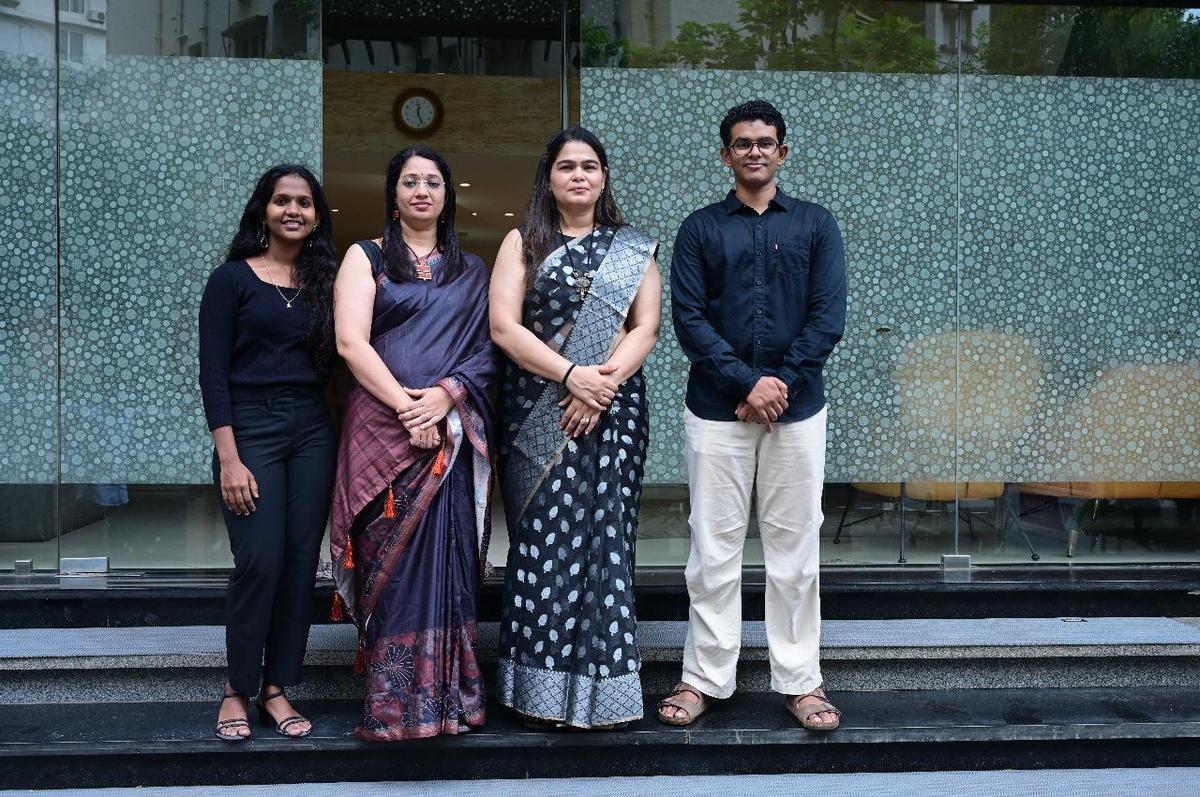
The core team of Brainybotz that includes Khyathi Lekhana Ummidi, Gayathri Vadavalli, Nagashilpa Seethamraju and C Thanay Reddy.
| Photo Credit:
SPECIAL ARRANGEMENT
Nagashilpa’s professional background spans corporate work of more than 16 years, teaching her own children programming and volunteering in community schools. In 2018, she mentored eight students from Visakhapatnam who advanced to the national level of the FIRST Lego League Challenge. Her work continued steadily until the pandemic slowed in-person engagements. In 2024, she joined forces with Gayathri Vadavalli, an MBA who is certified in Artificial Intelligence and Machine Learning by the Raspberry Pi Foundation, to build Brainybotz into a more structured platform for STEM education.
Gayathri holds a Master’s degree in Business Administration and has trained as an entrepreneurship coach under an international faculty at Northeastern University in Boston.
Together, the two founders have built a programme that responds to the growing demand for practical STEM learning. The core team of Brainybotz includes Khyathi Lekhana Ummidi, who is the head of curriculum and C Thanay Reddy, head of operations. In August this year, they opened the Robotics and STEM Club at Lawsons Bay, offering a 90-minute session every Saturday.
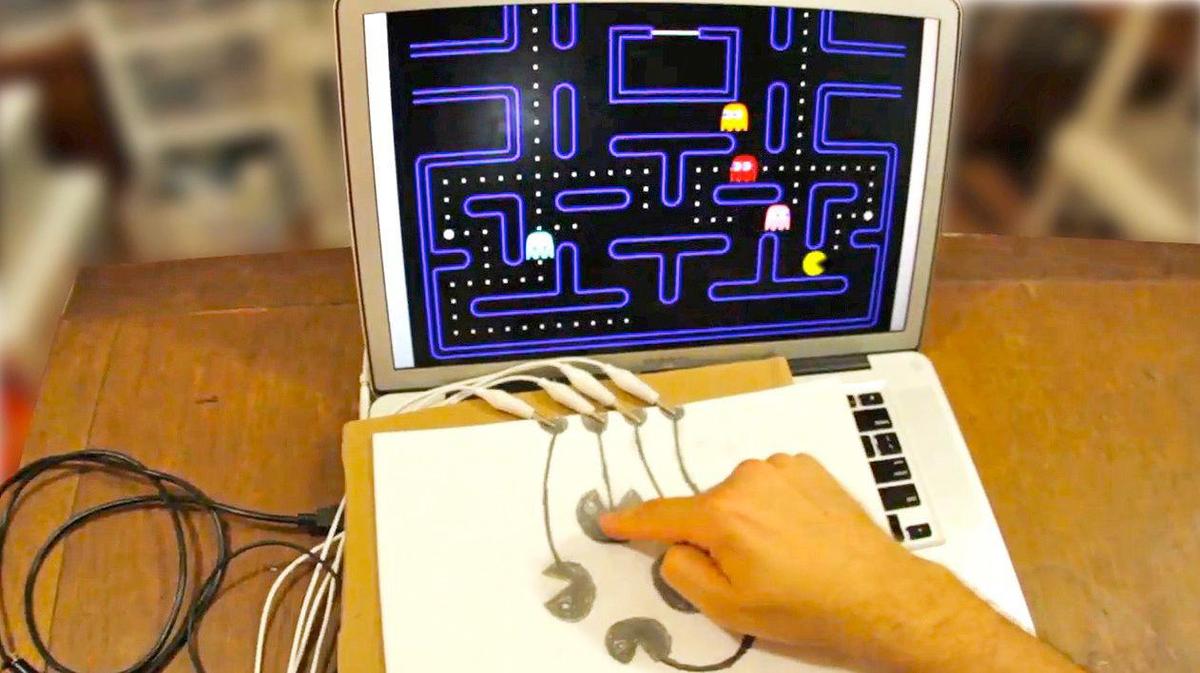
Makey makey circuit
| Photo Credit:
Special Arrangement
The club uses a range of kits to help children understand foundational concepts. “We have kits that support the conceptual part,” says C Thanay Reddy, head of operations and one of the mentors. “For instance, Makey Makey circuits act as input controllers for devices. A Makey Makey kit allows children to turn everyday objects such as coins or pencil graphite into functional buttons for a computer.” Before they progress to circuit-making, the sessions usually begin with building tasks. “We divide them into groups and sometimes create an impromptu competition, such as designing a robot that can navigate a circuit,” he adds.
Shu-Ha-Ri teaching approach
The club’s teaching approach draws inspiration from the Japanese concept of Shu-Ha-Ri, which describes stages of growth from novice to mastery. “Shu is the stage where the learner understands and practises established concepts. In Ha, the learner begins to experiment and interpret what they have learned. In Ri, they develop something of their own, occasionally bending the rules in the process. That is part of the learning journey,” Thanay explains.
Aroha STEM Expo
This year, Brainybotz is organising its first annual STEM Expo, titled Aroha, in association with GITAM (Deemed-to-be University). The event will take place at the Mother Theresa Auditorium on December 6 and is open to all. STEM competitions for students from grades IV to IX will be held for registered participants in teams of two to four. A showcase zone will feature student projects and demonstrations. Industry experts will deliver talks through the day, offering children and parents a broader view of possibilities within STEM fields.
New centre
Meanwhile, Brainybotz is preparing to open a state-of-the-art Experience Centre in Yendada. Spanning 2,500 square feet, the centre will include workshops, technology demonstrations and short bootcamps. Schools will also be able to use the space for field trips. “We hope it becomes a place where children can explore new technologies at their own pace,” Gayathri says.
For more details, visit brainybotz.ai.
Published – November 28, 2025 08:15 am IST