



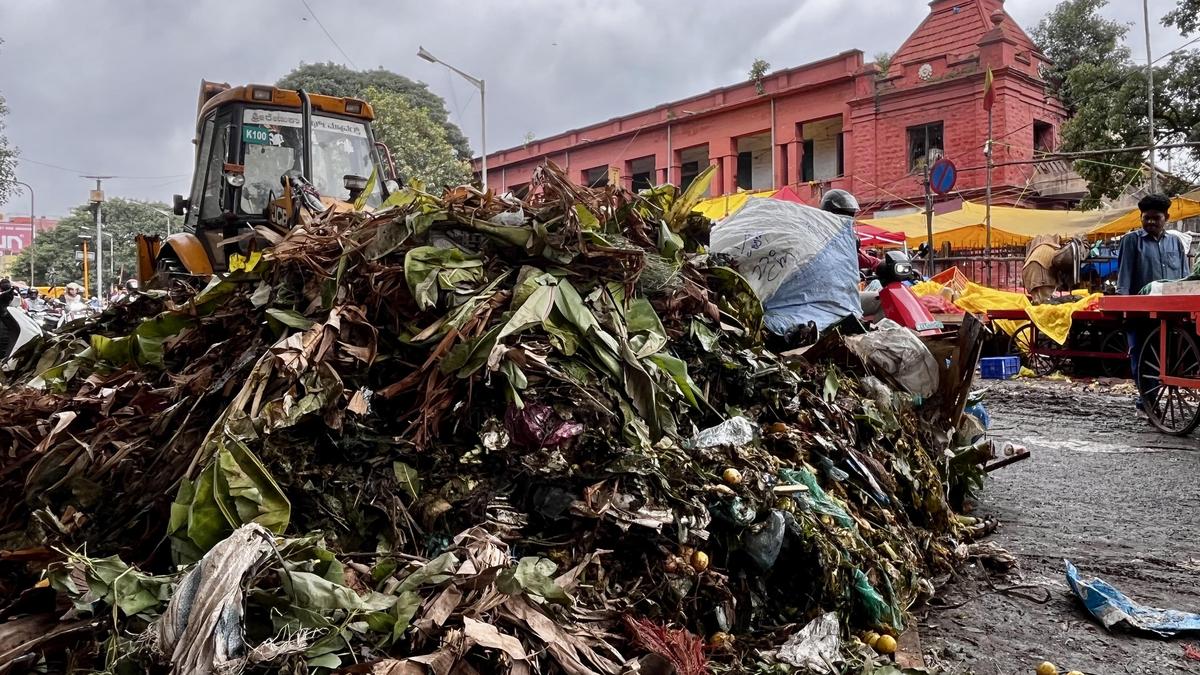

In a fresh push to tackle the city’s garbage hotspots, 500 additional garbage collection kiosks are likely to be installed across the city by the Bengaluru Solid Waste Management Limited (BSWML), which will be sponsored by a people’s collective.
Karee Gowda, Chief Executive Officer (CEO), BSWML, told The Hindu that the collective is keen on funding the initiative, which is seen as a major step toward eliminating black spots in the city. “We are currently in talks with the collective to decide on the approach,” he said.
An effective measure against black spots
This development comes a month after the BSWML, in collaboration with a multinational company and an NGO, installed a semi-automatic waste collection kiosk in Adugodi, southeastern Bengaluru. These kiosks are modern-day replacements for the large cement rings that were once a common sight across the city.
People used to dump garbage inside the rings, which eventually led to challenges like overflowing and spillage.
Bheemesh, an official from the BSWML, explained that near Koramangala’s Regional Passport Office, several problematic and persistent black spots have now been reduced following the installation of the kiosk.
“That specific location was a hotspot that had turned into a major dumping area. We are now seeing several residents handing over their garbage directly at the kiosks,” Mr. Bheemesh told The Hindu.
Placing high hopes on these semi-automatic kiosks, the BSWML plans to install 60 booths of its own across strategically identified areas in the city. This will be in addition to the 500 kiosks expected to be sponsored by the collective.
Scientific identification of locations
Mr. Bheemesh explained that the BSWML has compiled a list of areas where black spots reappear despite regular clean-ups and repeated warnings. For example, several sites near the Banashankari Temple in south Bengaluru are long-standing black spots that authorities have struggled to clear, even after implementing various measures.
Officials have studied the reasons behind the recurrence of these black spots and the causes of dumping in specific locations. Based on these insights, an action plan has been drawn up to determine where kiosks should be installed.
Additionally, areas with irregular waste collection, narrow roads, or those vulnerable to becoming black spots will be prioritised for kiosk installation.
For now, the 60 kiosks being installed directly by the BSWML are funded through the existing Bruhat Bengaluru Mahanagara Palike grants. In the future, the agency plans to involve Corporate Social Responsibility funds.
Cost factor
According to the BSWML officials, each kiosk requires around ₹2.5 lakh annually for operation, excluding the installation cost, which is estimated at ₹1.5 lakh. The installation expenses include construction, fabrication, and setting up of the kiosks.
“We need at least one person to manage each collection kiosk since it is semi-automatic. The salary for this staff member, along with booth maintenance, will cost around ₹2.5 crore in total annually,” Mr. Bheemesh told The Hindu.
The initiative to eliminate black spots comes in response to the city’s poor performance in the latest Swachh Survekshan rankings. Since the rankings were announced in July, the BSWML has introduced multiple measures to improve the situation.
The department has advanced the mustering time to 6 a.m. for better waste collection coverage and launched the ‘Kasa Suriyuva Habba’ campaign, which returns illegally dumped garbage to source households, and new corporations are frequently organising mass cleaning drives. Recently, the BSWML also announced cash rewards for individuals who report litterbugs.
The BSWML officials argued that while these measures can help reduce the problem, cultivating civic sense among citizens remains the only lasting solution to Bengaluru’s garbage woes.
Published – November 22, 2025 10:03 pm IST