




On June 24, 2020, as the country was still grappling with the COVID-19 pandemic, the Union Cabinet approved the participation of the private sector in space activities and the creation of the Indian National Space Promotion and Authorisation Centre (IN-SPACe) to provide a level playing field for private companies to use Indian space infrastructure.
This reform was hailed as historic in India’s space journey, which started in 1962 with the establishment of the Indian National Committee for Space Research (INCOSPAR), an earlier avatar of the Indian Space Research Organisation (ISRO).
Soon, space start-ups started mushrooming across the country (currently, there are 330 active space startups in India). The Central Government followed up with further reforms with the Indian Space Policy 2023, and opening up the sector to 100% foreign investment with a new FDI policy.
More importantly, this paved the way for many States, including Karnataka, to roll out their own space policies.
The Karnataka government, which recently approved the Karnataka Space Technology policy 2025-30, aims to make Karnataka a global space technology destination.
The policy has two main aims:
to sustain Karnataka as the number one destination for space technology in India and hold 50% of the national market share which is $ 22 billion market by 2033
to propel Karnataka into a global space technology destination with comprehensive capabilities across the space value chain, targeting 5% of the global market share.

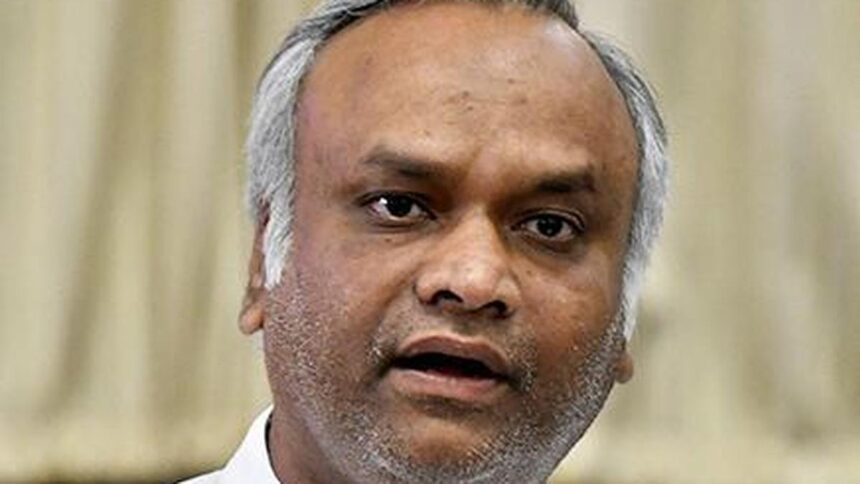
“The State’s Space Technology Policy 2025-2030 positions Karnataka as India’s premier space economy hub. Building on our unparalleled aerospace legacy and research excellence, we are charting Karnataka’s trajectory in the fast-growing space sector. The five strategic pillars of the policy are skill development initiatives, investment incentives, infrastructure creation, innovation and facilitation, adoption and awareness. This policy creates a thriving ecosystem for space startups, industries and academic institutions, fostering innovation from the ground up”Priyank KhargeMinister for Electronics, IT, BT and RDPR
ISRO paves the way
Space and Karnataka, in particular Bengaluru, are synonymous with the ISRO headquarters having been established in the city about five decades ago.
Many of ISRO’s critical establishments like the U.R. Rao Satellite Centre, ISRO Telemetry, Tracking and Command Network, Laboratory for Electro-Optics Systems and Human Space Flight Centre, are located in Bengaluru.
Some of the leading start-ups in the sector are headquartered in Bengaluru which gives Karnataka a headstart when compared to its rivals like Tamil Nadu, Telangana, Andhra Pradesh and Gujarat, which have also come up with their own space policies.
Heart of ecosystem
“Karnataka has long been the heart of India’s space tech ecosystem, and the new space policy is a strong step toward deepening that leadership. It recognises how rapidly the sector is evolving, whether in satellite manufacturing, Earth observation, launch, or downstream analytics. It creates a framework that enables companies like ours to build globally competitive capabilities from India,” says Awais Ahmed, founder and CEO, Pixxel, a Bengaluru-based startup.
He added that as a company based in Bengaluru, Pixxel has consistently benefited from the State’s depth in engineering, talent pool, and innovation culture.
“The new policy creates opportunities for us to advance satellite manufacturing further, strengthen our research partnerships with institutions in the State, and foster closer collaboration with emerging startups and suppliers within the region,” said Ahmed.
He argued that the focus on high-precision manufacturing, testing infrastructure, and support for emerging technologies is particularly ‘relevant to our work in hyperspectral Earth observation and planetary intelligence’. “With the right support mechanisms now coming into place, we expect this to strengthen our ability to build, test, and deliver high-impact space systems from Karnataka,” Ahmed added.
Infrastructure needs
Among the infrastructure which the government wants to establish through the policy are space manufacturing parks across Karnataka, new testing centres through Public-Private-Partnership (PPP) mode to expand upstream and downstream testing capabilities, and a Centre of Excellence in partnership with industry and academia, which will be the nerve centre and platform connecting industry, academia, start-ups, and government to innovate and accelerate the adoption of space technologies.
The policy states that its focus area will include upstream and downstream activities for commercial space, defence space, electronics and space research, including astronomy and astrophysics
The upstream (including space and ground systems) segment also aims to incorporate areas like space stations, space tourism, in-orbit services, and space manufacturing activities.
“The government of Karnataka shall support enterprises engaged in the development of next-generation space capabilities, including space stations and tourism infrastructure, in-orbit manufacturing, and servicing capabilities. This also includes space situational awareness systems that ensure safe and sustainable space operations,” the policy states.
According to the policy, start-ups and MSMEs will be reimbursed Provident Fund (PF) or Employee’s State Insurance (ESI) of ₹1,800 per employee per month for two years subject to total reimbursement of up to ₹12 lakh. This will be applicable for all new employment created during the policy period, provided the employment is for a continuous period of only two years.
Upskilling and reskilling
Suyash Singh, co-founder and CEO of GalaxEye, welcoming this initiative, said that the focus on upskilling and reskilling prepares the workforce for emerging opportunities.
“Space technology demands advanced, hands-on expertise that goes beyond classroom learning. It’s encouraging to see the government of Karnataka recognise this as a vital element in developing human capital. Such initiatives will also encourage companies to relocate here, attracted by the presence of a highly skilled talent pool. I also see the PF and ESI reimbursement as a very practical measure,” he said.
“For us, it means the ability to grow our team sustainably while ensuring they get opportunities to learn, adapt, and stay aligned with the fast-moving nature of space technology. It’s a thoughtful policy design that supports both innovation and people,” he added.
Support for 500 start-ups
The policy further states that, during the policy period, at least 500 space sector start-ups and MSME will be supported to grow and innovate.
“During the policy period, 50+ satellites with substantial indigenisation shall be designed, manufactured, assembled, integrated, tested, launched and operated by Karnataka based NewSpace enterprises for commercial, defence-space and research purposes,” it states.
Bengaluru-based start-ups are all game to leverage this policy.
Yashas Karanam, co-founder & COO, Bellatrix Aerospace, said that being headquartered in Bengaluru gives it a natural advantage, and the new policy expands that significantly.
“We plan to engage closely with the State’s thrust areas: skilling, R&D collaboration, and manufacturing incentives. For example, we’re evaluating expanding our subsystem manufacturing footprint within Karnataka if the proposed incentives — capex support, cluster benefits and testing infrastructure — are formalized. Propulsion development relies on high-precision facilities. Hence, access to State-supported test beds or shared qualification centers can dramatically reduce development cycles and costs,” he said.
His company intends to leverage Karnataka’s positioning efforts — space parks, cluster branding, international outreach — to grow its international customer base while scaling manufacturing locally.
Leveraging NIPUNA
The policy states that leveraging NIPUNA (an initiative aimed at equipping youth in the State with industry-specific skills and harnessing their potential) and other initiatives of the government of Karnataka, during the policy period, 50,000 professionals and students will be trained or up-skilled up to industry standards.
This shall include at least 15,000 women professionals and students who will be trained or up-skilled up to industry standards.
Going back to the ambitious vision the policy has set for itself, which is ‘to capture 50% of India’s space market by 2034 and 5% of the global share’. Is it realistic?
Execution is key
Karanam says that the policy’s real value will depend on execution. His company Bellatrix Aerospace develops and manufactures advanced propulsion technologies.
“Propulsion, in particular, requires precision manufacturing, vacuum-test infrastructure, high-fidelity qualification labs, and predictable regulatory pathways. The framework is promising, but its impact will hinge how quickly on-ground capabilities materialize. However, the State’s ambition to capture 50% of the national space market is both pragmatic and achievable if the ecosystem investments are deep and sustained,” Karanam says.
Karnataka, given its space history, is certainly a front-runner in the space race. However, other States are catching up, and start-ups see this as a positive sign.
Sign of strategic sector
“It’s a positive sign for the country. State-level policies show that India is recognising space as a strategic sector with economic, environmental, and technological significance. While ISRO and IN-SPACe continue to guide national-level priorities, States creating their own frameworks helps unlock regional strengths, whether that’s manufacturing, innovation clusters, universities, or specialised research facilities,” says Ahmed. For companies like Pixxel, it means a more distributed and resilient ecosystem to build in, he added.
“As long as these policies complement national goals and facilitate ease of doing business, they can collectively accelerate India’s emergence as a global space technology hub,” he added.