



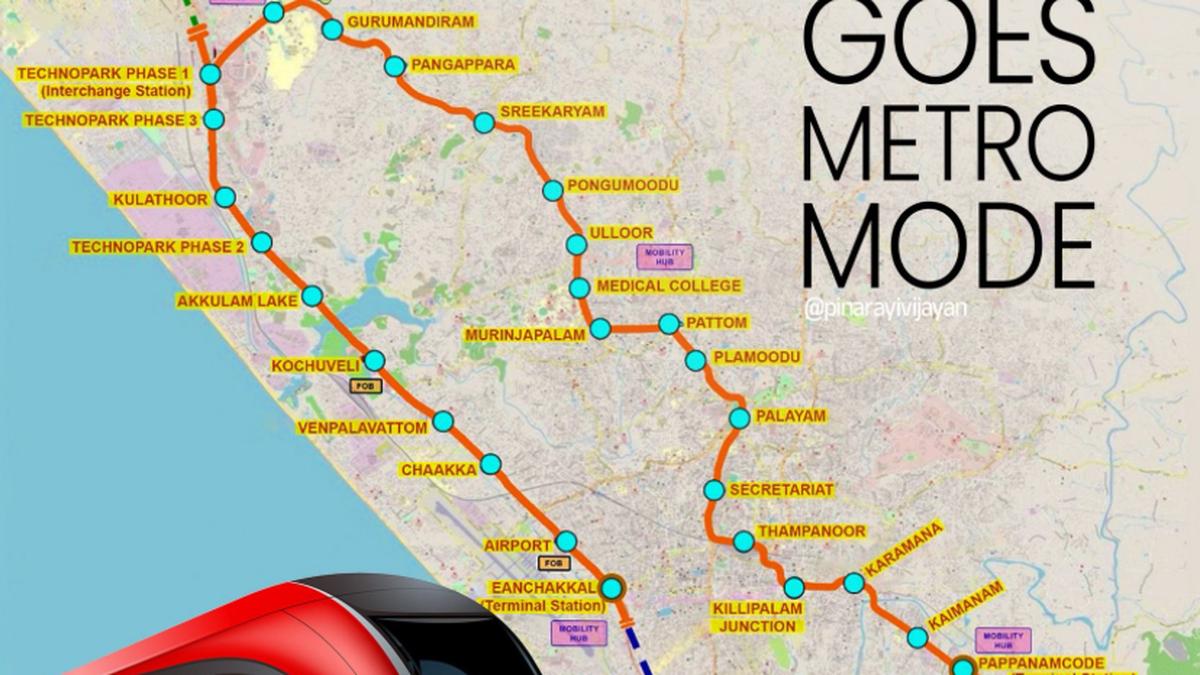

Although the alignment of the Thiruvananthapuram metro project was approved by the State government recently, the next government, which will be elected in six months, will have a major say in deciding the course of the project. A senior officer associated with the Delhi Metro Rail Corporation (DMRC) told The Hindu that it would take at least one year to secure the Union government’s final approval for the detailed project report (DPR).
As the initial alignment has changed, details of land to be acquired have to be finalised and a fresh DPR must be prepared, which would require the State government’s approval first, before it is submitted to the Union government. Under normal circumstances, it will take at least a year to complete the exercise. Once approval is procured, the project would take five years to be completed, said the official.
₹8,000-crore project
The State government issued an order on November 7 approving the new alignment for the project starting from Pappanamcode to Eenchakkal, covering 31 km with 27 stations, terming it the most feasible alignment of Phase I of the Thiruvananthapuram metro rail project. The project requires around ₹8,000 crore for completion, with per kilometre cost coming to ₹250 crore.
A change in the new government’s priorities too would have a bearing on the project, the officer added. At present, the State government envisages an elevated metro project since a hybrid project, with underground line too, will result in further cost escalation. Around ₹550 crore is required to construct a 1-km underground line.
‘Not many changes’
A senior officer of the Kochi Metro Rail Ltd. (KMRL)said there were only a few changes from the previous alignment. Hence, the KMRL is hopeful of completing the DPR without much delay by making some changes to the previous DPR prepared by the DMRC. The rest of the work and its progress will depend on the political decision of the State government, he said.
Only after receiving the Central approval will the State government look at the financing of the project. The current financing model involves equity participation by the Central and State governments, as well as loans to cover the remaining costs. The current model is that the Centre and State will bear 20% each of the project cost and 60% will be met with loans.
Published – November 10, 2025 08:44 pm IST