


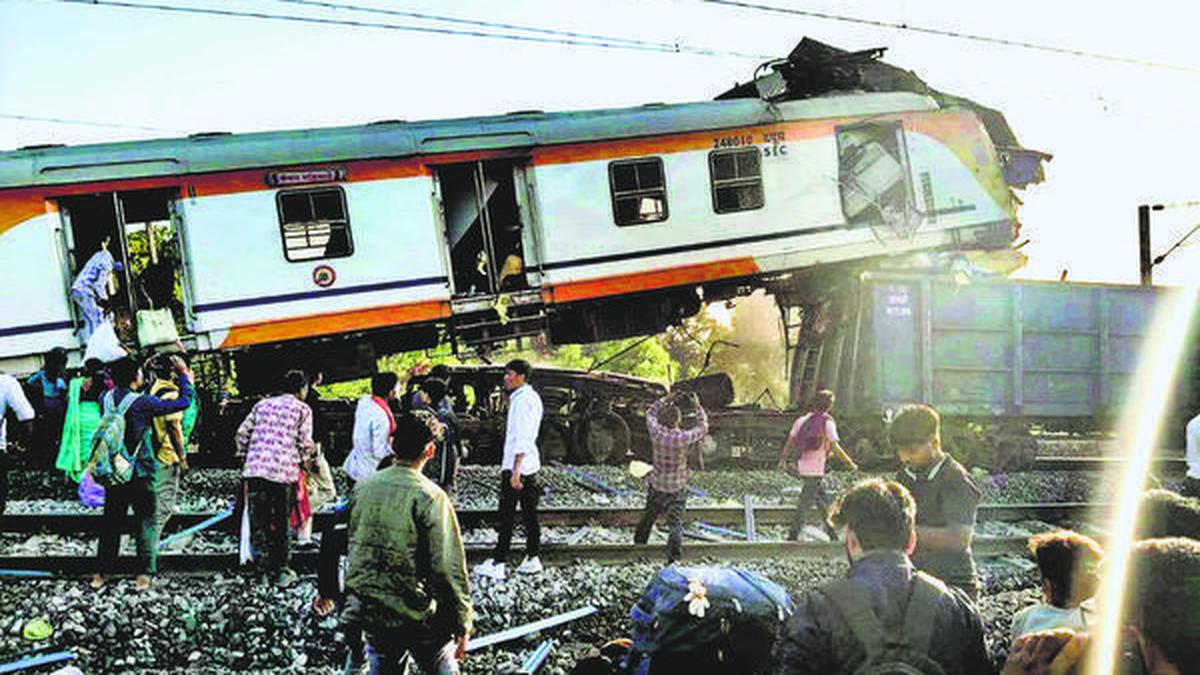

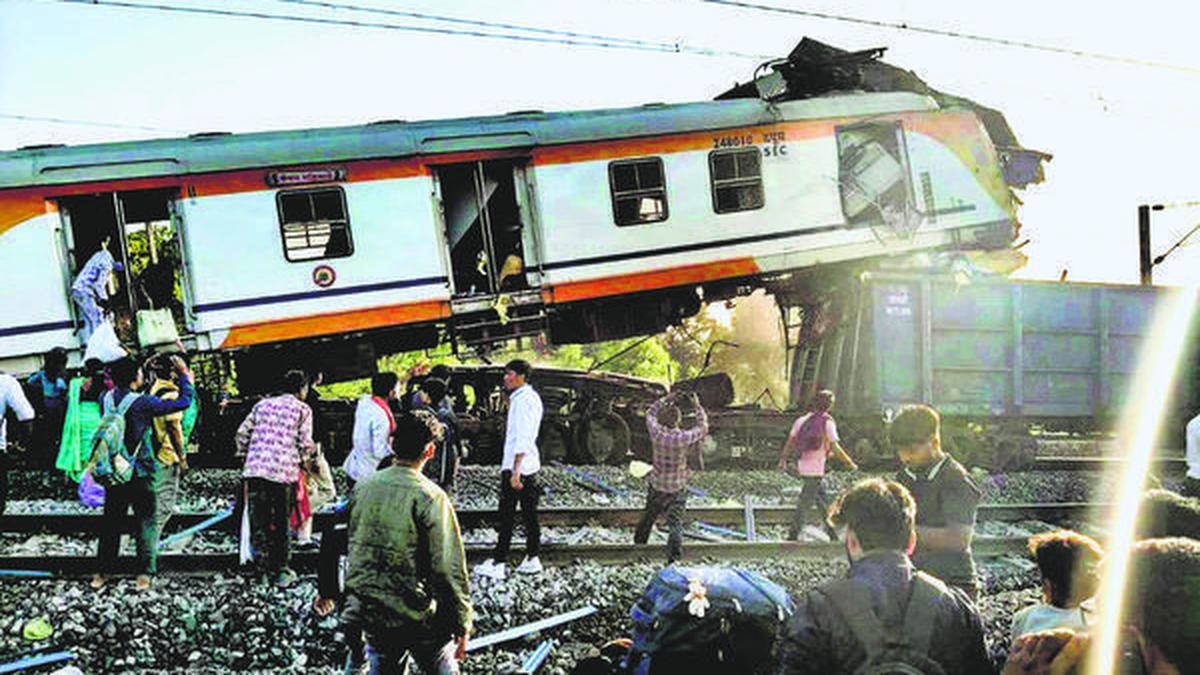
The passenger train collided with a goods train proceeding ahead on the same line on Nov. 4, 2025.
| Photo Credit: PTI
A preliminary investigation into the train accident near Bilaspur in Chhattisgarh that left 11 people dead and a few more injured on November 4, 2025, has found the crew had crossed the signal in red, resulting in the collision.
While a loco pilots’ association claimed there were visibility issues as the accident took place in a curve with different lines and signals, leading to confusion under the glaring sunlight, a fact-finding report comprising senior railway officials drawn from various departments concluded that the accident came under the “Signal Passed At Danger” (SPAD) category.
The ill-fated passenger train collided with a goods train proceeding ahead on the same line. Loco pilot Vidya Sagar died on the spot while his assistant was admitted to the hospital with grievous injuries and was not fit to give statement on the circumstances that led to the accident.
According to sources in the All India Loco Running Staff Association (AILRSA) in South East Central Railway, mainline electric multiple unit (MEMU) passenger trains usually had only one loco pilot. However, in Train no. 68733 (Gavera Road to Bilaspur), an assistant loco pilot was also deployed since the loco pilot had not cleared the aptitude test.
Crew lost control
The probe report said the crew “failed to control the signal at danger” and collided with the rear brake van of the freight train resulting in the SPAD case. “The crew are held responsible for not controlling the train at the right time and right position before the ‘danger signal…,” the source who had access to the report told The Hindu on Sunday (November 9, 2025).
AILRSA zonal secretary V.K. Tiwari said an attempt was being made to blame loco pilots immediately after the accident even without conducting an inquiry. He said the train was running at 45 kmph after crossing the earlier signal in yellow and the loco pilots picked up speed to 76 kmph probably thinking that the double-yellow signal meant for the adjacent line in the curve was theirs.
“However, on seeing another train on the same line the loco pilot applied emergency brakes and brought down the speed of the train. The speed of the MEMU at the time of collision was 48 kmph going by data logger report,” Mr. Tiwari said.
Meanwhile, B.K. Mishra, Commissioner of Railway Safety (under the Ministry of Civil Aviation), South Eastern Circle, Kolkata, concluded his mandatory investigation into the fatal accident. “The AILRSA has given a representation to the CRS conveying our concerns,” he said.
Published – November 09, 2025 08:02 pm IST