


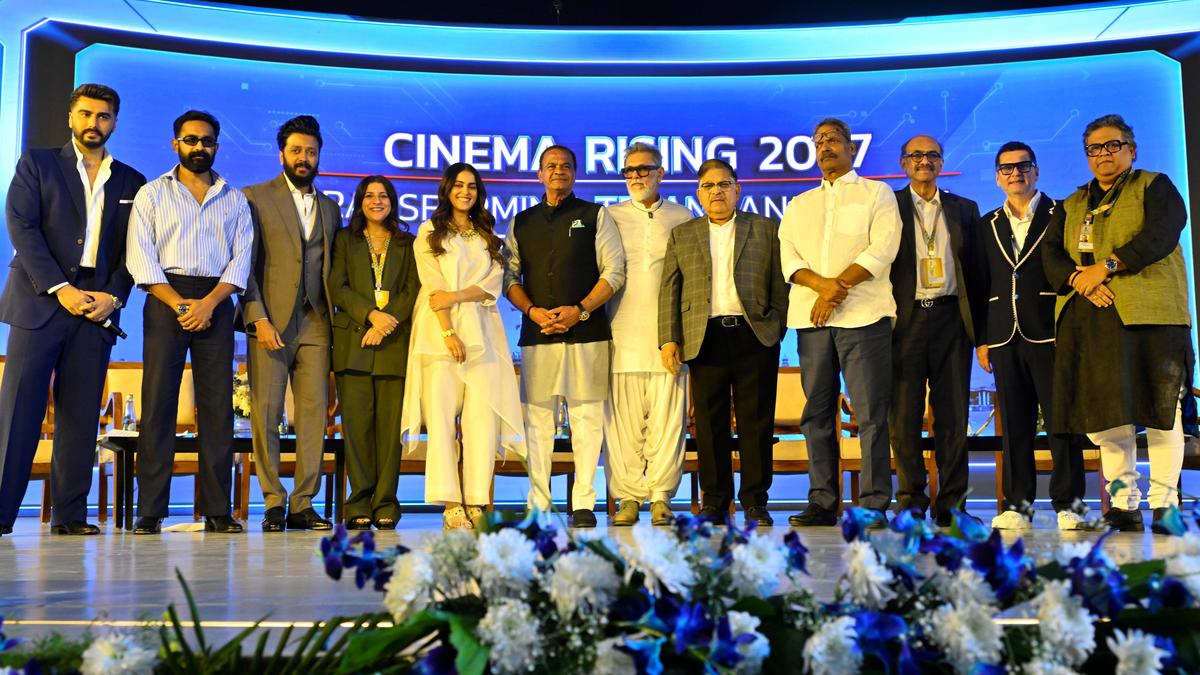

Minister for Roads and Buildings, National Highways, Civil Aviation and Cinematography Komatireddy Venkat Reddy along with cinema industry leaders and actors at the Telangana Rising Global Summit at Bharat Future City in Kandukur Mandal, Rangareddy district on Tuesday.
| Photo Credit: NAGARA GOPAL
At the Telangana Rising Global Summit 2025, the government set out an ambitious vision to transform the State into a global creative hub by 2047, bringing together leading filmmakers, producers, actors and investors for a panel discussion titled ‘Cinema 2047: Transforming Telangana into a Global Creative Hub’. The session explored how industry and government could collaborate to build an ecosystem that nurtures storytelling, supports talent and takes Indian cinema to the world.
Before the panel discussion, Telangana Minister for Roads and Buildings, National Highways, Civil Aviation and Cinematography, Komatireddy Venkat Reddy, delivered a keynote that traced the historical evolution of Hyderabad’s film industry while laying out the State’s long-term creative ambitions. The Minister traced the lineage of studio development, beginning with Sarathi Studios in 1956, followed by Ramakrishna and Annapurna Studios in 1976, then Padmalaya Studios in 1984 and Ramanaidu Studios in 1989.
Following the Minister’s address, the panel discussion moderated by actor Arjun Kapoor opened with a reflection by Producer Daggubati Suresh Babu on the industry’s journey over the last 25 to 30 years. He recalled how a small tax incentive and government support led to the Telugu film industry shifting from Chennai to Hyderabad, where strong infrastructure quickly developed. Director Rakeysh Omprakash Mehra argued that creative excellence must precede infrastructure. He called for a dedicated school for writing and said India must cultivate young storytellers driven by pride, diversity and curiosity.
Malayalam actor Asif Ali said Hyderabad serves as a technological backbone for the Malayalam industry, providing advanced equipment and creative support. The Telugu industry, he said, feels ‘20 years ahead’, and he expressed enthusiasm for deeper collaboration. Producer Allu Arvind highlighted that global stories begin locally. Citing Kantara and Pushpa, he said sincerity and rootedness matter more than aspiring to mimic international franchises.
Producer Shyam Prasad Reddy described cinema as one of the most powerful forms of influence, capable of shaping culture across borders. Using the example of Tampopo, a Japanese film that sparked global interest in ramen, he illustrated cinema’s ability to drive economic opportunities.
Actor-director Ritesh Deshmukh said India must build integrated film cities and formal training institutes to strengthen production, direction and technical talent. Regional cinema thrives, he said, only when deeply rooted in culture, after which its universality shines through.
The discussion also turned to women in cinema. Director and Producer Zoya Akhtar said Mumbai succeeded because major production houses and male stars trusted women directors, creating safe, respectful and inclusive sets. Actor Genelia Deshmukh said Hyderabad has always made her feel secure and valued. Early in her career, she was often the only woman on set, yet the presence of strong women producers inspired her to believe she could do more.
Bengali filmmaker Aniruddha Roy Chowdhury said with the support of the State, incentives and modern technology, cross-regional stories could flourish, including narratives rooted in both West Bengal and Hyderabad.
Published – December 09, 2025 11:50 pm IST