



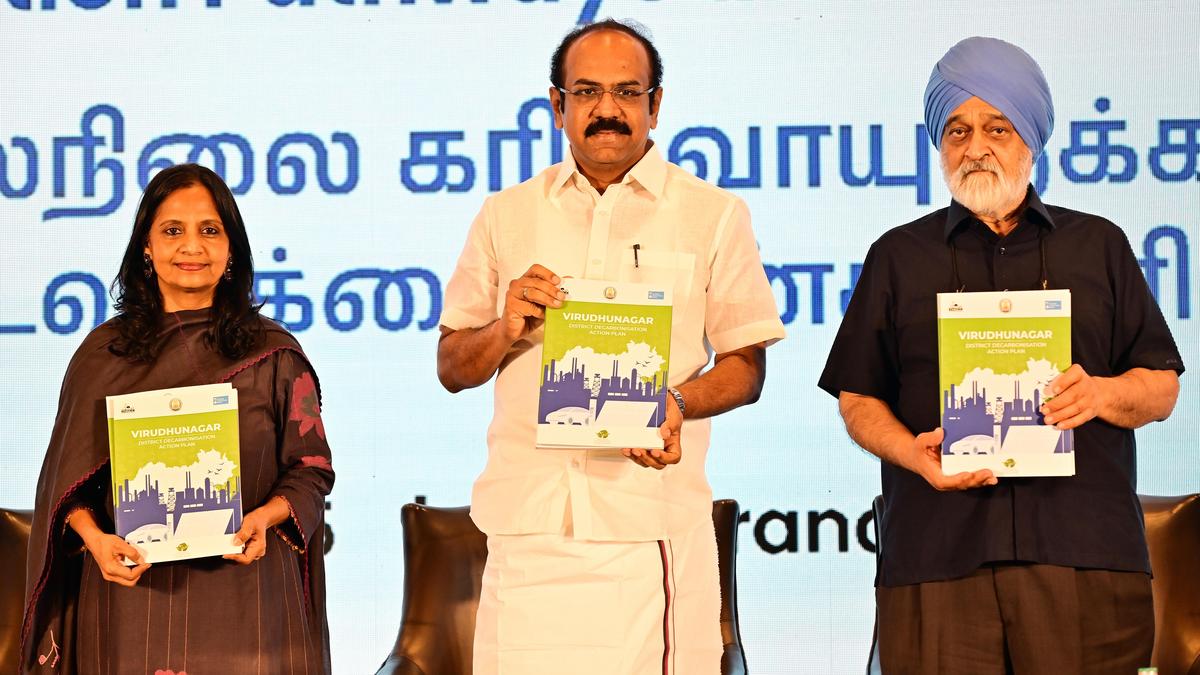

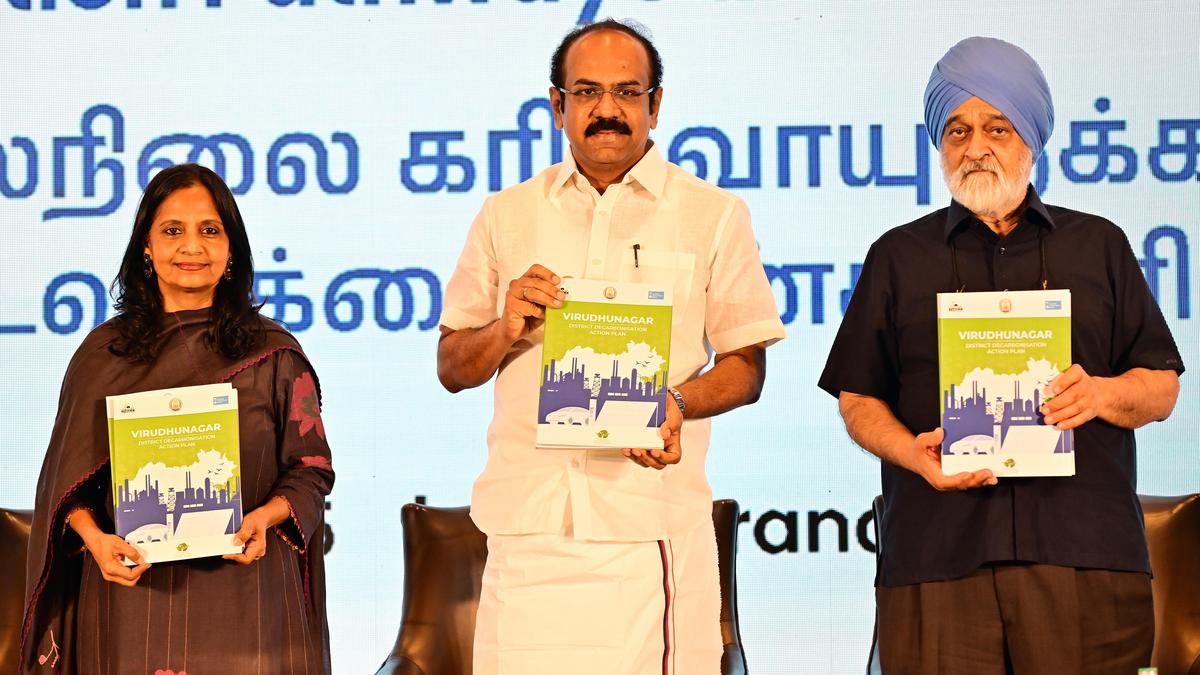
Minister for Finance and Environment Thangam Thennarasu launching the climate action tracker in the city on Friday. Additional Chief Secretary Supriya Sahu is also seen.
| Photo Credit: B. VELANKANNI RAJ
Minister for Finance, Environment and Climate Change Thangam Thennarasu launched the ‘Climate Action Tracker for Tamil Nadu’ and ‘Climate Decarbonisation Pathways’ for some districts, including Ramanathapuram, Virudhunagar, Coimbatore, and Nilgiris.
A complete analysis of each of these districts has been carried out with the support of Vasudha Foundation and government agencies.
Decarbonisation
“Today, we are launching the district decarbonisation action plan and the Tamil Nadu climate action tracker – two powerful instruments that will guide our path to net zero, district by district and community by community. This framework will be progressively expanded across the State,” Mr. Thennarasu said.
He said the Tamil Nadu government was committed to building an economy that was not only strong and competitive, but also resilient, inclusive, and environmentally responsible. “Climate action for us in Tamil Nadu is not a challenge, it is a strategy for economic prosperity.”
Mr. Thennarasu also highlighted various schemes, and said the Meendum Manjappai movement had become a symbol of responsible consumption. “Under the Thooimai Mission, we are transforming waste management to build a cleaner Tamil Nadu,” he said.
He added: “As we advance, financing this transition is key. Implementing plans will require a mix of public investments, private partnerships, CSR partnerships, and innovative instruments such as green and transition bonds.”
Energy targets
Supriya Sahu, Additional Chief Secretary, Environment, Climate Change and Forests Department, said District Collectors and all stakeholders would have the blueprint.
She explained how each target would be measured and recorded on the tracker.
She said: “Tamil Nadu has added close to 10 GW of renewable energy in the installed capacity in the last five years. If you look at the entire energy scenario in our State today, 60% of the total installed capacity is from renewables.”
Montek Singh Ahluwalia, Governing Council Member of the Tamil Nadu Climate Change Mission, pointed out that large industries would soon face limits on emissions. “It’s only a start; the framework will develop over time.”
Some of the projects that can be implemented in Coimbatore in the near term include electrification of 500 intra-city buses (15% of current bus fleet) by 2030 and heating processes in industries by 2050, with a pilot by 2030-35 and replacement of 5 lakh streetlights with LED lights by 2030. Suggestions were also given on how to finance each of these projects.
To preserve biodiversity and empower communities, plans have been made to transform the Nilgiris into a carbon-neutral and climate-resilient hub. Some of them include designating and developing eco-heritage villages in areas with strong tribal or historic significance, fostering ecotourism-centric livelihoods, and replacing 40% of fuelwood-based heaters with electric heaters.
Virudhunagar’s path to decarbonisation hinges on electrified transport, clean energy, and enhanced sequestration with additional scope to decarbonise hard-to-abate industries.
The proposals for Ramanathapuram include enhancement of seaweed and seagrass by 2023, restoration of 61 ha of mangrove forests by 2030, and electrification of 900 mechanised and motorised fishing vessels.
Published – November 01, 2025 12:35 am IST