




Director Sujeeth’s latest action thriller, the Pawan Kalyan gangster drama They Call Him OG (which began streaming on Netflix in October), has a curious pacing problem, one that has become increasingly common among star vehicles in Telugu cinema.
Every time the plot threatens to move in an interesting direction, Sujeeth freezes the main narrative and subjects the audience to yet another flashback that underlines, for the umpteenth time, how lethal Kalyan’s exiled gangster OG (Ojas Gambheera) is, how his very name strikes terror in the hearts of his enemies, how all and sundry bow down to his everlasting magnificence et cetera.
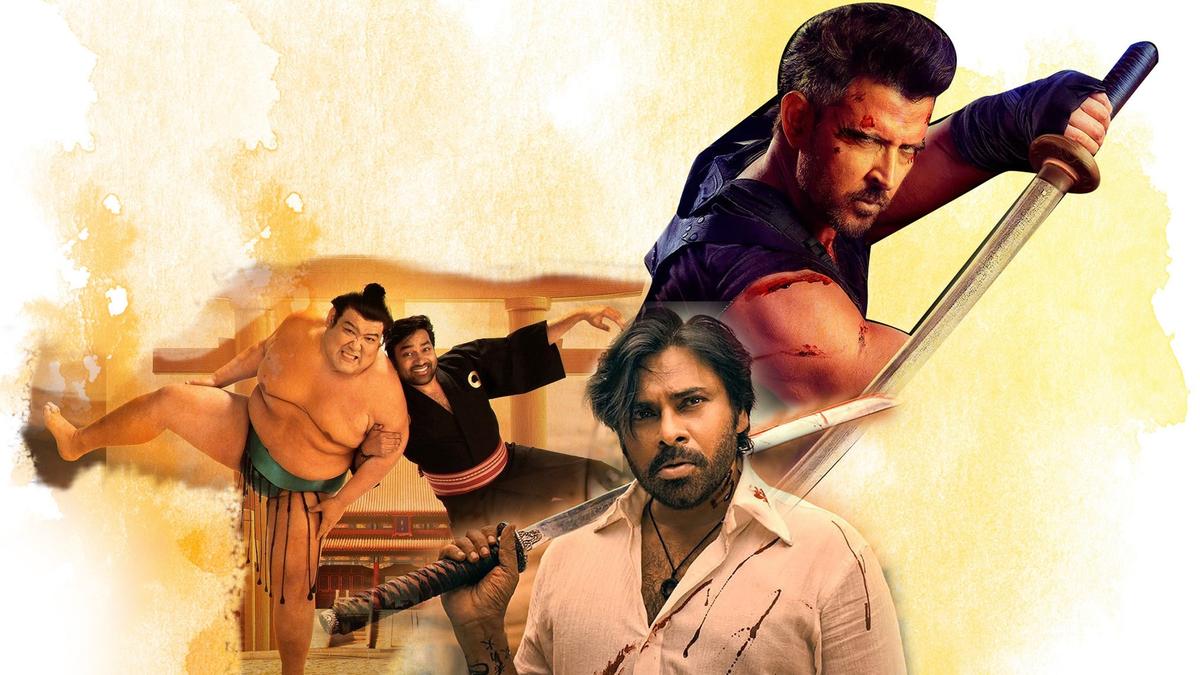
And for some reason, Sujeeth chooses to do this within a Japanese framework here. OG is shown to have trained at a Japanese dojo in his childhood, his weapon of choice throughout the film is a katana, the film’s credit sequences have a Japanese-inspired font, and the yakuza clans he annihilates still call him ‘Master Orochi Genshin’ in fear and awe.
And yet, for all of this, there is no real engagement with Japanese culture or society in the film. Replacing Japan with, say, China, in any scene here would not have made an iota of difference to the screenplay. Not to mention, one actor after another confidently mispronounces ‘yakuza’ throughout the film (the emphasis ought to be on ‘ya’, not ‘ku’). Sujeeth’s deployment of Japan here is, therefore, akin to Instagram users applying ‘filters’ to their vacation photographs. And he is hardly alone: over the last year or so, several Indian filmmakers have chosen to use Japan as the window-dressing-of-choice in their action thrillers.
Katana craze
For instance, on Independence Day, two high-budget action thrillers clashed at the box office — Ayan Mukerji’s Hindi-language War 2, starring Hrithik Roshan and NTR Jr., and Lokesh Kanagaraj’s Tamil film Coolie, starring Rajinikanth. War 2 begins with a rather perfunctory Japan-set sequence where Roshan single-handedly kills scores of yakuza fighters and finally, their ageing boss, who waffles on about honour and duty even as his men are mowed down all around him.
Coolie goes full Japan in its interval block sequence, where in the middle of a drunken revelry, Rajinikanth whips out a katana and uses it to kill a minor character out of the blue. He then poses on a rooftop, katana draped around his left shoulder, as the lit-up word ‘kingpin’ shines behind him.
With Rajinikanth, one can at least offer the logic of appealing to his Japanese fans, of which there are many since the mid-’90s, after films like Muthu and Baashha earned the actor a cult following there. But what about Pushpa 2? The Allu Arjun-starrer, which became one of the most profitable films of 2024, begins with a bizarre dream sequence, wherein Arjun’s uneducated, functionally illiterate sandalwood smuggler Pushpa finds himself in Japan via his own smuggling vessels — and lo and behold, he claims to have taught himself Japanese on the journey there. He soon taunts his yakuza counterparts in Japanese and hands out a fearful thrashing — before he wakes up, of course. The film does not return to this scene at all across the next three hours and nobody even tries to explain why or how Pushpa’s dream-tongue is Japanese.
Similarly, the teaser for Salman Khan’s recent Sikandar (directed by A.R. Murugadoss) featured Khan taking on a group of gangsters in Japanese-style ‘antler helmets’ (worn by warlords and chieftains in medieval Japan).
Return of the sumo
A recent Tamil-language comedic movie attempts to engage with Japan a bit more earnestly — at least at first. In Sumo, directed by S.P. Hosimin and starring Shiva alongside Japanese actor and former sumo wrestler Yoshinori Tashiro, the narrative follows a sumo wrestler who washes up ashore near Chennai one morning — comedic hijinks ensue when happy-go-lucky surfer Shiva and his girlfriend Kani (Priya Anand) decide to help the hapless, disoriented wrestler who they dub ‘Ganesh’.
Sumo’s premise is simple but promising and had a lot of potential for funny, empathetic commentary about xenophobia, building cultural bridges et al. Instead, it opts to make jokes about the sumo wrestler’s belly, and his broken English and Tamil are likened to a developmental disability.
I am not entirely sure how or why Japan has become the fetish of choice for Indian films — one would have thought South Korea would be the more obvious target, given the rampant popularity of K-dramas, K-beauty and so on. But whatever the reason, for the love of God, somebody has to stop Indian filmmakers from going overboard.
The writer and journalist is working on his first book of non-fiction.
Published – November 06, 2025 04:48 pm IST