





A grab from the reel on urbaser Sumeet’s Instagram page about conservancy worker Udaykumar’s rescue of a Chestnut winged cuckoo from Oliver Road in Mylapore, Chennai. The bird had been bitten by a dog and it was cowering in a house.
Recently, on its Instagram page, Urbaser Sumeet raised a hymn of praise to a conservancy worker within its fold. Not a verse in that praise struck a superfluous note. Udaykumar, the conservancy worker, rescued an injured bird, pulling it out of the jaws of death after it had come between the jaws of a canine. While Udaykumar was on his beat, clearing garbage on Oliver Road in Zone 9, a resident told him about a bird bitten by a dog and cowering in the neighbouring house. The reel shows Udaykumar narrating the sequence of events that led to the bird’s recovery: how he took the bird, the injury from the bite on the side of its neck evident, to a vet, informed his office and finally, handed the bird over to the forest department. If it had not been a Chestnut winged cuckoo (CWC), the story would have ended then and there as a heart-warming act of kindness. No sequel to it.
The sight of this CWC in the reel held gently by Udaykumar, with bare hands and with gloved hands could not but put this writer in mind of an observation ornithologist V. Santharam had made in the context of a discussion about the CWC five years ago.
He had made the observation in an article in The Hindu titled, “How much of a passage migrant is the Chestnut winged cuckoo?” (dated November 22, 2020).. He recalled two instances of rescuing a Crested winged cuckoo in the Santhome of the 1980s when he was a resident of the neighbourhood. On both occasions, the CWC had flown into a house, and crows had launched into it. In one of those two instances, it had “crash-landed” next door in Santharam’s neighbour’s house.
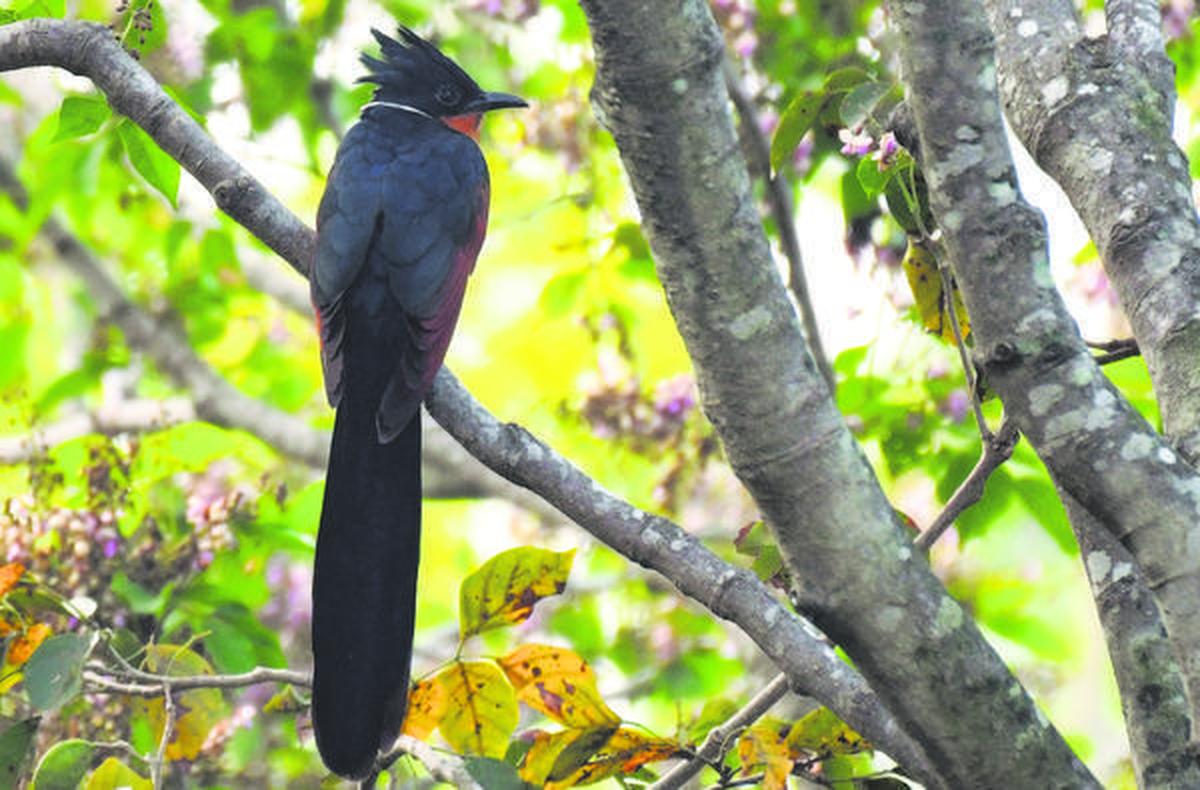
Chestnut winged cuckoo at Nanmangalam.
| Photo Credit:
Kumaresan Chandrabose
In a conversation connected with the current article, the ornithologist shared that again in the same time period, a resident of north Chennai brought a rescued CWC to his office in Nungambakkam, seeking his help. At that time, Santharam was working with UBS Publishers which had an office in Nungambakkam.
The recent incident at Oliver Road provides an object lesson about this CWC trait (getting disoriented and flying into houses) for the current generation.
It probably could come as an interesting trivia to many young birders, one seasoned birders are familiar with. A considerable part of what one hears about the CWC from birders now is about how it has started patronising certain patches. For five years, winter after winter, there have been accounts of CWC sightings happening almost on an appointed date (putting it without hyperbole, around a particular time of year) at Nanmangalam reserve forest.
Kumarasen Chandrabose is among birders in Sembakkam, Nanmangalam and surrounding areas that have been documenting the arrival of the CWC at Nanmangalam for the last five years.
In the early years of the Chestnut winged cuckoo’s engagement with the Nanmangalam forest, tyres from a distant land rolled in. Reportedly, birders from Bangalore queued up one day at Nanmangalam for a glimpse of the bird..
Cut to now, the relative regularity of CWC sightings in various other parts Chennai and its vicinity make a compelling case for asking an old question all over again — no marks for guessing what it is. Let us get to it in a minute. AM Aravind has reported a CWC sighting from Puzhuthivalkam. Sundaravel Palanivel has seen it at a patch of Pallikaranai in Kamakotti Nagar, just a chirp away from his home. He then caught up with the species in Kumizhi near Guduvanchery. Jithesh Babu had a “meetup” with the bird in Karikali. There have been sightings of the CWC in Adyar, one recently by Kumaresan Chandrabose. And then the Oliver Road incident.
This writer puts the same question to Santharam, five years later — how much of a passage migrant is the Chestnut winged cuckoo. Without taking a nanosecond to think it over, the ornithologist shoots back the same answer. “It is a passage migrant; but some of them could be staying on in Chennai for the winter.” Who knows, probably more of them than before.
According to Santharam, there are two time capsules when CWC sightings are largely reported in Chennai — November-December and during March-April on the return migration. Those time frames suggest strong passage migration, but that does not rule out the fact that some individuals might be going against the grain and resting their feathers longer in Chennai.
Published – November 23, 2025 07:19 am IST