



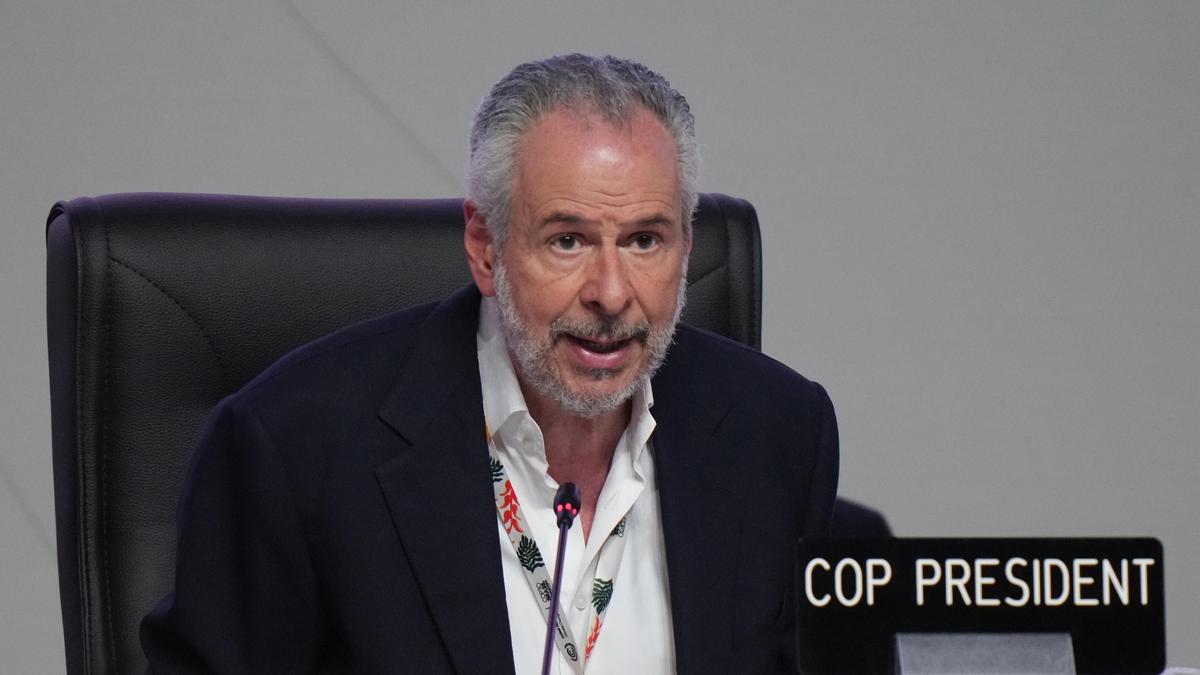

André Corrêa do Lago, COP30 president, speaks during a plenary session at the COP30 U.N. Climate Summit in Belem, Brazil, on November 22, 2025.
| Photo Credit: AP
The 30th edition of the Conference of Parties (COP 30) in Belem, Brazil, drew to a close late Saturday (November 22, 2025) with COP President Andrei Lago giving a personal commitment to get countries to deliberate upon two ‘road maps’ to end deforestation as well as a path towards ending fossil fuel use by countries.
“As [Brazilian] President Lula [da Silva] said at the opening of this COP, we need road maps so that humanity in a just and planned manner can overcome its dependence on fossil fuels, halt and reverse deforestation and mobilising resources for these purposes. I, as President of COP 30, will therefore create two road maps — one on halting and reversing deforestation and another on transitioning away from fossil fuels in a just, orderly, and equitable manner,” Mr. Lago said, while gavelling a consensus agreement, called the Global Mutirão: Uniting humanity in a global mobilisation against climate change. Mutirao is a Portuguese-Brazilian term for ‘coming together’ and has been a theme of the COP 30 proceedings.

This Mutirao refers to a consensus agreement on the most contentious topics of climate talks — implementation of article 9 of the Paris Agreement that makes it mandatory for developed countries to mobilise funds for developing countries to transition away from fossil fuels; promoting international cooperation steps by countries to impose “trade-restrictive unilateral measures”; progress on the countries nationally determined contributions and addressing the 1.5°C ambition and implementation gap, among others.

Developing countries (including some petro states and India) were insistent on not including language that commits countries to a timeline on eliminating fossil fuel from their economies.
Developed countries have insisted that specifying such a path is critical to keep the planet from overheating beyond 1.5°C by century end and that finance necessary for adapting to climate change and transitioning away from fossil fuel use must mobilise money from private and public sources.
Outreach to developed countries
While the final Mutirao agreement did not include language on fossil fuels, the President’s opening statement was seen as a placative outreach to developed countries as a way to keep conversation open on a definitive fossil fuel road map.
The President’s statements do not appear in the Mutirao agreement and hence is not considered binding on countries.

Other than Mutirao, there were 10 major agreements facilitated by separate groups of countries ranging from a wide of topics such as ‘just transition,’ (equipping labour forces globally to adapt to new jobs, loss and damage [from current effects of climate change] and technology implementation [regarding transferring clean energy technology] as well as a ‘global goal on adaptation,’ that is meant to measure progress towards the world adapting to climate change). While the President slammed his gavel, there were objections by various South American countries on aspects of the global goal on adaptation, forcing the President to interrupt proceedings. Country statements are expected to last all through Saturday evening (Belem time).
“Climate negotiations risked being disconnected from climate reality and the action that is already happening. At COP 30 in Brazil, the real world finally came back into the room,” Arunabha Ghosh, CEO, Council on Energy Environment and Water, and Special Envoy to COP 30 representing South Asia, said. “In a year where climate multilateralism has been challenged, getting a good deal was better than failing to get any deal in pursuit of the best deal. We saw important steps calling for at least tripling adaptation finance (even though by 2035); recognising diverse national pathways for a just transition; deciding to establish a two-year work programme on climate finance, including on Article 9.1 in the context of Article 9 as a whole; reaffirming that measures taken to combat climate change, including unilateral ones, should not constitute a means of arbitrary or unjustifiable discrimination; and finally, deciding to launch a Global Implementation Accelerator, including a high-level dialogue next year,” Mr. Ghosh said.
Published – November 22, 2025 10:38 pm IST