


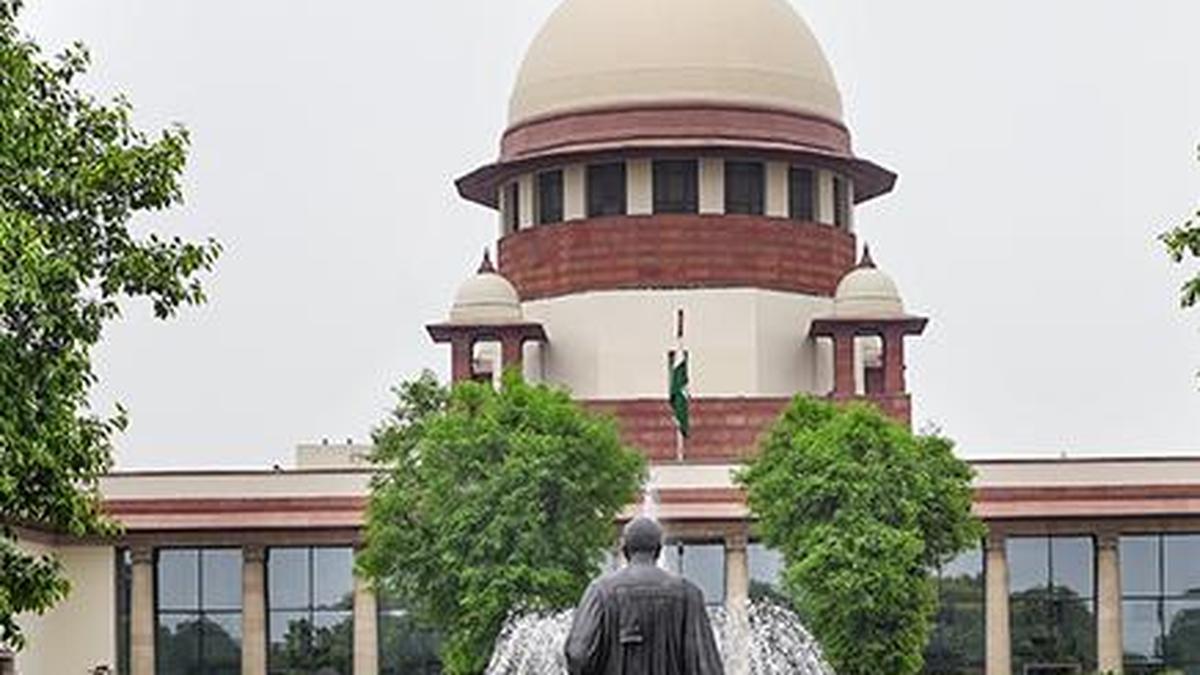


The Supreme Court directed that its order must be communicated to all the State High Courts to be forwarded to Special and Sessions Judges. File
| Photo Credit: PTI
The death of an intellectually-disabled rape survivor three months ago, after years of waiting for the authorities to compensate her as a ‘victim of a serious crime’, has led the Supreme Court to realise the lack of awareness about victim compensation and, worse, that many trial judges simply forget to pass the order.
“We find that one of the impediments in disbursement of victim compensation to the victims is the absence of a direction being issued by the Special Courts/Sessions Courts to pay compensation to the victims of a crime. Consequently, the victims have to seek such compensation on their own, either by making an application to the State Legal Services Authority or by any other means known to law. There is also an absence of awareness in this regard,” a Bench of Justices B.V. Nagarathna and R. Mahadevan observed in a recent order.
Trial courts play a crucial part in recommending the States to pay adequate financial compensation to victims of crimes. The compensation is seen as a restorative or rehabilitative measure for victims, which plays an equal part in criminal justice as the reformation of the accused.
Under Section 396 of the Bharatiya Nagarik Suraksha Sanhita 2023, which replaced Section 357A of the Code of Criminal Procedure, every State government, in coordination with the Centre, should prepare a Victim Compensation Scheme, to provide funds to compensate “the victim or his dependents who have suffered loss or injury as a result of the crime and who, require rehabilitation”.
States are backed by the Union government through the Central Victim Compensation Fund in order to avoid disparity, especially in cases of rape, acid attacks, and human trafficking. The State and District Legal Services Authorities implement the schemes.
Sessions and Special Courts which try serious cases of crimes, including offences under the Protection of Children against Sexual Offences Act (POCSO), are empowered to recommend victim compensation at the end of a trial if the judges find the money allowed under the penal statute would not be enough to rehabilitate the victim. Section 396 arms trial courts with the authority to direct victim compensation even if the prosecution’s failure to prove its case has led to the discharge or acquittal of the accused.
“We direct that Special/Sessions Courts ought to pass appropriate directions with regard to payment of victim compensation in appropriate cases, so that the implementation of these directions can be easily made by the State Legal Services Authority through the District Legal Services Authority or the Taluk Legal Services Authority, as the case may be,” the Supreme Court ordered.
The Supreme Court directed that its order must be communicated to all the State High Courts to be forwarded to Special and Sessions Judges. Further, the order copy was directed to be sent to the Directors of State Judicial Academies to be used as part of their training module in order to spread awareness.
The order came in a petition filed by advocate Jyoti Praveen Khandpasole, represented by advocates Gaurav Kumar Bansal and Rani Mishra, who brought to the attention of the court the “grave Constitutional and systemic failure, namely, the State’s continuing denial of rightful compensation to rape victims due administrative apathy and neglect”.
The petition narrated the tragic case of the 25-year-old victim who was brutally raped at Khadaka village in Amravati district of Maharashtra in September 2020. The offender was convicted and the trial court had explicitly ordered victim compensation. Despite this, the compensation was not disbursed to the victim, whose mother and sole caregiver, after years of struggle to get the money, died in May 2024.
The victim herself died a little over a year after her mother passed away in August 2025. At the time of her death, the district legal services authority had only partially released the compensation due to her, too little to be of any meaningful relief for her.
Published – November 08, 2025 06:26 pm IST