




In an electrical shop in north Delhi’s Gandhi Vihar, Geeta Devi sits hunched on a worn out revolving chair, eyes glued to her smartphone. Exhausted with the swarm of reporters thronging the neighbourhood for the past week, she looks up with exasperation at a man who has stopped at her shop. She’s half-expecting to be questioned about the alleged murder of a 32-year-old man in the neighbourhood. It turns out the person at her counter is a potential customer.
Relieved that the customer is a local, she rushes into a conversation on the incident that has become a subject of discussion in the area. “Dekhiye aaj kal ki ladkiyon ko (Just look at this generation’s women),” she says. “He was a nice boy. The only vice I could see in him was that he would sit on the steps of shops and smoke.” She adds that she hadn’t known him personally.
On October 6, Ramkesh Meena’s body was found in a burnt down flat in Gandhi Vihar. Within two weeks, police said they had traced the death to his partner Amrita Chauhan and her associates Sumit Kashyap and Sandeep Kumar.

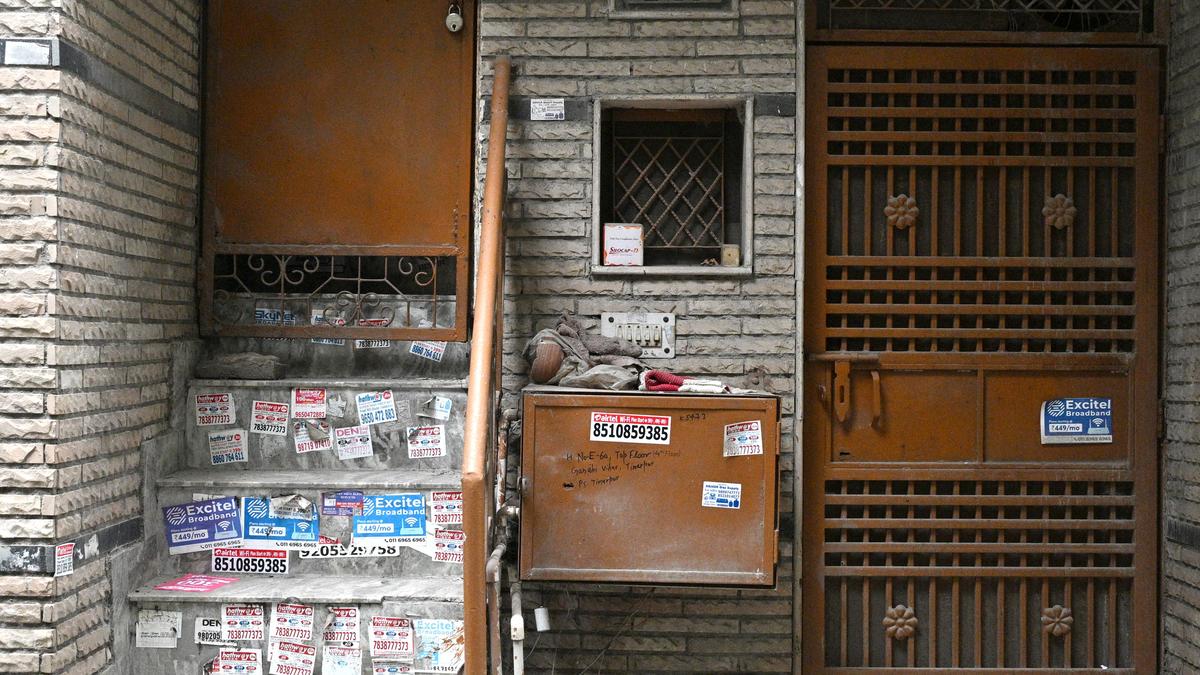
The burnt room where a UPSC aspirant was allegedly killed by his partner.
| Photo Credit:
SHASHI SHEKHAR KASHYAP
Gandhi Vihar is a neighbourhood where single-room flats with little ventilation dominate. Here, every second house is inhabited by migrants preparing for government examinations. It lies next door to Mukherjee Nagar, once the hub of coaching centres. Many live here for years, picking up books from bookstores that dot the markets, clustering in groups to discuss the future, or just grabbing a bite from roadside stalls for sustenance.
Familiarity is often limited to facial recognition and observable habits and mannerisms. Ramkesh led a life similar to all other government job aspirants. He was preparing to write the Union Public Service Commission (UPSC) examination that offers those who clear it entry into India’s civil services. He had an engineering degree from Netaji Subhas University of Technology, Delhi.
While Geeta Devi recalled him as a smoker, the owner of a nearby shop recalled him as a tea lover. Now, he is discussed as the man who was allegedly killed after he refused to delete intimate videos of his partner despite her asking him to do so several times.
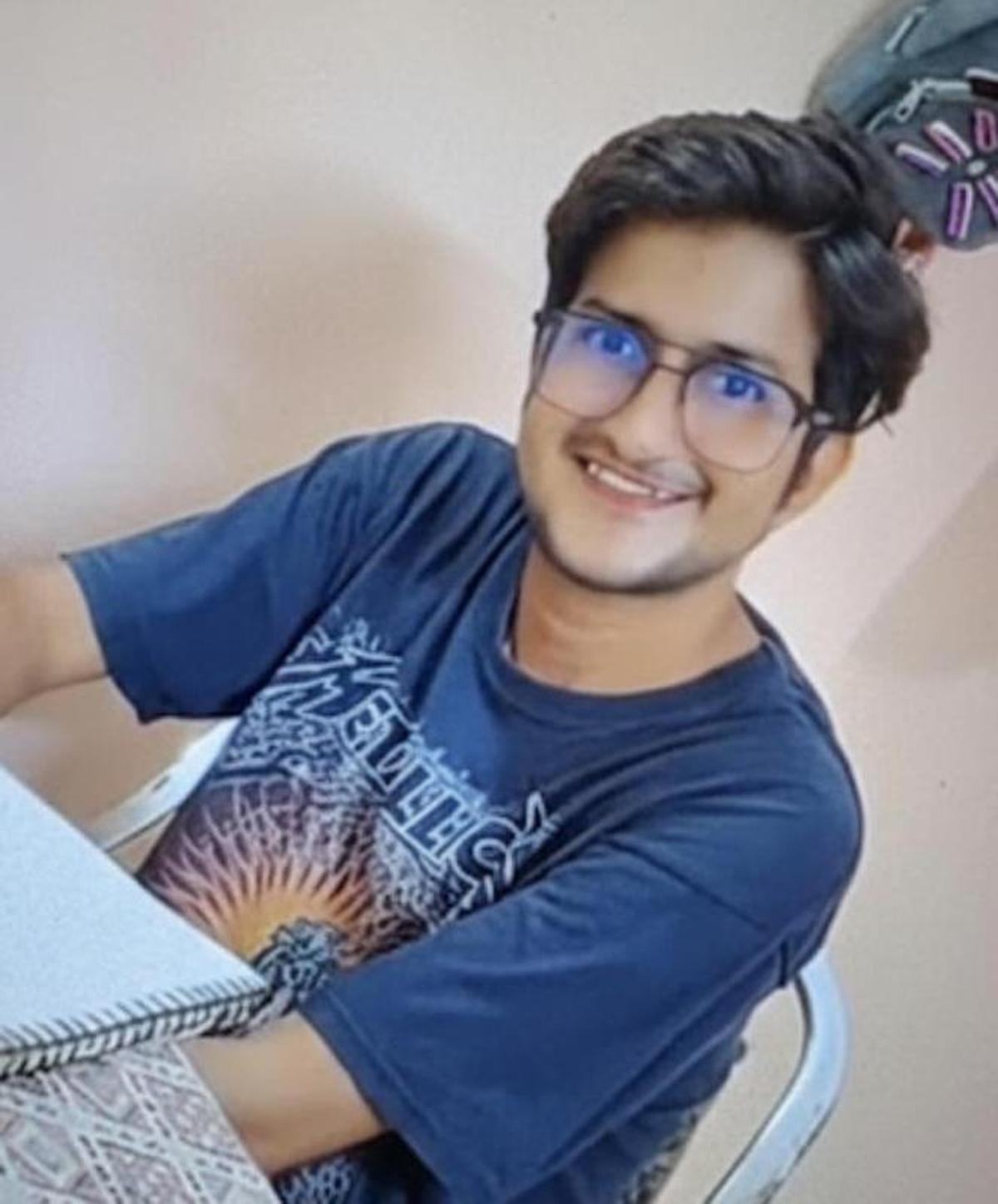
Ramkesh Meena
| Photo Credit:
Special Arrangement
A dark night
On the intervening night of October 5 and 6, black fumes choked the tightly packed houses lining the narrow lanes of the neighbourhood. Awakened by the thick smoke, the neighbours alerted the Delhi Fire Services (DFS) at 2.56 a.m. A fraction of a minute later, the neighbourhood was shaken by a blast in a flat on the fourth floor, impacting the adjacent walls and waking up even those in deep sleep.
When firefighters reached the spot, high flames engulfed the flat, says Kalpnath, a senior DFS official who led the rescue operation. “After hours of firefighting, we found a body. A part of the torso was found and some bones; it was completely charred,” says Kalpnath. The officers wrapped the remains in a sack and after scanning the spot, handed it over to Delhi Police.
At first, the death seemed to be an accident. “Our suspicions arose because there was a gas cylinder in the bedroom. So, we started to investigate if it was a death by suicide,” says a senior Delhi police officer. The police spoke to Ramkesh’s family that hails from Dausa district of Rajasthan. The family ruled out the possibility of suicide, the officer says. “His father, who is a farmer, was in disbelief. Later, his brother pointed out the involvement of Ramkesh with a woman named Amrita,” says the officer.
However, the investigation only changed course when the police scanned several CCTV cameras around the house. In the footage from Ramkesh’s neighbour’s CCTV camera, the police saw two people with their faces covered holding bags and leaving the building right before the flat caught fire. “That was the moment we realised that neither was this another fire incident nor a suicide,” says Raja Banthia, Deputy Commissioner of Police (North).

Amrita Chauhan
| Photo Credit:
Special Arrangement
The police then went through Ramkesh’s call detail records and traced Amrita’s number. He had made multiple calls to her number in the past few days. “There were calls made to his family members and friends. One number was saved by the name Amrita. We traced the geographic location of all recent calls and found that Amrita’s device was near his house before the fire,” says Banthia.
The police began the hunt for Amrita. “Ramkesh’s relative confirmed that Amrita was his present girlfriend and showed us her social media account. We then showed her photographs to the neighbours who recognised her as someone who would frequently visit his apartment. However, none of them knew her,” says the officer. Through human intelligence and technical surveillance, the police reached the house where Amrita was taking shelter along with Kashyap, her alleged former boyfriend, in Uttar Pradesh’s Moradabad.
Police action
The police detained Amrita on October 18. Kashyap and Kumar were picked up on October 21 and 23. At first, they denied the allegations. “We showed them the footage of the two of them stepping out, minutes before the flat caught fire. Seeing this, they confessed,” the DCP adds.

The CCTV behind the building where a UPSC aspirant was allegedly killed.
| Photo Credit:
SHASHI SHEKHAR KASHYAP
During interrogation, Amrita confessed that she went to Kashyap for help after Ramkesh refused to delete an intimate video, he says. “Amrita was alarmed when she realised that Ramkesh did not want to delete the video. She was afraid that he would use it against her,” he adds.
Police say Amrita had asked Ramkesh multiple times to delete the video and tried to take the hard disk in his absence. “He would always carry the hard disk even when he went for tea,” says a police officer in charge of the investigation. Amrita allegedly confided in Kashyap. Together, they hatched a plan that would make Ramkesh’s murder look like an accident, the police say based on Amrita’s alleged confession.
They say on September 20, Amrita and Kashyap decided to coerce Ramkesh into handing over the devices and threatened to kill him if he didn’t. “Subsequently, they rented a flat in south Delhi’s Chattarpur and moved into it on October 2,” a police officer adds.
On October 4, Amrita allegedly left for Ramkesh’s house. The visit came as no surprise to him. “She would come and stay with him for a few days and then leave. They were dating and not in a live-in relationship,” says the police officer. Amrita told the police on October 4 that she and Ramkesh were physically intimate.
The following day, Ramkesh stepped out of his house around 5.30 p.m. and came back by 9.45 p.m. Meanwhile, Amrita stepped out once to collect vegetables, as per CCTV footage, police say. By 8 p.m., both Kashyap and Kumar reached the neighbourhood. Only after Ramkesh returned did they quietly go up to the flat, police say.
“On corroborating the statements of all three accused, we learnt that they first beat up Ramkesh, seized all his devices, and strangulated him to death,” says the DCP. According to the initial probe, Ramkesh’s time of death has been ascertained as 10 p.m. While Kumar fled to Moradabad, Amrita and Kashyap stayed put till about 2 a.m. “To ensure that no fingerprints or evidence remained, they poured wine, ghee, and oil on Ramkesh’s body and left an open cylinder next to his head,” a police officer says.
Both Amrita and Kashyap tried to pass off an alleged murder as a fire-related accident. “Amrita had studied forensic science at a university in Moradabad and Kashyap used to run his family business of distributing LPG cylinders. They placed the cylinder next to his head to ensure that the carbon monoxide emitted during the fire would enter his oesophagus and it would be declared as the cause of death,” the police officer says. It was also to ensure that all signs of strangulation and physical assault that tied them to the crime would disappear, he adds.
The trio has been booked on charges of murder, criminal conspiracy, and arson under relevant sections of the Bharatiya Nyaya Sanhita. The police have sent the hard disk for forensic examination. They say there were also 16 intimate videos of other women in it.
The aftermath
A relative, who does not want to be named, says the allegations levelled against Ramkesh are “unbelievable”. “I accept that his hard disk has videos of multiple women, but they were all recorded with consent,” he says, adding that the police had shown him the videos.
It is “not unusual” to record videos during periods of intimacy, he says.
The police confirm that the videos were recorded on smartphone cameras. Preliminary investigations reveal that the women were not recorded using hidden cameras.
The relative also feels that Kashyap “wanted revenge” from Ramkesh “because he had established physical ties with Amrita”. He alleges that while Kashyap was married and had a child, he continued to be in a relationship with Amrita. Once Ramkesh entered her life in May this year, the distance between them grew, he adds.
Amrita’s family, based in Moradabad, refuses to speak about their daughter. However, a newspaper declaration dated 2021 read that they had severed ties with her after she “married Kashyap in a temple”.
“The family was against Amrita’s choice of marrying him, so they filed a complaint against him. However, since Amrita was an adult, she told the police that she had left her house by choice,” a senior Delhi Police officer says.
Amrita made her living by taking Biology tuition classes for students of Classes 8 to 12. While she was first enrolled as a forensic science student in a college in Moradabad, she quit after a year and enrolled in a college in Bijnor to pursue computer science, police say.
Meanwhile, Kumar, who was preparing for a government entrance exam, has been implicated in a murder that police say he did not help plan.
alisha.d@thehindu.co.in