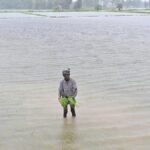




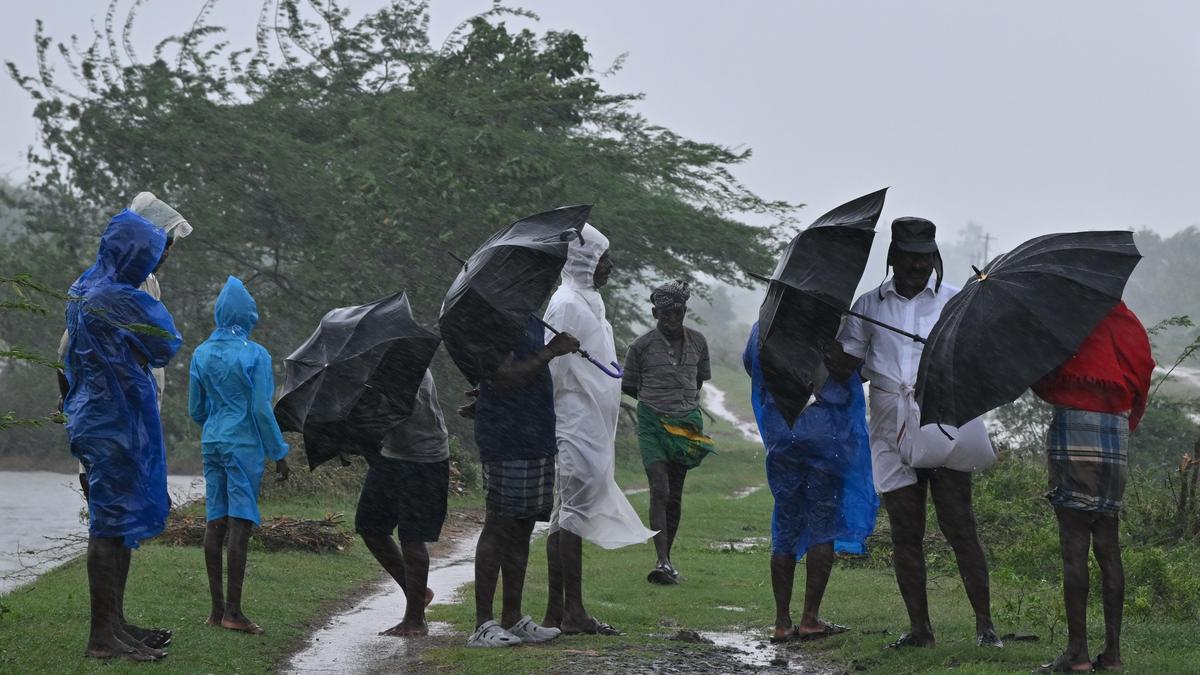

“Look at this… the tillers have already started to rot. If the water doesn’t drain in a day or two, everything will be lost,” said K. Rajendran, a farmer from Puzhuthikudi panchayat in Tiruvarur district, clutching a handful of damaged paddy shoots from his five-acre field on Saturday. His is not the only case. Farmers across the Cauvery delta were worried on Saturday as continuous rain under the influence of Cyclone Ditwah has caused standing samba and thalady crops to be submerged.
For the third consecutive day, rain swept through Tiruvarur, Nagapattinam, Mayiladuthurai, and parts of Pudukkottai, exposing the vulnerability of low-lying villages and long-neglected irrigation channels.
Across the delta districts, official sources said, if the rainfall continued at the current intensity, samba, thalady, direct-sown, and transplanted paddy crops faced a high risk of widespread damage.
Large large tracts of land in Kottur block in Tiruvarur district have been submerged, causing distress to farmers in the low-lying Puzhuthikudi panchayat limits, including Chozhanganallur, Somasi, Sabapathipuram, and Keezha Puzhuthikudi villages.
Farmers said even routine monsoon spells lead to stagnation due to the topography and Ditwah’s continuous downpour has sharply intensified the situation.
P. Soundararajan, Kottur unit secretary of the Tamil Nadu Vivasayam Sangam (CPI), said urgent intervention was needed. “The Adappar irrigation canal, which drains this whole belt, is blocked by hyacinth and silt. Unless it is cleared immediately, these fields won’t drain for at least seven days if the rain continues. We can’t save much unless desiltation is taken up,” he said.
In the neighbouring Pichankottagam, former panchayat president M. Mahalingam said around 650 hectares of samba are raised in the village, of which 400 hectares are submerged.
“At least crops on 200 hectares cannot be saved because there is no drainage. We rely on the Valavanar irrigation canal, but its sub-channels — especially the 5-km-long Pichankottagam canal — have not been desilted. That is why the water keeps standing here. No steps have been taken to restore the canal, even though it connects to the sea,” he said.
In Chettiya Moolai, under Rayanallur panchayat, about 150 hectares of samba remain under water. The village, a well-known low-lying pocket, has no effective drainage network.
M. Dhanapal, a farmer from the village, said water stagnation had become an annual feature. “Even if we wait a month, the water will not drain. The Mulkiyatru–Sanganthi irrigation sub-canal, which runs nearly 10 km from Adappar to Sanganthi, has not been cleared for many years. Because of that, we face the same problem every monsoon,” he said.
About crop prospects, he said: “The loss is certain — either the whole field will go or the total yield will drop sharply.”
Agriculture department sources said crops on nearly 37,000 acres in the district are submerged in water.
Villages marooned
Fresh heavy rain returned to Nagapattinam on Friday evening, just hours before Cyclone Ditwah’s expected approach. The district — still recovering from last week’s flood — saw widespread inundation yet again.
Officials confirmed that crops on 22,600 hectares of land were under water as on Saturday. Though there was two days of sunshine earlier in the week that allowed some water to drain, the return of intense showers brought back the crisis.
“Nagapattinam district is already surrounded by water. If this spell intensifies further, large-scale crop loss is inevitable,” said S.R. Tamilchelvan, State Policy Propaganda Secretary, Tamil Nadu Farmers’ Protection Association.
8,710 hectares hit
The Mayiladuthurai district administration said 8,710 hectares of agricultural land was under water on Saturday morning as 7.34 mm of rainfall was recorded between 8.30 a.m. and 10.30 a.m. with Mayiladuthurai town, Sembanarkoil, and Sirkali receiving the highest rainfall.
Farmers in the Tharangambadi-Sembanarkoil belt said even moderate spells could cause fields to submerge as earlier rainfall had only recently receded.
Floods in Karaikal
Karaikal has reported 4,500 hectares of total submergence, which happens to be the district’s entire samba cultivation area.
All paddy fields are now under water, agriculture department sources said. The flooding is attributed both to the cyclone’s impact and the continuous flow of Cauvery water released, officials added.
Poor drainage
In Pudukkottai, Agriculture department sources estimated 10,000 acres of crop land under water due to continuous rainfall and poor drainage in interior pockets.
Published – November 29, 2025 08:38 pm IST