





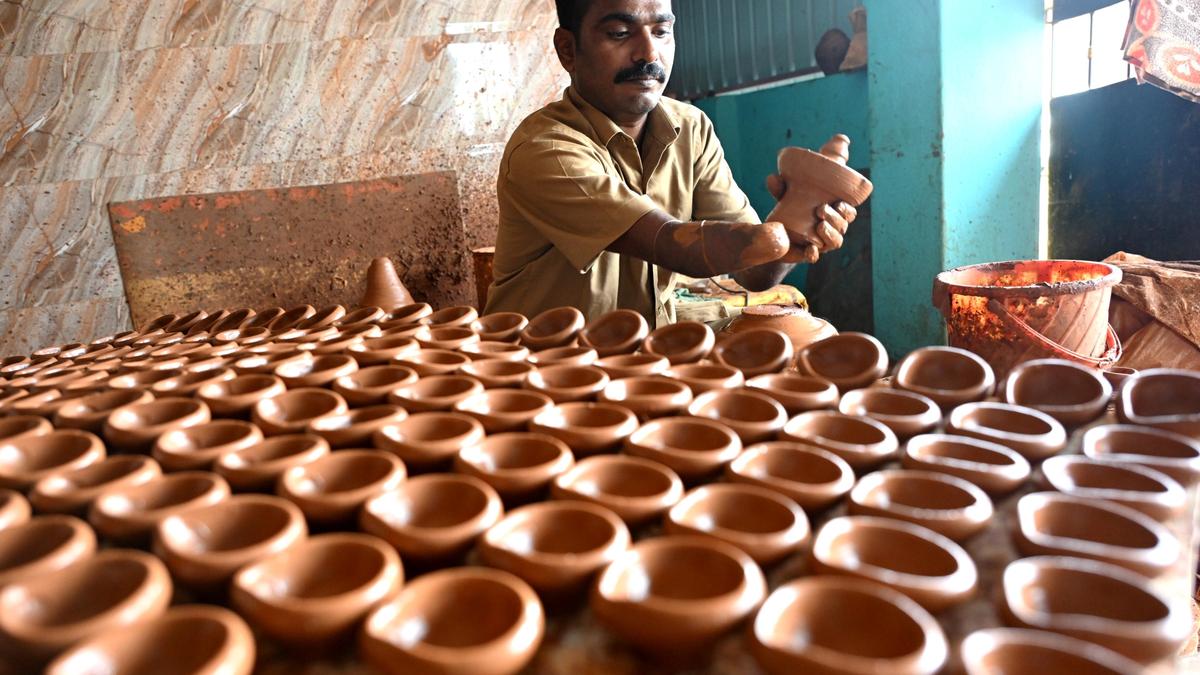
Velmurugan shaping an earthen lamp at Paravai in Madurai.
| Photo Credit: G. Moorthy
It’s been a week since the month of Karthigai began and people have started lighting earthen lamps outside their homes, keeping alive a long-held tradition. But for artisans who make these lamps, sales this season have been dull compared to earlier years. At Khadi Craft, Poompuhar and other outlets, the shelves are stocked, yet the makers behind them say the festival’s glow has dimmed.
R. Velmurugan from Paravai has been making earthen lamps and various clay products since he was 13. Along with his family, he produces a wide range of traditional lamps — from six-faced lamps, double-layer lamps, to large and deep-bowled lamps that can hold more than 50 ml of oil. These are supplied to households and temples across the district.
“We used to make more than two lakh lamps during the Karthigai season, but now we hardly make 50,000”, says Mr. Velmurugan.
He said that the decline is due to both rising costs and changing consumer choices. “For bulk orders, we sell at 70 paise per lamp. But when they reach the shops, the prices go up. Customers see the higher rates and think the craft has become expensive,” he says.
“People are also attracted to machine-made alternatives they see online. Our handmade lamps cannot compete with that speed,” he adds.
When asked how they manage to dry the freshly made earthen lamps during the rainy spell, he explains, “These lamps need to be sun-dried for at least two days to get a good finish. Whenever it starts raining, we quickly move them all inside and wait until the rain stops before spreading them out again.”
Last year, Velmurugan’s family received large orders from Meenakshi Amman Temple, keeping them engaged round the clock. “By this time last year, we were too busy even to step outside, but now, we did not get that opportunity, and the work is far slower.”
While speaking about the challenges involved in making earthen lamps, Mr. Velmurugan says that sourcing suitable mud remains a major hurdle. “The government asks us to collect mud from nearby areas, but what we receive is filled with stones. It is not suitable for making lamps, and paying for this clay becomes a burden and a loss for us,” he says.
He adds, “After bringing the clay, we have to dampen it to make it soft enough to handle. We do this manually, using our legs, and it takes nearly four hours. By the end of it, we are exhausted. I request the government to provide a clay kneading machine for artisans like us. It would make our work easier and save a lot of time,” he says.
When asked about the support extended to women artisans involved in earthen lamp making, R. V. Shajeevana, Managing Director, Tamil Nadu Corporation for Women Development, said that members of Self Help Groups are eligible for dedicated enterprise financing, offered with a subsidised interest rate of less than 12%.
She added that women-led enterprises are also eligible for an interest subsidy of up to ₹1.5 lakh.
Ms. Shajeevana pointed out that the State government’s Kalaignar Kaivinai Thittam, implemented through the District Industries Centre (DIC), which supports MSMEs, offers further support to artisans by facilitating access to credit and training.
On the request for a clay kneading machine, she said that such equipment can be obtained through the schemes and loan options already available to artisans.
Published – November 23, 2025 09:32 pm IST