



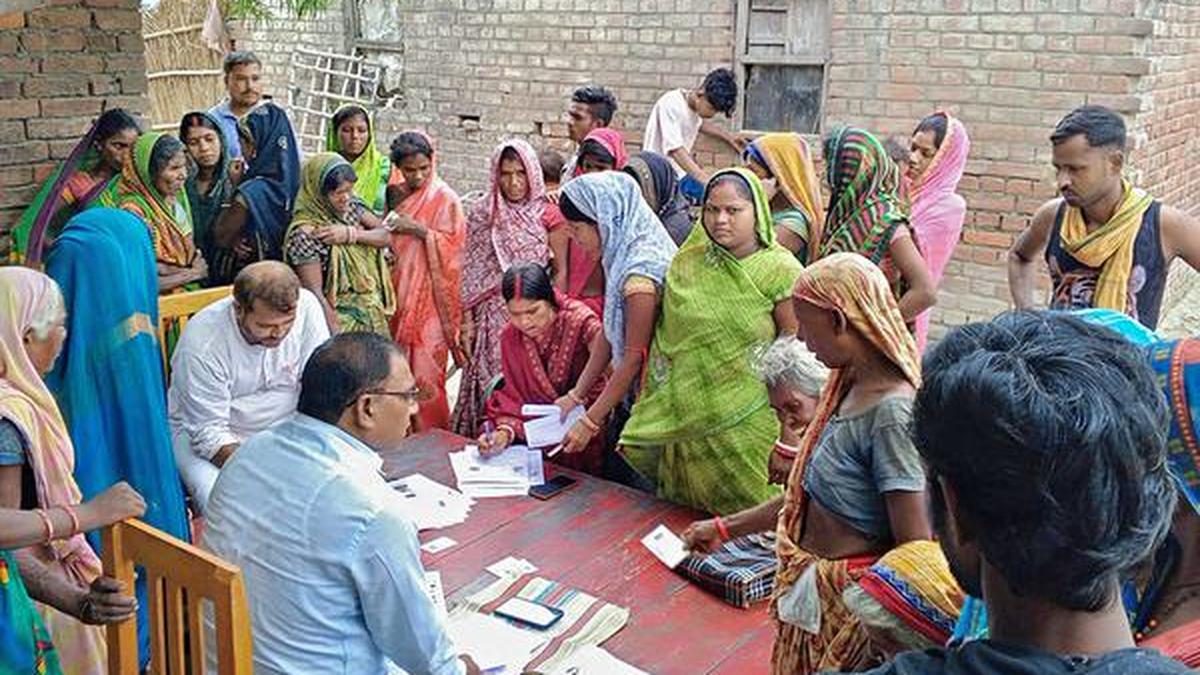

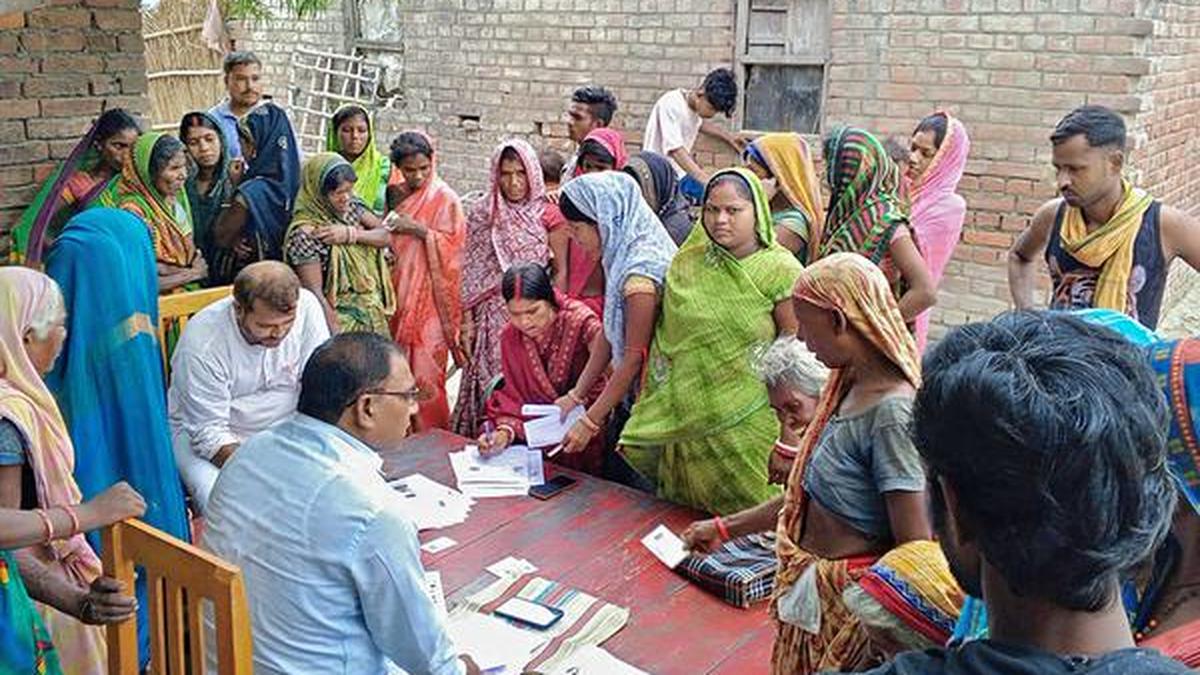
Booth Level Officers verifying voters’ forms during the SIR exercise in Patepur block of Vaishali in Bihar.
| Photo Credit: ANI
The Special Intensive Revision (SIR) of electoral rolls became one of the most contentious issues in Bihar’s 2025 Assembly elections, with accusations and counter-accusations flying between the ruling National Democratic Alliance and the opposition Mahagatbandan. The Bharatiya Janata Party and its allies welcomed the process as necessary to remove “infiltrators” from voter lists, while the Congress and Rashtriya Janata Dal decried it as systematic disenfranchisement—part of what they termed “vote chori,” or vote theft, alleging collusion between the Election Commission of India and the ruling BJP to manipulate electoral rolls in the latter’s favour.
The controversy wasn’t confined to campaign rhetoric. The SIR process required multiple Supreme Court interventions, including orders to publish reasons for the deletion of names from the draft electoral roll and permission for electors to use Aadhaar as the 12th identity document for enrolment. The scale of the revision was unprecedented: approximately 68 lakh electors were deleted from Bihar’s electoral rolls, while 24 lakh were added, resulting in a net deletion of around 44 lakh voters between January 2025 and October 2025.
Given this backdrop, a critical question emerges: did the SIR process actually influence the election outcome? A data-driven analysis comparing changes in vote share patterns with the extent of electoral roll deletions across assembly constituencies suggests that it did not play a determining role in the NDA’s victory.
The electoral outcome itself showed remarkable continuity with the 2024 Lok Sabha elections. The NDA secured close to 46.6% of the vote share in the Assembly polls, a marginal drop of around 1.4 percentage points from the parliamentary elections held in May 2024. The Mahagatbandan’s vote share declined more sharply, falling by approximately 2.2 percentage points from 39.2% to 37%. While these shifts favoured the NDA, the pattern suggests the alliance retained rather than expanded its existing advantage over the opposition.
To examine whether the SIR process contributed to these patterns, we analysed two key variables across Bihar’s assembly constituencies: the change in the vote share difference between the NDA and MGB from the 2024 Lok Sabha elections to the 2025 Assembly elections, and the decrease in electorate numbers following the SIR as a percentage of the original electoral roll.
The below map illustrates the changes in vote share difference between the two elections at the assembly constituency level. Darker red shading indicates constituencies where the NDA increased its advantage over the MGB, while darker blue shading shows the opposite.

The below map depicts the decrease in the electorate across constituencies, with darker red indicating larger percentage reductions in voter numbers following the SIR process.

The below chart plots these two variables against each other for every assembly constituency in Bihar. If the SIR process had systematically benefited the NDA by removing opposition voters, we would expect to see a clear pattern: constituencies with higher deletions showing greater increases in NDA’s vote share advantage. The scatter plot, however, tells a different story.

The correlation coefficient between these variables is 0.192, indicating an extremely weak positive relationship. To understand what this means, consider that correlation coefficients range from -1, representing a perfect negative correlation, to +1, representing a perfect positive correlation, with 0 indicating no relationship whatsoever. At 0.192, the data reveals virtually no meaningful connection between the extent of electoral roll deletions in a constituency and the change in the NDA’s advantage over the MGB.
This is further confirmed by the R² value of 0.037 visible in the chart’s trendline, which indicates that only 3.7% of the variation in the NDA’s electoral performance can be explained by changes in the electoral roll. In practical terms, assembly constituencies that experienced large-scale deletions were no more likely to see an increase in the NDA’s vote share advantage than constituencies with minimal deletions. Similarly, constituencies with smaller reductions in the electorate showed no distinct pattern in voting behaviour compared to those with larger reductions.
The scatter plot itself is revealing. Points are dispersed widely across both axes with no clear upward or downward trend. The near-flat trendline and the clustering of points across the entire spectrum suggest that the SIR’s impact, if any, was not a determining factor in electoral outcomes. Had the revision systematically disenfranchised opposition voters to the NDA’s benefit, the data would show constituencies with higher deletion rates trending toward greater NDA advantage—a pattern conspicuously absent from the analysis.
The conclusion is straightforward: there was no major increase in NDA vote shares relative to the decrease in the electorate across Bihar. The NDA’s advantages from the 2024 Lok Sabha elections remained largely intact, and the coalition’s victory appears to have been based on the same factors that gave it an edge in the parliamentary polls rather than being a product of the SIR process.
This is not to diminish the concerns about the SIR process. After all, data revealed that there was a disproportionate decrease in the number of women in the electorate following the SIR, leading to the gender ratio dropping from 907 in the January rolls to a meagre 892 in the final rolls released in September. And yet women turned out in much larger numbers compared to men (four lakh more despite being forty lakh fewer in the rolls).
However, the data also suggests that the SIR, despite being a major political flashpoint and campaign issue besides being a flawed administrative step, did not alone determine the outcome of Bihar’s 2025 Assembly elections.

Published – November 21, 2025 04:22 pm IST