




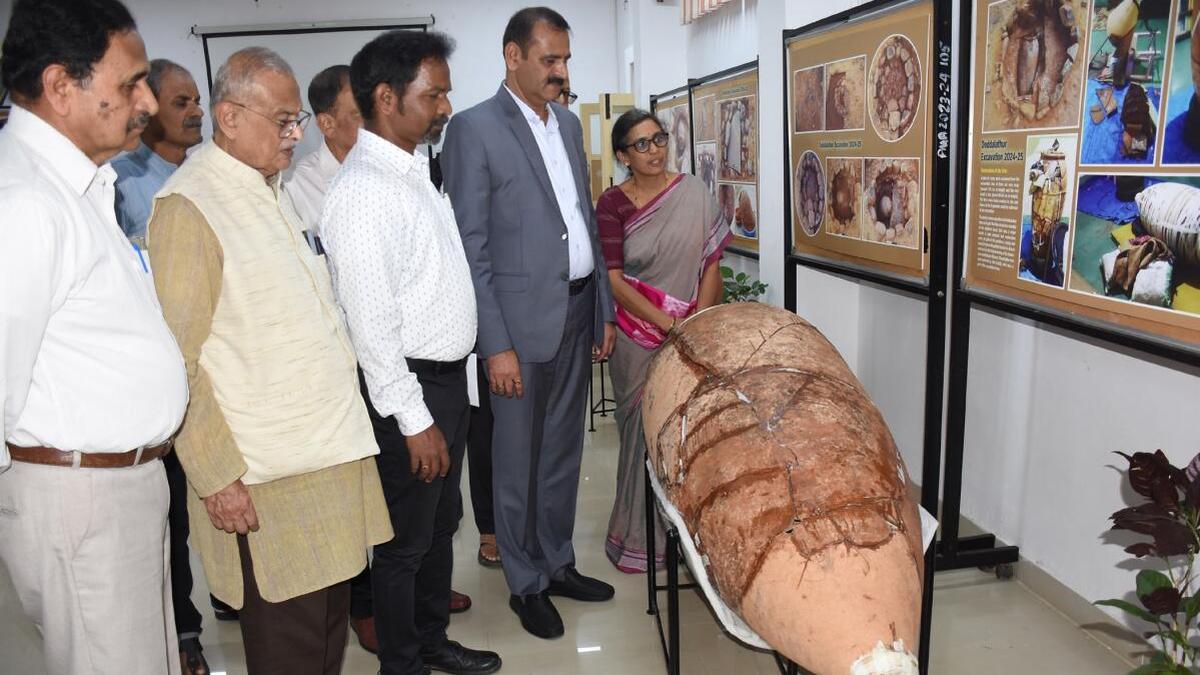

Dr. N.K. Lokanath, V. Nagaraj and others at a heritage exhibition of Doddalathur artefacts, in Mysuru on November 24, 2025.
| Photo Credit: SRIRAM MA
Recent excavations at Doddalathur in Chamarajanagar district have revealed new insights into early megalithic burial culture and traditions in southern Karnataka, including unusual layouts and rare engravings on boulders.
Doddalathur, located in Hanur taluk and 5 km southwest of Kowdalli, is one of the few surviving megalithic landscapes in the region where a large number of burials remain intact.
Although over 40 sites in the belt were first recorded in the 1960s by archaeologist C. Krishnamurthi, the present excavation marks are one of the few systematic investigations of such sites undertaken in Karnataka in recent decades.
Latest excavation
The field work and excavations were carried out from October 2024 to February 2025, led by Dr. V. Shobha of the Department of Studies in Ancient History and Archaeology, University of Mysore, in collaboration with the Mythic Society, Bengaluru, which is funding the project.
According to Dr. Shobha, the excavation exercise – which was co-directed by C.B. Patil, retired officer of ASI – led to the opening of 13 burials, comprising stone circles and cairn circles, constructed with natural boulders of varying diameters. Four contained cists, or stone-slab chambers, while the rest were urn burials.
“In the megalithic burials, the usual burial repertoire includes pottery known as black-and-red ware, black ware and red ware, and iron objects. ‘’These were also found in some of the burials that were excavated at Doddalathur, in addition to skeletal and animal remains and a few beads,” she added.
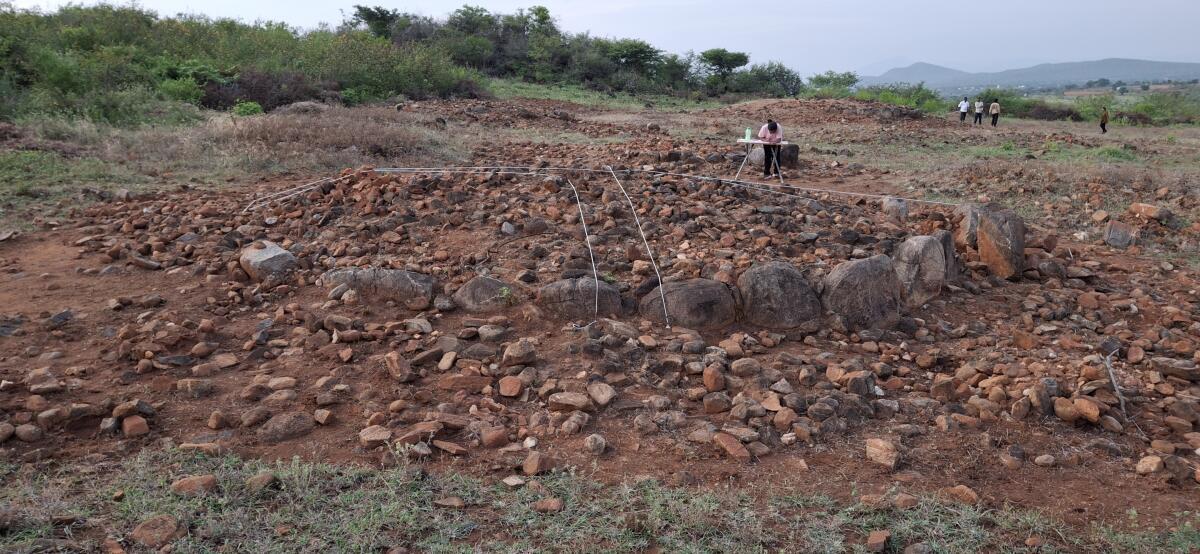
The megalithic burial site near Hanur in Chamarajanagar district that was excavated.
| Photo Credit:
Special arrangement
Iron object
These findings formed the core of an exhibition inaugurated on Monday (November 24, 2025) at the University of Mysore as part of World Heritage Week 2025. The most interesting discovery, according to researchers, is that of an iron object, which is circular in shape with two loops on either sides and resembles an iron shield. This was found in association with iron weapons like axe, arrow and a two-pronged sword while the same burial has human figures engraved on the boulders. Underlining its importance, Dr. Shobha said this is significant because rock art is rare in this part of Karnataka
Charcoal samples from both urn and cist contexts were dated through AMS Carbon-14 analysis, placing the burials between the 6th century BCE and the 4th century CE, a timeframe consistent with megalithic occupation phases elsewhere in peninsular India, she added.
Filling a gap
Scholars at the event noted that despite Karnataka’s long archaeological record, large-scale, university-led excavations of megalithic sites remain rare due to funding constraints. The Doddalathur project, they said, not only fills a longstanding gap in regional Iron Age studies but also underscores the need for sustained institutional support for excavations and heritage research.
The exbibition will be open to public till November 28.
Published – November 24, 2025 05:17 pm IST