


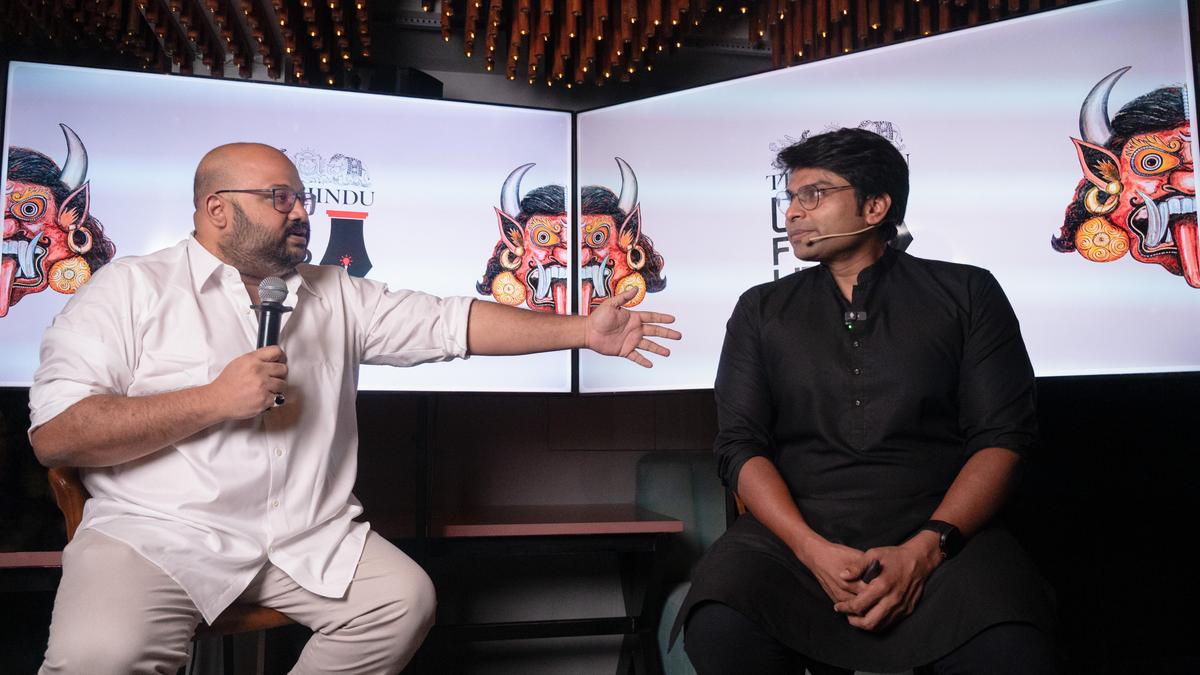

Ashvin E. Rajagopalan, director, Ashvita’s and Piramal Foundation, and photographer Amar Ramesh in conversation at The Hindu Lit for Life Unplugged on Friday.
| Photo Credit: Thamodharan B.
Take a journey across Tamil Nadu and it is hard to miss the iconography of drishti everywhere around — ranging in size and finding a place of prominence on the walls of homes, factories, rice mills, and shops.
Distinct symbols
For photographer Amar Ramesh as well, spotting these distinct drishti symbols of moustachioed men — eyes wide and their tongues hanging out — was hard to miss, and served as inspiration for his book Kolli Kannu: Drishti Paintings of Tamil Nadu.
The book and the evolution of the drishti iconography took the spotlight in the conversation between Mr. Ramesh and Ashvin E. Rajagopalan, director, Ashvita’s and Piramal Foundation, on Friday evening at Madco (a speakeasy bar in Chennai) for The Hindu Lit For Life Unplugged.
The event, modelled after New York City’s Lectures on Tap movement, saw the discussion unfold before a packed audience, who participated when the floor was thrown open for questions.
“Over the last 15 years, I kept shooting pictures of these drishti symbols, not with the intention of having it be a part of a book, but simply because it was interesting. It was much later, when I saw the collection of images I had shot over the years, that I decided to work on putting it all together,” Mr. Ramesh said.
‘Universal concept’
He said working on the book helped him meet artists who worked on such paintings, and understand how it was an important part of their livelihood. “The concept of dristi itself is very universal and takes different forms across cultures — like the blue evil eye in Turkey and masks in Mexico. In Tamil Nadu, it is fascinating to see it take the form of paintings,” he added.
Tracing the history behind the kirtimukhas or the drishti symbols, Mr. Rajagopalan spoke about how, in the 1890s, enamel paints reached Tamil Nadu, and its vibrant pigments met terracotta artists and potters who began to paint the iconography, which evolved into what we see today.
Responding to a question on what he hoped readers would take away from his documentation of drishti, Mr. Ramesh said he hoped that it would sparks conversations and inspire others.
The Hindu Lit For Life Unplugged is done in association with Christ University, associate partner Akshayakalpa, and bookstore partner Crossword.
In the run up to The Hindu Lit For Life on January 17 and 18, 2026, watch out for more events as a part of Lit for Life Unplugged. Follow @hindulitforlife on Instagram for more updates.
Published – November 29, 2025 12:31 am IST