



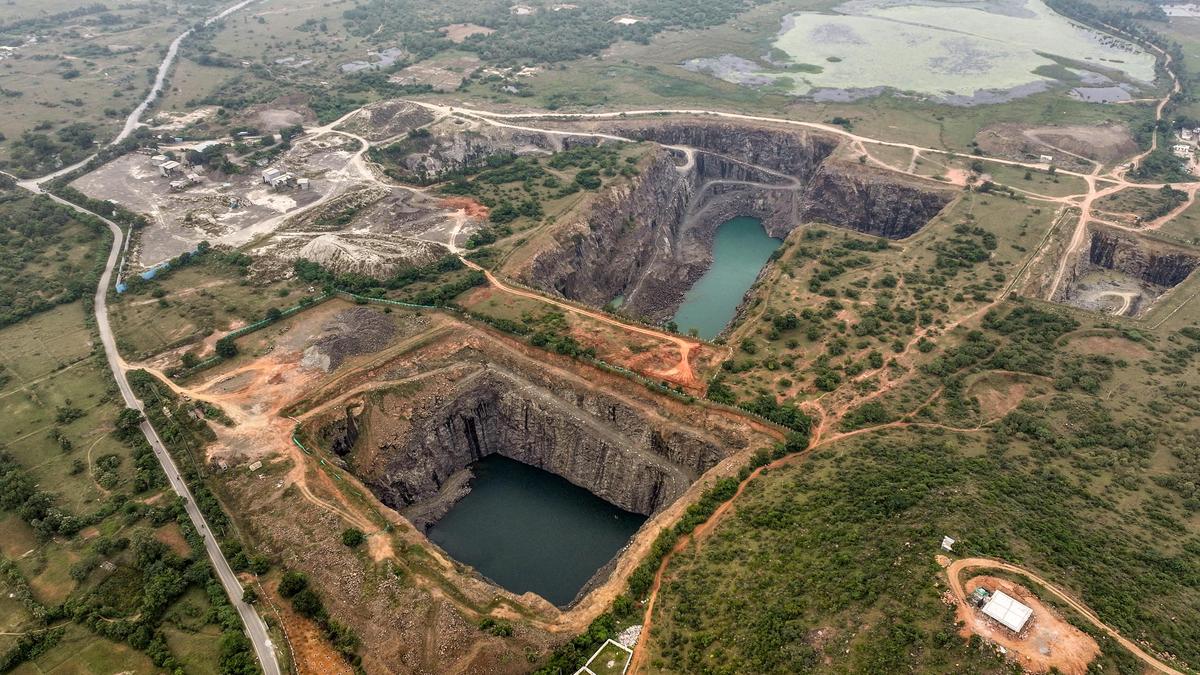

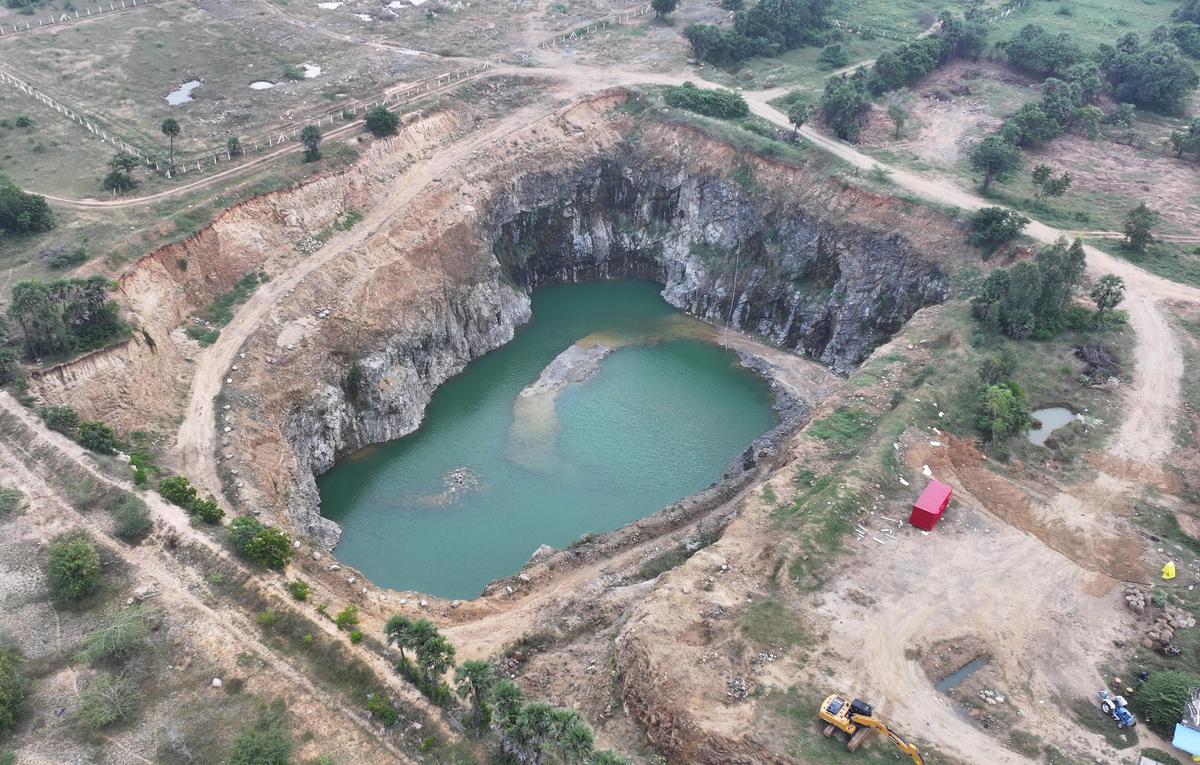
If one were to have a bird’s eye view of Uthiramerur taluk in Kancheepuram district, it would possibly be a canvas of grey with small patches of green. However, it was not like this in the not-so-distant past. A vast portion of the land known for its kuda olai system of election and bewitching temple architecture is “greying”, thanks to a large number of granite quarries and crushing units. Almost every tree and plant, roads, mud on the roadsides, and crops in the fields have turned grey in and around villages including Siruthamur, Pazhaveri, Arungundram, Pazhaya Seevaram, Alanjeri, and Thirumukkudal, thanks to quarrying and stone crushing units that make M-sand. On a cloudy, still afternoon in November, the roads around these units feel eerie, and the trees seem frozen as if petrified.
Estimates show that close to 60 villages in this region are affected by quarrying, and there are around 80 quarries. According to a mapper, data from the National Remote Sensing Centre show that in 2005-06, a total of 4.21sq. km. was under mining in the erstwhile Kancheepuram district. The area increased to 33.13 sq. km. in 2015-16, but this figure includes some sand mining areas too. The district also saw a reduction in land under paddy, with quarrying being a major cause.
Farmers at Alanjeri said a proposed quarry (Kori as they call it) that they were protesting against had fenced off land where a channel bringing water from a hillock runs through. “The channel, constructed by the Rural Development Department, used to carry water to our irrigation tank wherein two wells that meet our drinking water needs are situated. The water gets contaminated by quarry dust and if the water does not fill up the Alanjeri tank, a chain of 10 other tanks won’t get water. We used to grow three crops of paddy a year. Now, we struggle to grow one crop,” said V. Balakrishnan, a farmer.
The village only has Dalit farmers and they claim the first quarry in their village is located on Panchami land unknowingly sold in bits and pieces to others. “We have been petitioning the Collector for several years to stop the operation of the quarry and not allow a second one to come up. The new one lies on the route of the annual procession of our village deities Theni Amman and Palani Amman. They won’t allow us to take a detour even,” said Vijayakumar, another farmer.
Farmers lead the battle
C. Devaraj of Arungundram said his father Chinnapaiyan was the first to die in an accident caused by the heavy vehicles carrying stones from a quarry. “He was one of the first to protest against the quarry operations in the area. It was in November 2003.” In one village, the panchayat president refused to pass a resolution against the quarries since he himself owned one. “The quarries are so close to each other in some cases that we have no space for our animals to graze,” he added.
Last year, farmer leaders from several villages joined to stage a hunger strike seeking relief to Rajendran, a farmer whose land could not be cultivated, with the well drying up because of quarry operations. “We were denied police permission even to use chairs for the protest,” said Harikrishnan of Pazhaveri. Mr. Rajendran said it was 12 years since his well dried up. “I have been holding up against the quarry operators and managing with the income from milch animals. If I approach elected representatives, they tell me to sell off the land handed down by my forefathers. I don’t want a car or air-conditioner; I want to grow crops on my land and pass it onto my son to grow food for the people,” he said.
Farmer leader Manavalan said public hearings for new quarries are not held in the village or nearby, but in places where quarry owners muster enough supporters to out-number those opposing them. “Last year, a public hearing for a quarry witnessed very angry exchanges between farmers and an IAS officer. We told him to travel with us by bike without a helmet to feel the kind of dust we inhale from the trucks carrying the stone without cover. People are getting asthma and wheezing. The quarries do not follow basic rules like sprinkling water regularly to prevent the dust from flying,” Mr. Harikrishnan added.
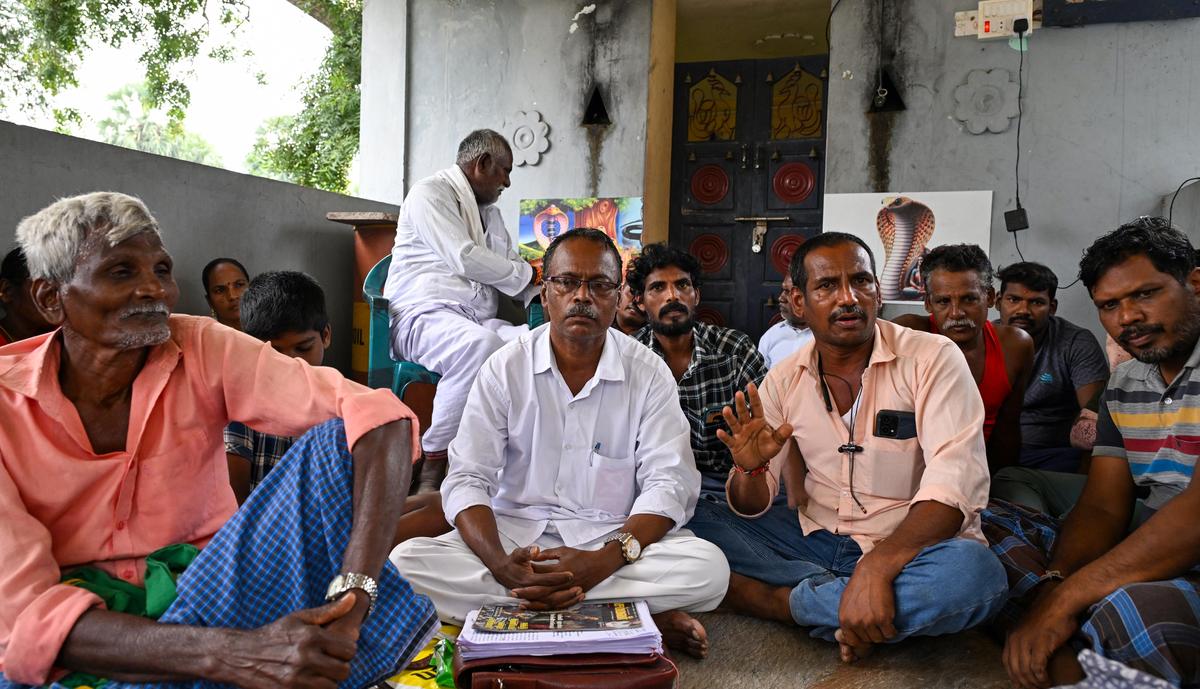
Up in arms: Farmers at Alanjeri say a proposed quarry that they are protesting against has fenced off land where a channel bringing water to the irrigation tank runs through. They used to grow three crops of paddy a year, but struggle to grow even one now.
| Photo Credit:
B. JOTHI RAMALINGAM
Accidents a daily occurrence
The village roads running around the taluk are like a dirt patch for the mighty trucks that carry blue metal and stones. “Since the vehicles are always overloaded, they cannot stop as soon as they should. We shudder to send children to school as accidents keep happening. We are waging a continuous battle with the trucks. Two bridges across Palar River, connecting Pazhaya Seevaram and Thirumukkoodal and and Avalur and Walajahbad, have a continuous flow of vehicles on all days, except on Sundays,” said Premkumar of the BJP, which has been holding protests in the area, calling for restriction in the timing for the trucks to ply. Farmers have been demanding that the timing of the trucks be regulated so that students can travel safely.
Quarries and stone-crushing units are a major source of fugitive dust, a significant environmental concern that arises at nearly every stage of the operation. Dust is emitted during unloading of raw materials, crushing, screening, conveying, and storing of finished products. As stones are broken, shaken on vibrating screens, transported along conveyor belts, and stored in open stockpiles, fine particles — particularly stone dust — become airborne. A 2023 study in the International Journal of Health Sciences and Research found that prolonged exposure to silica dust significantly impairs lung function among stone quarry workers in South India. The researchers observed that lung impairment was the highest among loaders, followed by stone grinders, drillers, blasters, and stone cutters.
The problem is particularly acute with fine materials, like stone dust, which are easily carried by the wind and can linger in the air for long. Dust from stone quarries not only affects the workers on site but also people living nearby. Poornima Prabhakaran, Director, Centre for Health Analytics Research and Trends at Ashoka University, said that though the dust particles released from quarries are relatively large, they are hazardous to human health. Prolonged exposure to high dust levels can lead to respiratory problems, silicosis, and skin or eye irritation, she added.
The Central Pollution Control Board (CPCB) has outlined stringent guidelines for stone-crushing units. They include the requirement for full enclosure around crushers and screens to contain dust at the source. Additionally, units must install fine-mist water sprinklers to dampen dust particles, along with bag filters and dry dust-extraction systems to capture airborne dust. Conveyor belts are to be fully covered to prevent dust from escaping, and discharge points must be fitted with telescopic chutes to control dust release when materials are transferred. Stockpiles of crushed material should either be kept wet or covered to reduce dust dispersion, ensuring that emissions are minimised and air quality is preserved within and around the crusher zones.
S.M. Shiv Nagendra, a professor in the Department of Civil Engineering at the Indian Institute of Technology Madras, and an expert in air quality monitoring, said the carrying capacity of areas near quarries should be assessed. He noted that quarrying close to residential areas contributes significantly to pollution.
The CPCB guidelines also mandate that internal roads be paved to prevent dust resuspension; wind-breaking walls and foggers be installed; and accumulated dust cleaned regularly. Units must also recycle water used for suppression and conduct ambient air monitoring to ensure the control of particulate emissions. While industries are required to implement continuous real-time air quality monitoring, quarries are not bound by the same regulation. However, even with these monitoring systems in place, they may not fully capture the extent of the pollution. Mr. Nagendra pointed out that current air quality monitoring stations measure pollution only in a one-kilometre radius, leaving out the full extent of pollution affecting surrounding areas.
In July 2025, the National Green Tribunal (NGT) directed the Tamil Nadu Pollution Control Board (TNPCB) to enforce stricter standards for granting or renewing Consent to Operate (CTO) for quarrying and mining units in the State, after several units came under the scanner for violations. It ruled that quarrying activities should not continue unless penalties for past environmental violations were fully paid. These violations included failure to maintain safety distances, inadequate fencing and greenbelt development, insufficient dust control measures, and exceeding the approved extraction limits.
The NGT instructed the TNPCB to require water sprinkling, greenbelt development, black-topped roads, and equipment enclosures before granting CTO. It also recommended that greenbelt development begin at the application stage to ensure saplings are ready when operations start.
G. Sundarrajan of Poovulagin Nanbargal, an environmental organisation, called for the identification of quarry clusters and a third-party audit of the Cumulative Impact Assessment to evaluate the effect on groundwater and air quality. He also pointed to other States, like Telangana, which use satellite imagery to monitor sand mining and storage in near real-time and suggested that Tamil Nadu adopt a similar approach.
A channel brings water from a hillock to the Alanjeri tank. The water gets contaminated by quarry dust. If the water does not fill up the tank, a chain of 10 other tanks will not get water.
| Photo Credit:
B. JOTHI RAMALINGAM
State lacks law
A senior hydrogeologist, who preferred to remain anonymous, said the lack of a proper law to govern mining and groundwater extraction is the main reason for the current situation. The management of groundwater is governed by a mere government order: MS 142. A draft Tamil Nadu Groundwater (Development and Management) Act has been drawn up, but is yet to be enacted. Mining is a major subject in this Act because mining for coal or sand or rock will affect groundwater extraction. In Neyveli, the groundwater level, which used to be at 6 feet, is now at 35 feet-40 feet with continuous mining, he said. He said there is regulation only at the individual mine level now. Nobody is seeing the larger picture, and this is leading to environmental damage.
An ecologist said that when people keep scooping stuff out of the quarries, the surrounding groundwater level will go down. In the long run, the nature of the soil will change owing to water loss. This will lead to gradual desertification, the kinds of plants able to grow on such a soil will change, and farmers will have to change their crops. Food crops will vanish. One day, the soil, instead of becoming grey, will go “bald” and will not be able to grow anything.
No alternative to M-sand
A former government official who had worked in Kancheepuram said the district administration was seized of the matter and there were times when up to 30 quarries had been shut down. “The quarry owners have been warned to keep the truck tops closed with tarpaulin and instructed to carry only the permitted load. The TNPCB is the one that has the larger role in controlling the quarries,” he said. However, without the quarries, construction activities and road laying in and around the city would come to a standstill. “Give us an alternative material to M-sand, gravel, and blue metal. As river sand cannot be mined, the administration has no other option but to allow rock mining,” he pointed out.
The District Environmental Engineer of Kancheepuram acknowledged the complaints and representations about the pollution from stone quarries. “We have received representations forwarded from the Collectorate. They have sought a report, and we are starting work on it,” he said.