


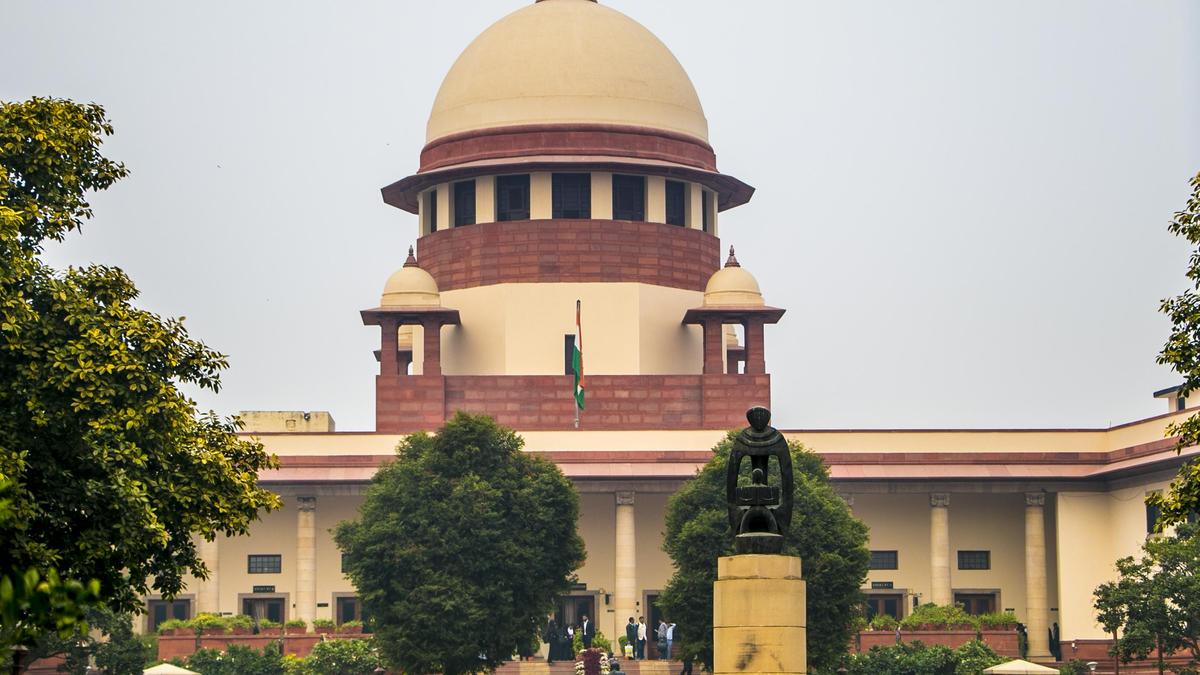

Image for the purpose of representation only.
| Photo Credit: Subhashish Panigrahi
The Election Commission of India has dismissed arguments raised in the Special Intensive Revision (SIR) case by Opposition parties that only the Union government has exclusive authority to scrutinise citizenship, saying the Centre’s power is “limited” to inquiring into the circumstances in which Indian citizens voluntarily acquired foreign citizenship.
The Commission referred to Section 9 of the Citizenship Act, 1955, which deals with the termination of citizenship in cases of voluntary acquisition of foreign citizenship. Section 9 vests in the Centre the authority to determine “when or how” an Indian citizen acquired foreign citizenship.
“The powers of the Central government are confined to reviewing the acquisition of foreign citizenship, and whether based on such acquisition, the Indian citizenship of a person should be terminated… It is only for this limited purpose that the exclusive jurisdiction has been vested in the Centre, to the exclusion of all other authorities. Every other aspect related to citizenship can be inquired into by other authorities,” the Election Commission argued in a 184-page affidavit.
Opposition parties in Tamil Nadu, Kerala and West Bengal have described SIR as citizenship screening. Parties including the Dravida Munnetra Kazhagam have alleged that the EC is misusing the revision of electoral rolls to conduct a “de novo National Register of Citizens”.
The EC asserted its authority to “assess citizenship” for the purpose of registration in electoral rolls. Indian citizenship is one of the constitutional preconditions under Article 326 for entry into the voter list.
“Even if we assume, without conceding, it is only the Centre which can appraise citizenship, it is imperative to note that proof of citizenship sought from existing electors under the SIR exercise is for a limited purpose, that is, registration in the electoral rolls which enable the right to vote,” the Commission submitted.
It emphasised that the SIR exercise was not meant to determine the status of citizenship.
The EC reiterated that its power to scrutinise citizenship flowed directly from Article 324, which empowers it to supervise and control the conduct of elections, and Article 326. No parliamentary law could oust the EC’s jurisdiction, it said, noting that even the authority of Parliament to make laws on elections under Article 327 must align with the Commission’s plenary powers.
The Representation of the People Act (ROPA), 1950, through Sections 16 and 19, requires that voters must be Indian citizens. Section 16 disqualifies non-citizens from being included in the electoral roll, and electors must be “ordinarily resident” in a constituency to be registered.
An SIR, conducted under Section 21(3) of ROPA, has to be “intense” and is triggered by “felt necessities”, the EC said.
“The guidelines issued with respect to the SIR are constitutional and in the interest of maintaining the purity of the electoral rolls, which is a pre-requisite for free and fair elections that forms a Basic Feature of the Constitution,” it argued.
The EC denied the Opposition’s claim that SIR was unconstitutional because it shifted the burden of verification onto electors, who must fill up enumeration forms (EFs) to avoid exclusion from the electoral rolls.
The Commission said SIR was a “voter-friendly” and “cooperative exercise”. Electors were required only to sign their pre-filled EFs delivered at their homes by Booth Level Officers.
“This is a minimal requirement expected from electors who are unable to trace their eligibility to the previous SIR 2002,” the EC said.
Enrolment in the voter list was not the “end of the matter”, it added. Voters must be able to reach polling stations and cast their votes. Dead or permanently shifted electors cannot do so and should be removed from the rolls, the same as non-citizens, it said.
Published – November 30, 2025 09:37 pm IST