




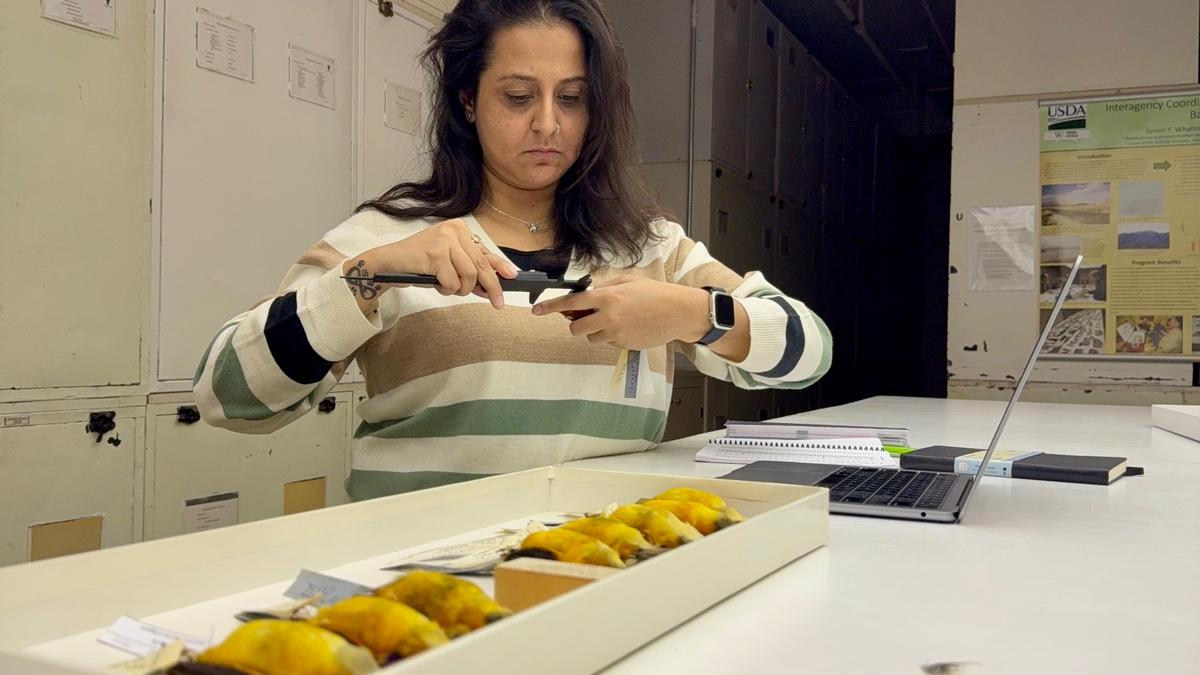

It started with a few feathers of an Indian silverbill that Esha Munshi had saved from one of her cats during the pandemic, back in 2020. Esha, an architect by training and the founder of the Feather Library, which has just added an extremely rare Sooty Shearwater —the only Indian specimen of this migratory seabird —to its collection, says, “I rescued the bird, but, in fright, it lost a few feathers.” She remembers looking down at the feathers she held in her hands, “smaller than my finger…so tiny and delicate,” and realised that she wanted to know more about them. “I just got curious and wanted to see the flight feathers of all birds,” says the self-confessed ‘bird nerd’, who has been obsessed with birds since she spotted a black-crowned night heron outside the window of her office in 2013.
She searched for more information about feathers but couldn’t find it. So, she set the thought aside and returned to her regular life in Ahmedabad, practising architecture and pursuing the Cornell Lab’s ‘Ornithology: Comprehensive Bird Biology’ course, an online certification course focusing on avian biology. She also began working on a project with Cornell, annotating bird sounds to train the AI tool for the Merlin App. “I am a bird sound recordist…was always interested in recording the sound of the bird, and during COVID got this project,” explains Esha, who travels frequently to birdwatch and has spotted more than 1000 of the 1300-odd species of birds in India.
Then, on a trip to the Rann of Kutch the next year, the idea came back to her. She recalls telling the friends who had accompanied her that she wanted to create a collection of feathers. “I remember the date, September 9. In the morning, I discussed this, and that evening, I found a roadkill of a hoopoe. So, I took it as a sign,” says Esha, who approached the Principal Chief Conservator of Forests soon after to get permission to collect bird feathers.
Since private individuals are not permitted to collect or possess taxidermy bird trophies or even feathers, she was asked to establish a private trust and got permission to document and digitise the flight feathers of birds that had died naturally.
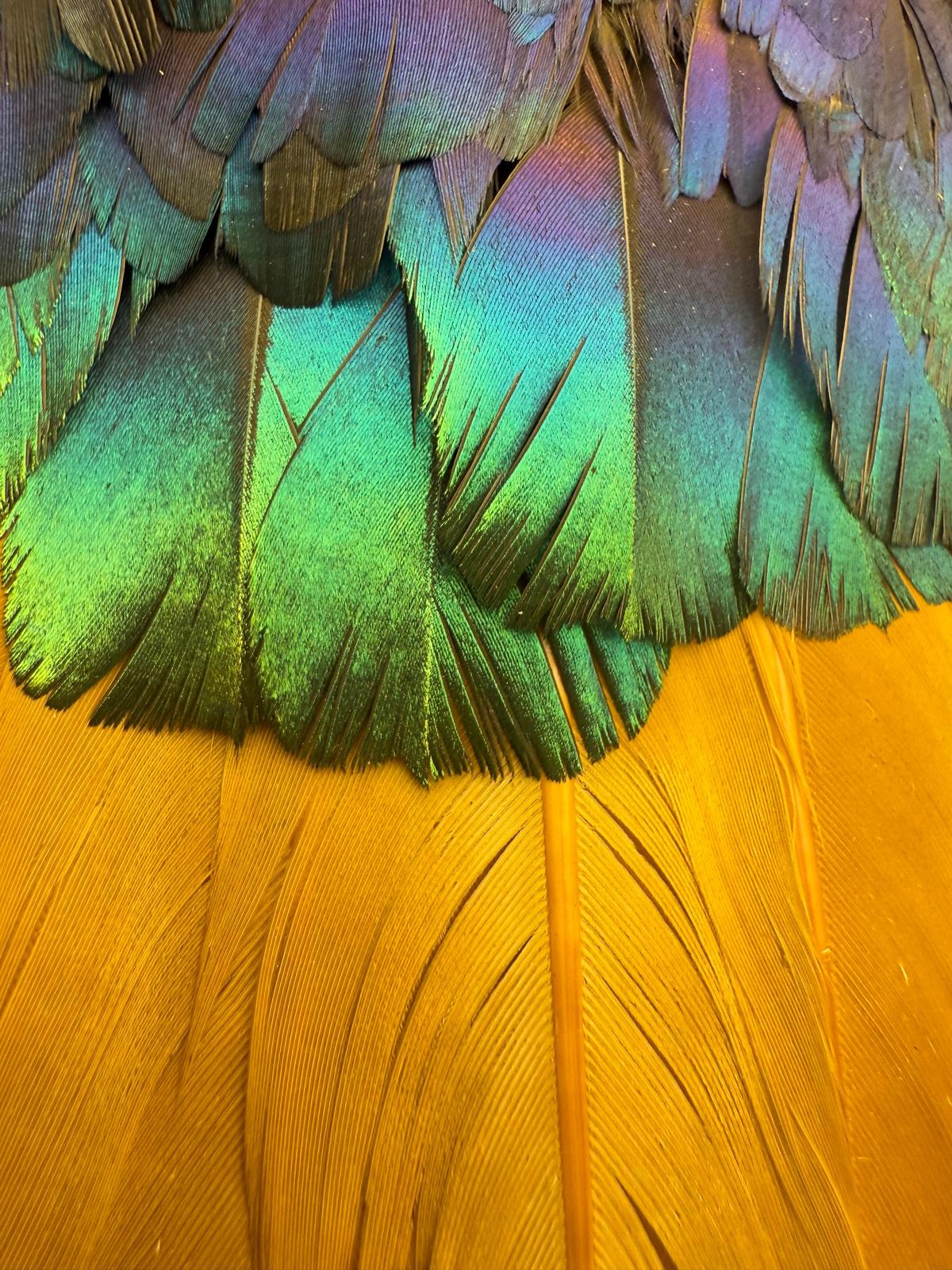
The Feather Library documents the flight feathers of Indian birds
| Photo Credit:
Special Arrangement
In November 2021, less than two months later, the Feather Library, a unique initiative dedicated to documenting, identifying, and studying the flight feathers of Indian birds, was born. “I published the website at midnight on November 15, which is also my birthday,” says Esha, now an Honorary Curator of Birds at the National Centre for Biological Sciences (NCBS-TIFR), Bengaluru, where the physical collection of the Feather Library is currently housed.
“I created a website with five specimens, a prototype,” she says, adding that her co-founder was Sherwin Everett, who used to work at an animal rescue centre called Jivdaya in Ahmedabad. “We would collect the birds that did not survive at Jivdaya and document their flight feathers.”
Two months after the launch, she formally quit architecture and poured her heart and soul into this initiative, deepening her expertise by studying further at the Cornell Lab of Ornithology. “I already had friends there because of my annotation project. I told them that I had released something like this in India, and wanted to come and learn taxidermy and how to make museum specimens,” says Esha.
On her return from Cornell, she had a meeting with ecologists Uma Ramakrishnan and Vivek Ramachandran at NCBS and decided to collaborate with the institute. “I shifted the whole collection here in August 2022,” says Esha, who had collected around 50-60 specimens back then.
Not only is the Feather Library the only one of its kind in India, but it is also a unique initiative globally, with only Germany’s Featherbase and the United States’ The Feather Atlas undertaking a similar endeavour, says Esha, who underwent training in feather microstructure at the National Museum of Natural History, Smithsonian Institution, Washington, D.C, earlier this year.
Today, it has grown to encompass feathers of nearly 160 species of birds and approximately 400 specimens housed in the temperature-controlled research collections facility at NCBS. Esha shows me around, opening drawer after drawer filled with wings, feathers and preserved whole birds, adding that she now has permission in Karnataka and Gujarat to collect deceased animals for stuffing, not just their feathers.
I listen to her reel off names, “barn owl, spotted owlet, Indian pitta, golden oriole, coppersmith barbet, house crow, the Asian koel” until we finally reach the pièce de résistance: the Sooty Shearwater, which she received in August this year after it died of natural causes at a rescue centre in Porbandar, Gujarat.
“It was a jackpot, actually,” she believes. “There is only one other previous record of a Sooty Shearwater in India…a photographic record taken off the coast of Mangaluru in Karnataka.”
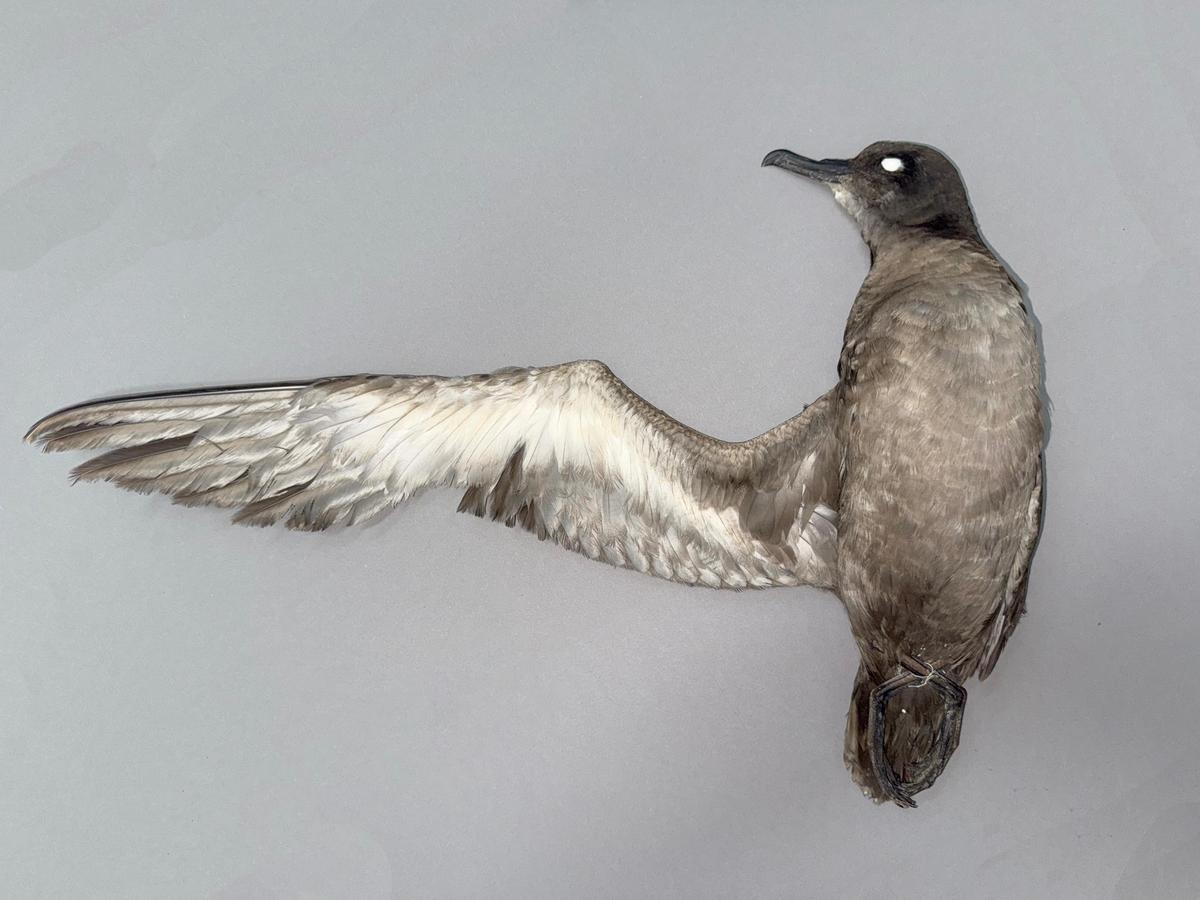
The rare Sooty Shearwater
| Photo Credit:
Special Arrangement
Preserving these birds is a lengthy and meticulous process that requires considerable patience and precision. “When I find a bird, it is frozen for two days to take care of basic biosafety, if there are any bacteria or viruses,” says Esha.
After filling a form recording specific details about the bird, including species and specimen number, where and when the bird was found, and the cause of its death, Esha takes some basic measurements, “like weight, wingspan, length of the bird, head and beak width.”
Then, she performs the taxidermy of the bird, skinning, stuffing, sewing, and drying it before mounting it, with one wing stretched out to exhibit its shape and various feathers. “Before pinning, I remove individual flight feathers, scan and number them and keep them in the correct order. And then, when everything is done, I upload it to the website.”
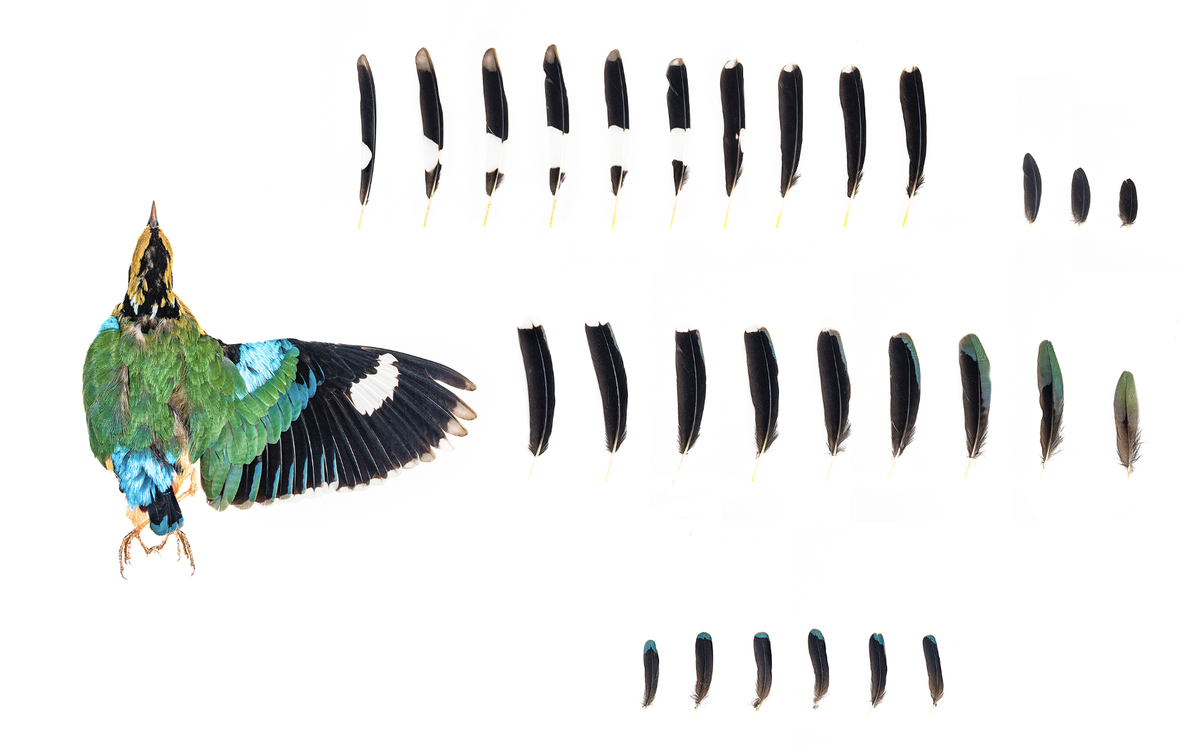
The feathers of an Indian Pitta
| Photo Credit:
Special Arrangement
The feather library serves more than just quenching Esha’s thirst to learn about and collect bird feathers. In her opinion, many fundamental questions about feathers remain unanswered because there are very few researchers working on feathers worldwide.
“That is what makes it very unique and niche,” she says, pointing out that saving these feathers could help answer some of these questions. “The hope is that someday, we can expand across India and at least have one specimen of every Indian bird,” says Esha, who also wants to someday transform the collection into an ornithology museum where specimen-based research can be conducted.
“Having a bird in your hand allows you to figure out so many minor details, which you’ll never be able to do while birdwatching. And there is something new to learn from every bird.”