



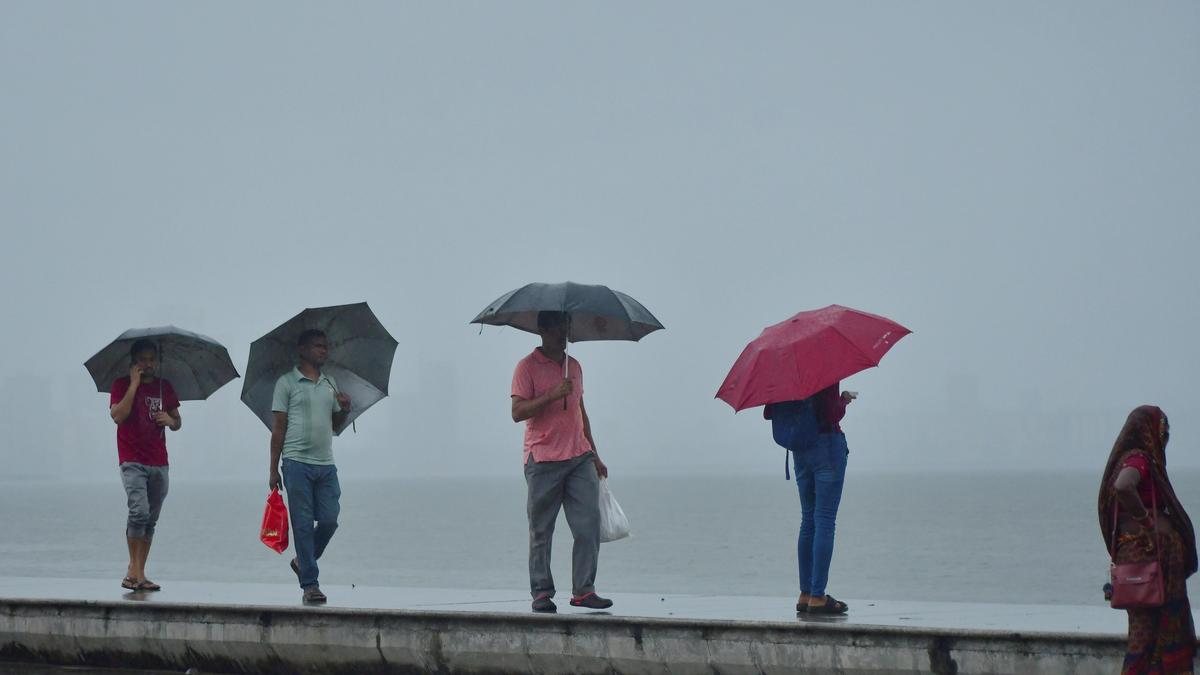

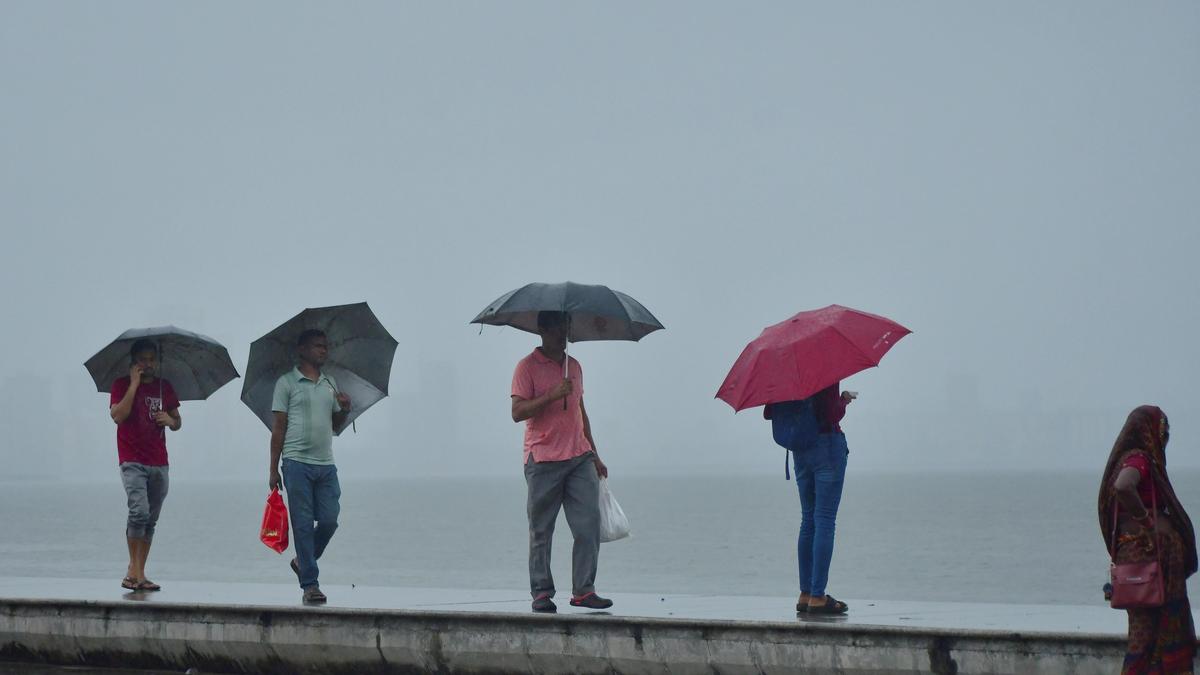
People walk down a sidewalk during rain at Marine Lines, Mumbai. File
| Photo Credit: PTI
Excess rains were responsible for around 8% of Mumbai’ deaths – an average 2,500– in the monsoon season from 2006-2015, a figure “comparable” to deaths from all causes of cancer, says an econometric analysis published in the journal Nature on Wednesday (November 12, 2025).
While it is anecdotally known that flooding and water-logging from excess rains are linked to road accidents, water-borne diseases, electrocution, infrastructural damage that may kill, the study is unique in putting a number to such deaths.
The authors analysed municipal deaths records and correlated it with rainfall data during this period to calculate ‘excess mortality’ from extreme rain – or how many of the deaths, over and above what’s usual in Mumbai city in the monsoon months- could be attributable to heavy rains alone. Days that saw extremely heavy rains (15 cm or more) raised the city’s death rates by 2%.
The monsoon months of June-September frequently register days of extremely heavy rainfall made worse, as scientists say, by human-caused climate change.
The excess mortality burden of rainfall is borne unequally across age, gender and socio-economic groups. For children under the age of five, it amounts to 18% of their overall monsoon season deaths—the highest relative proportion among all age groups. 85% of deaths were reported among those who lived in slums. About 11% of the excess deaths were reported in slum residents as opposed to 2.4% at non-slum addresses.
A day with 150 mm of rainfall causes a 5.3% increase in five-week mortality for those under five, but only a 1.6% increase for the 5–64-years-old age group, and a 2.3% increase for the 65-years-and-older age group. “These results are consistent with the fact that flood-related morbidities such as diarrhoea are known to strongly affect children. However, the much higher baseline mortality for older age groups means that even small proportional increases due to rainfall translate into a large number of excess deaths among older individuals,” say the authors Tom Bearpark (Princeton University, United States); Ashwin Rode (University of Chicago) & Archana Patankar (Green Globe Consulting, Mumbai – an environmental consulting group)
“Bearpark and colleagues powerfully reframe urban rainfall as not just an infrastructure challenge but also a pressing public-health crisis shaped by inequity,” Subimal Ghosh, Professor, Indian Institute of Technology, Mumbai, said in an accompanying opinion article in Nature. “Their study quantifies how sub-daily rainfall, tidal dynamics and socio-economic vulnerability converge to drive excess mortality in an expanding megacity. As climate change deepens these risks, the path forward lies in coupling scientific forecasting with equitable urban planning and targeted adaptation. Mumbai’s experience offers a crucial lesson for the world’s rapidly growing coastal cities: resilience to climate extremes must begin with protecting the people most at risk,” Mr. Ghosh said.
Published – November 13, 2025 12:12 am IST