



If the Encyclopaedia Britannica, the world’s oldest publication of its kind universally recognised for setting standards in quality and authenticity, its French equivalent can claim to set similar benchmarks in the advancement of knowledge and in the sheer scale of the undertaking.
The extraordinary contributions of 19th century French scholar Larousse Pierre (1817-1875) who produced 17 volumes of the “Grand Dictionnaire universel du xix e siècle” (The Great Universal Dictionary of the 19th century), that included two supplements, in addition to his works as lexicographer, are being showcased at an exhibition hosted by the Pudhuvai Museum at its research centre in Colas Nagar.
The encyclopaedic volumes were published in the 1866-1876 period from the “Libraire Larousse” (publishing house/bookstore) he co-founded in 1852 with like-minded school teacher and friend Augustin Boyer.
Incidentally, 2025 marks the 150th death anniversary of the encyclopedist, who was born in France’s Toucy commune where his father worked as a blacksmith.
“We have featured some of the oldest encyclopaedic volumes in our collection,” said Arivan Aruli, founder-director of the Puduvai Museum, a private enterprise that was established on a Ministry of Culture-approved plan for an Indo-French Museum around 2015.
While 13 volumes of the French encyclopaedia were brought out when Larousse was alive, the remaining tomes would be published post-humously.
“It took about 25 years to collect enough resources for the exhibition”, Aruli said.
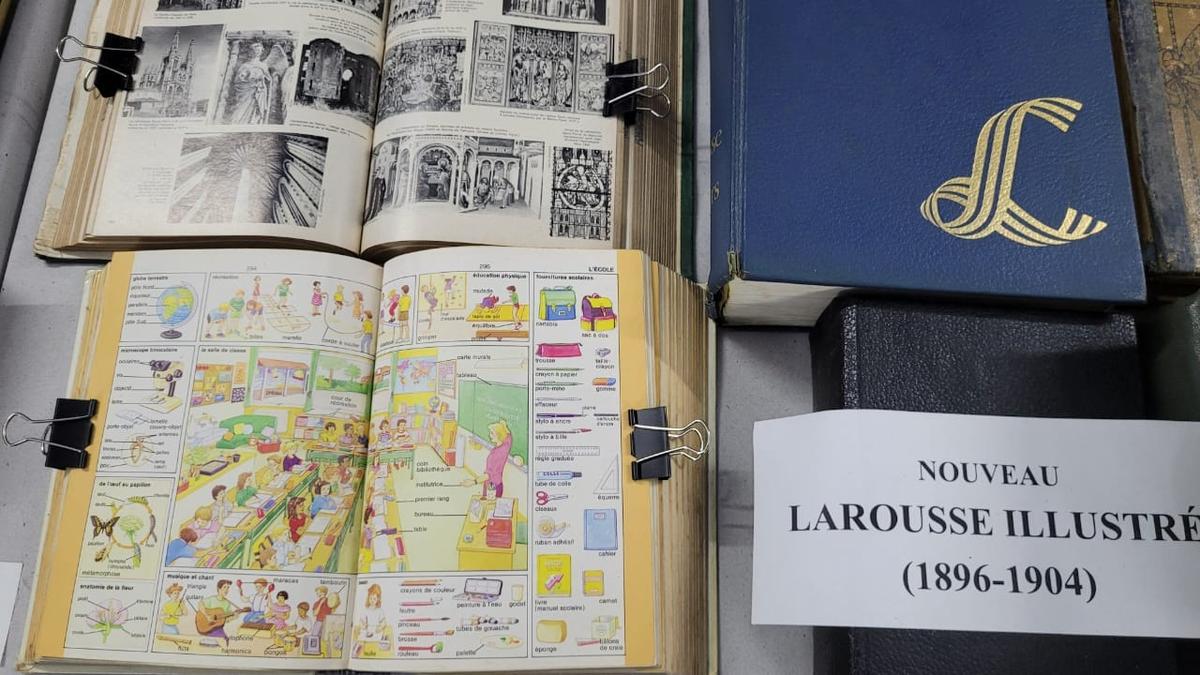
The expo also has a section on the Nouveau Larousse illustré, an illustrated French language encyclopedia brought out by French lexicographer Claude Augé, who was an associate at the bookstore, and proved to be the ideal torchbearer of the Larousse legacy.
These volumes, published by Éditions Larousse between 1897 and 1904, in 7 volumes and a supplement, were highly revered in its time for its depth of coverage of diverse domains of knowledge spanning science, art, history, music and literature. In fact, the volume on cookery, the “The Concise Larousse Gastronomique” (1938), which had a preface by Auguste Escoffier, the “king of chefs”, was immensely popular.
A good part of its catalogue is still found on the menu cards of many a ritzy hotel, says Aruli.
The use of illustrations and maps that add value to the dissemination of information speaks about the collaborative nature of an undertaking of such gargantuan dimensions. This is best exemplified by the section on “champignonn” (an exhaustive account of mushroom varieties) or the “Armes A Feu,” an explainer on the various types of firearms.
The organisers believe that showcasing the contributions of the two personalities, who are revered in French academia but relatively lesser known here, could be an eye-opener for both the Francophone community and the general public in a city that shares deep historical, linguistic and cultural ties with France.
The exhibition began on the birth anniversary of Larousse (October 23) and will conclude on the birth anniversary of Claude (October 31).
Published – October 29, 2025 08:32 pm IST