



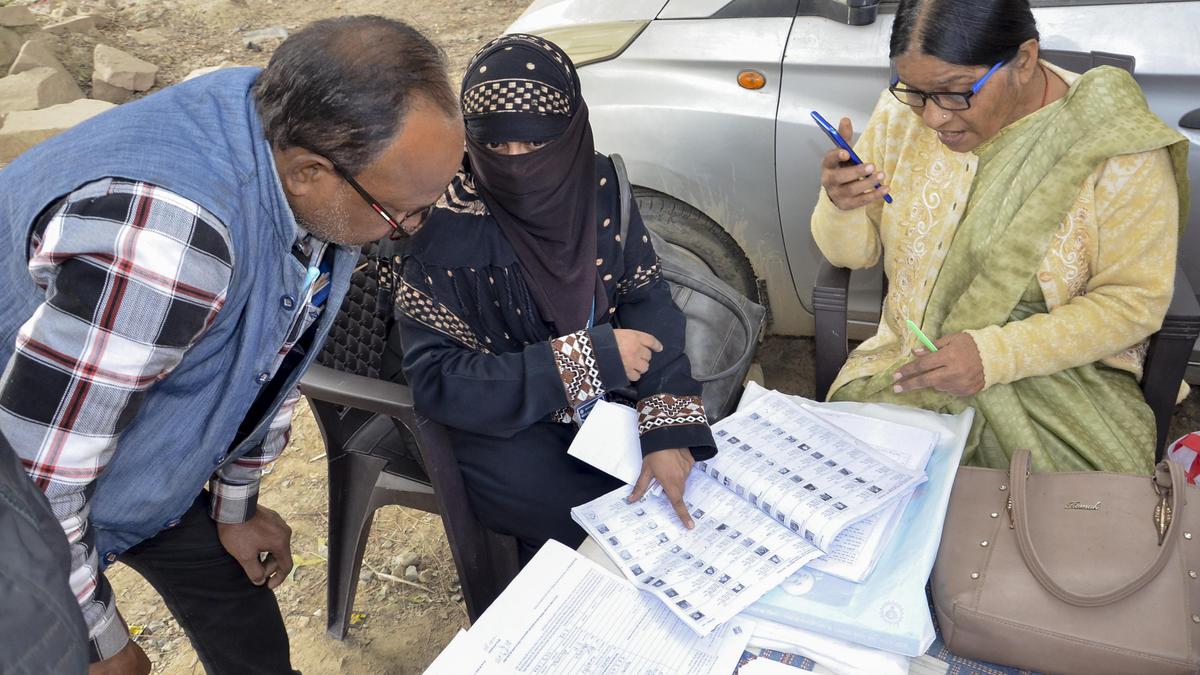

Poonam Pal, a Booth Level Officer (BLO) in Noida, Uttar Pradesh, often breaks into a sweat when she thinks about the consequences of making a mistake in the enumeration forms or missing her daily target of 50 houses. It is not the ₹2,000 allowance that she and other anganwadi workers — roped in for the special intensive revision (SIR) of the electoral rolls — are worried about. She is afraid of being sent to jail.
“Ever since we heard about FIRs against BLOs, all of us have been working tirelessly to meet our targets even if it means not being able to spare time for ourselves or our families,” said Ms. Pal, a 44-year-old resident of Noida Sector 82, who has been an anganwadi worker since 2005.
Ms. Pal is referring to three FIRs filed in the first fortnight of November at the Ecotech, Jewar and Dadri police stations against BLOs in Noida. The cases were registered under Section 32 of the Representation of the People Act, 1950, on the orders of District Magistrate Medha Rupam, who is also the District Election Officer.
The provision makes it a criminal offence to commit a “breach of official duty related to the preparation, revision or correction of the electoral rolls”. Officials who fail in this duty can face up to two years’ imprisonment and a fine.
One of the BLOs booked by the Noida Police is 62-year-old Premlata, who lives in Bhangel and has been an anganwadi worker since 2004. She said she had submitted multiple applications seeking exemption from SIR work.
“I told them multiple times that I’m old and can’t climb stairs or operate apps. But they did not listen and later filed an FIR against me,” she said. Ms. Premlata has been told that another BLO has been assigned her task, but she is awaiting information on what the FIR would mean for her.
Ms. Rupam told The Hindu that the FIRs were registered after the BLOs in question failed to collect their forms even 10 days after the starting date and refused to take calls. “We have not booked any BLO for lapses but only on grounds of absence to deliver their work,” she said.
She added that many who were unfit to complete the task were exempted after submitting relevant medical documents. “However, the BLOs against whom FIRs have been filed did not communicate with any of us,” she said.
Amid growing reports of stress and overwork among booth-level officers across the country, the Election Commission (EC) on November 30 extended the schedule for the SIR drive in nine States and three Union Territories to December 11.
Racing against time
Like Ms. Pal, many BLOs in Noida spoke of multiple challenges as they tried to meet their targets.
Anu Srivastava said the pressure to meet the deadline had taken a toll on her savings, forcing her to spend out of pocket on commuting.
“I wake up at 4 a.m., complete my household chores, and then set off for the distribution, collection and filling of forms. By 5.30-6 p.m., I’m usually back home and continue working on digitising the forms till 11 at night,” she said. “We get ₹2,000 for election-related work, but each day I have been spending around ₹100 on commuting since it is difficult to walk back with piles of paper,” added the 45-year-old anganwadi worker. The workload, she said, had pushed the care and education of her children “to the back burner” for the past month.
‘Limited training’
She added that most anganwadi workers struggled to understand English and to use the two apps: the Digital Layout Map for entering house coordinates and Census 2027-Houselist for uploading data. “Only one session was conducted for us at the beginning of October, after which we had to struggle and figure those out by ourselves,” she said.
Responding to this, Ms. Rupam said she was aware of the difficulties and that six data centres had been set up across Noida recently to assist with digitisation.
While over 99% of enumeration forms have been distributed in the States and UTs where the SIR drive is under way, Uttar Pradesh recorded the lowest digitisation rate at 69.56%, as per the EC.
Migrant-heavy areas
Ms. Pal spoke about encountering challenges in convincing people to submit their documents for enumeration. She said that usually, awareness drives generally precede mass-level documentation exercises. “Only in the past weeks have booths been set up for SIR work and announcements made to make people aware of the need for cooperation,” she said.
Adding to this, Suman Chauhan, another anganwadi worker, said data tallying had been particularly challenging in areas with a high migrant population. “In many parts of different blocks, the previous tenants have made their documents in a particular location and have moved. Now, in the absence of neighbours knowing their whereabouts, there is no way to complete their SIR forms,” Ms. Chauhan said.
Published – December 06, 2025 05:00 am IST