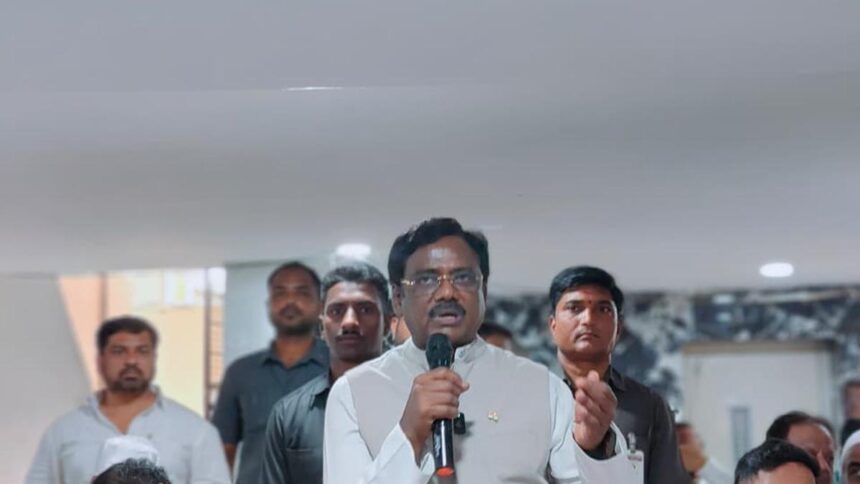





For generations of schoolchildren, Vatal Nagaraj was a familiar name — the man whose protests could unexpectedly give them a day off from school, be it over Cauvery water sharing issue or Kannada name boards. Few among them understood that behind the noise and spectacle lay a deeper history of Kannada identity and activism.
What was unfolding as “street drama” for the uninitatited was, in fact, just the latest chapter in a centuries-old struggle: one that began in poetry and evolved through various phases of politics.
Writers and activists view the Kannada movement as unfolding in four phases: the 1950s as a struggle for unification as a linguistic State, the 1960s as a period of celebration and assertion of identity, the 1970s as an era of drives for policy changes and movement against migrants, and the most recent phase as one focused on demand for federalism.
The gensis
Yet, Kannada writer Baraguru Ramachandrappa argues that the Kannada movement has existed since the 10th century, citing Adikavi Pampa’s words “Maarga mattu Desi” — an assertion of Kannada identity against the dominance of Sanskrit. However, it was centuries later in the 1900s that it emerged as a “movement” of a completely different nature.
Writer and critic Banjagere Jayaprakash pointed out that the State unification movement, led by writers and intellectuals such as Alur Venkata Rao, Kuvempu, Govinda Pai, and Niranjana, was fought through their writings and intellectual discourse, exerting influence on those in power.
He observed that the unification movement was largely characterised by Statewide conferences that drew the attention of those in authority.
Start of street fights
The actual “street movement” began in 1962. One of the iconic moments was when a group gatecrashed the Ramanavami Music Festival in Bengaluru, demanding Kannada songs — a demand that still resonates, but more in restaurants across the city.
In 1962, a group led by Mr. Nagaraj stormed the now-demolished Alankar Theatre, on KG Road, and vandalised it, demanding more screens for Kannada films. From then on, Mr. Nagaraj’s street campaigns were always a spectacle — featured buffalo weddings, donkey processions, and such other acts that made headlines occasionally even in English newspapers abroad.
What began as a unification movement had turned into a fight for linguistic assertion by the 1960s. Parallelly, writers such as Kuvempu and Kayyara Kinhanna Rai, and in a later phase the likes of K.S. Nisar Ahmed, spoke about the pride of the language through poetry.
The movement took a violent turn after the 1980s when the Cauvery issue became synonymous with language politics. Many lives were lost, and tensions rose against non-Kannada speakers. In another development, a major post-independence language campaign, the Gokak Movement emerged, which demanded primacy to Kannada in education.
A slew of reports related to giving primacy to Kannada in various spheres emerged around this time, such as the one recommending reservation to Kannadigas in jobs by Sarojini Mahishi — but most still remain unimplemented.
“In the 1990s, movements demanding federalism and usage of Kannada in everyday transactions emerged, and they continue to this day. These movements also opposed the governments pushing for the proliferation of industries, disregarding socio-cultural aspects,” said Mr. Jayaprakash. Amidst this, there were some disconcerting developments such as anti-Urdu riots, which broke out when Kannada activists took to the streets to oppose news bulletins in Urdu. This turned violent and resulted in several deaths.
From the late 2000s onwards, strikes and street demonstrations saw an upswing. Critics argue that the movement has turned into “hooliganism”. But Arun Javagal, a member of Karnataka Rakshana Vedike, counters that the so-called acts of “vandalism” emerged only when governments refused to act on pressing issues, be it blackening of Hindi nameboards in Metro or signboards of shops.
What has “compelled” them to act frequently, Mr. Javagal argued, was the Central government’s increasing control and “Hindi imposition” in Railway Board and other such Central examinations had their negative impact on local Kannada beneficiaries.
Frequent conflicts
As the job market expanded with the IT boom in the State capital, conflicts began between Kannada and Hindi-speaking people, often amplified in social media. These linguistic tensions have become everyday conflicts, giving even road rage incidents a linguistic undertones.
However, Mr. Ramachandrappa argues that core issues remain quite the same. “A matter of concern is the gap between intellectuals and activists today, and it needs to be bridged to make today’s campaigns truly effective.”
Published – October 31, 2025 11:38 pm IST