


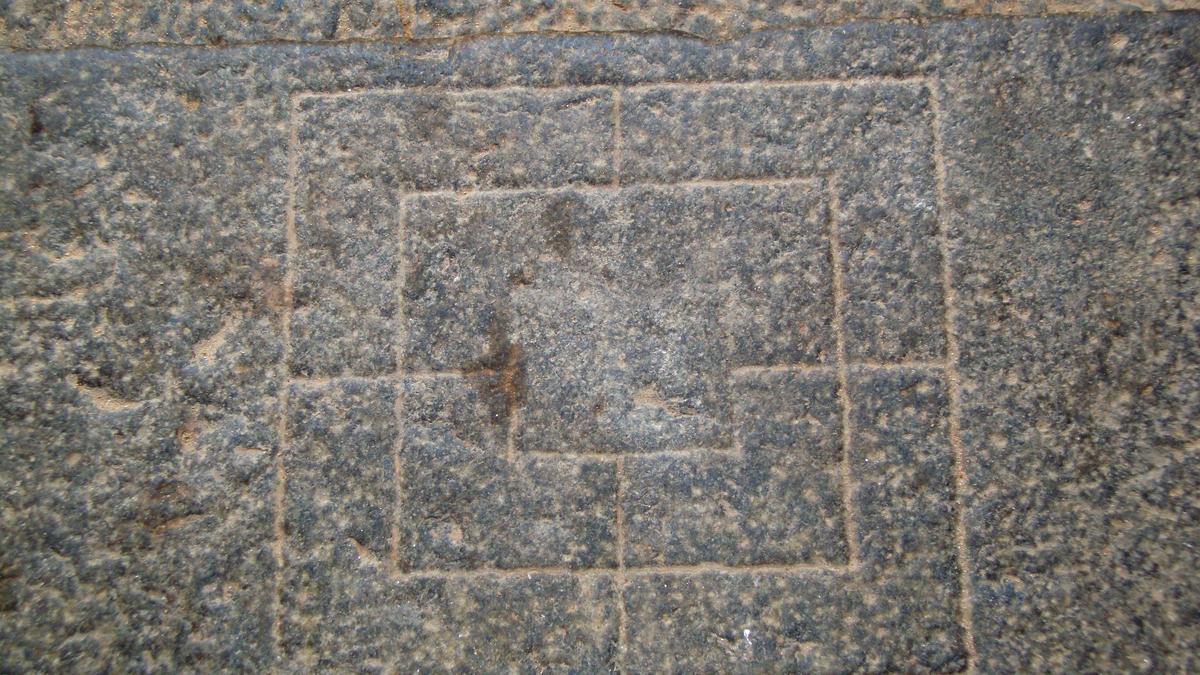

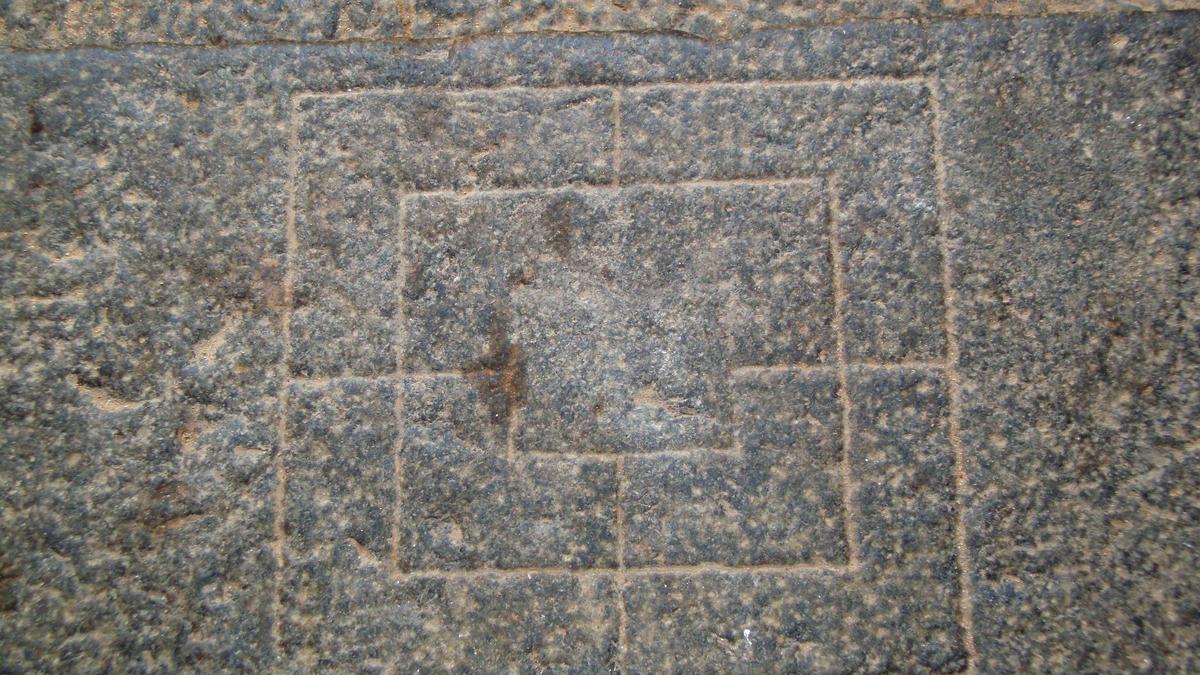
Dahdi at the Agatheeswarar temple in Chennai
| Photo Credit: Special Arrangement
For Vinita Sidhartha, the game of dahdi which has three nested squares, is something she refers to, almost fondly, as her ‘problem child’. Walking around her office, she points to posters on the walls, many bearing photos of these squares etched onto the floor at temples, historical monuments and even an excavation site.
“This particular game can be seen on the floors in so many temples in Tamil Nadu which includes at least 10 temples here in Chennai. I have always been surprised that nobody recognises or remembers this game even though not too far away in the Telugu heartland, it is called dahdi,” she says.
Her fascination and journey to unearth the history behind this game and its surprising links to Spain has been documented and is on display as Madras to Madrid, an exhibition, at the office of Kreeda, Vinita’s company that has been working for over two decades in researching, developing and reviving traditional games. The dahdi, is also known as nine men’s morris and is a strategy game which involves players placing their nine pieces on the board and forming mills or three pieces in a row to outsmart their opponent.
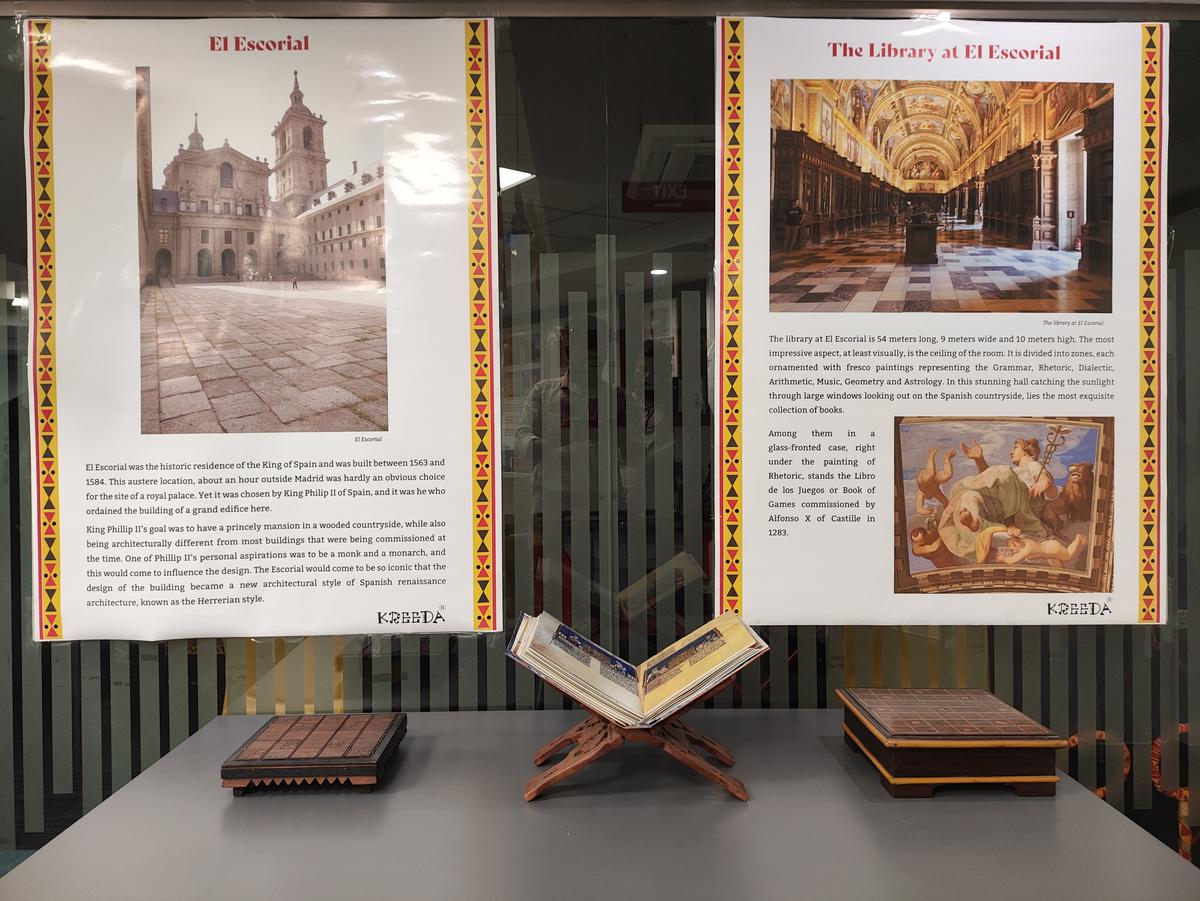
The replica of The Book Of Games displayed at the Madras to Madrid exhibition at the Kreeda office
| Photo Credit:
Special Arrangement
Vinita says that as she began to document this game found across the country, she began to get a clearer picture of how old it might be. “I found a very interesting style of etching at the Hoysala temples in Karnataka, crawled through shrubs at the JNU campus, Delhi and found the game etched on stone there, and even at the temple unearthed in Salavankuppam post the tsunami in Tamil Nadu,” she said.
It was a trip to Madrid, however, 5,500 miles away that not only gave her insight into an early documentation of the game, but also an interesting geographical link. Many churches in Spain, she points out, also have the game etched on the floors, much like the temples here.
“At the Library of the Monastery of El Escorial, near Madrid, I was able to look at the Book of Games commissioned by Alfonso X of Castille in 1283. The book features nine men’s morris, as well as interesting stories about games travelling from India,” she says.
A sample of the book has also been recreated by Vinita, which is on display as part of the exhibition.
“Another exciting discovery for me was to see these nested squares carved into stone under the Butterball or the large balancing rock in Mamallapuram. I was barely able to crawl under and take a few pictures of the games etched underneath. Popular legends say that the Butterball has probably been here since the 1100s or 1200s. This gave me some sense of the antiquity of the game in India” she says.
This journey to unearth the global spread of traditional games, Vinita says, has been an eye-opening one that has left her with many questions, possible answers, and some fascinating insights that she has documented through the exhibition. “I also noticed a game half hidden under the Butterball, a game different from the dahdi. I am already gearing up to hunt for more answers,” she laughs.
Madras to Madrid will be on display at the Kreeda office till November 30. From 10am to 6pm on weekdays for groups; on weekends by request. Contact 9841748309 or 40091500.
Published – November 06, 2025 11:48 am IST