


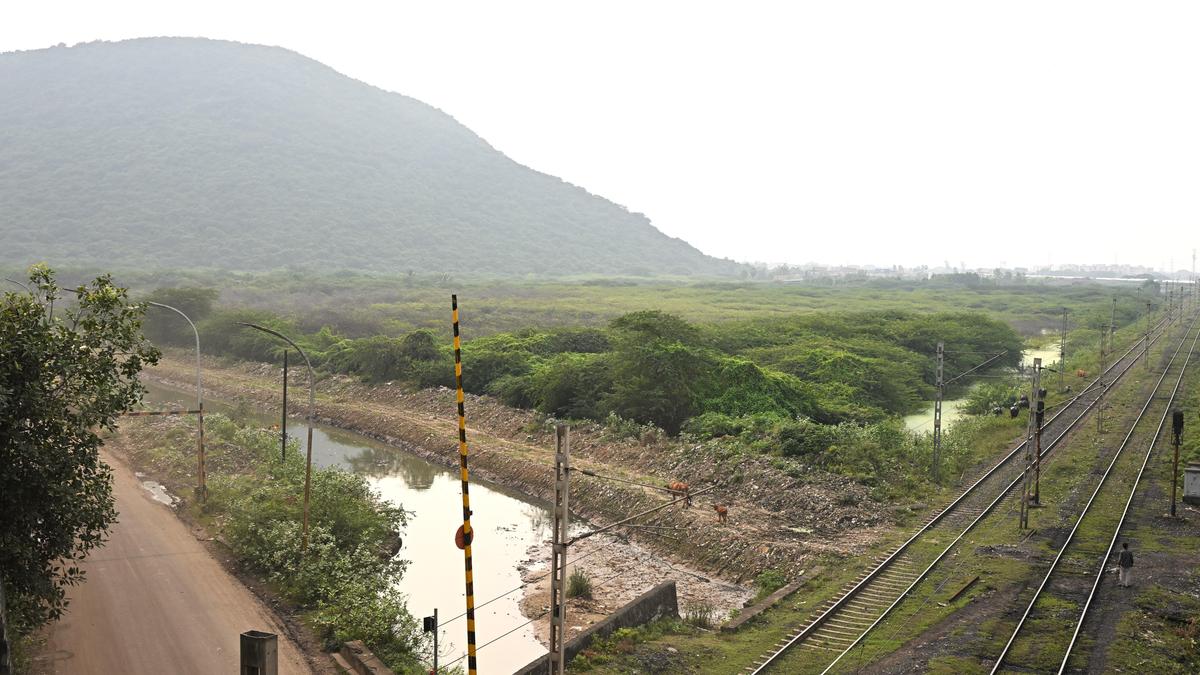

It was another pleasant morning on September 5, 2025, for the residents of Andhra Pradesh Housing Board Colony (APHBC) in Pedagantyada, part of Ward 76 under the Greater Visakhapatnam Municipal Corporation (GVMC). The residents as usual gathered at the colony’s committee hall at 6:30 a.m. for their daily newspaper reading session.
However, the atmosphere in the committee hall suddenly changed when P. Srinivas, a senior citizen, noticed an advertisement in a Telugu vernacular daily regarding an environmental public hearing scheduled for October 8, 2025, for the proposed Gangavaram Cement Grinding Unit of M/s Ambuja Cements Limited (of the Adani Group), with an investment of ₹1,000 crore.
Mr. Srinivas immediately shared the information with his neighbour Mr. Mohan Rao who was sitting beside him. Already struggling with breathing issues due to his age, Mr. Rao voiced concern about his worsening condition. Eventually, the news spread like wildfire through the residential colony and reached M. Srikanth, president of the APHBC Residents’ Welfare Association.
“Yes, the news has been giving us sleepless nights. As the proposed site is just 200 metres away, the residents have joined forces to oppose it in our area. We called for a meeting to discuss ways to oppose the cement unit as it will be detrimental to us,” said Mr. Srikanth.
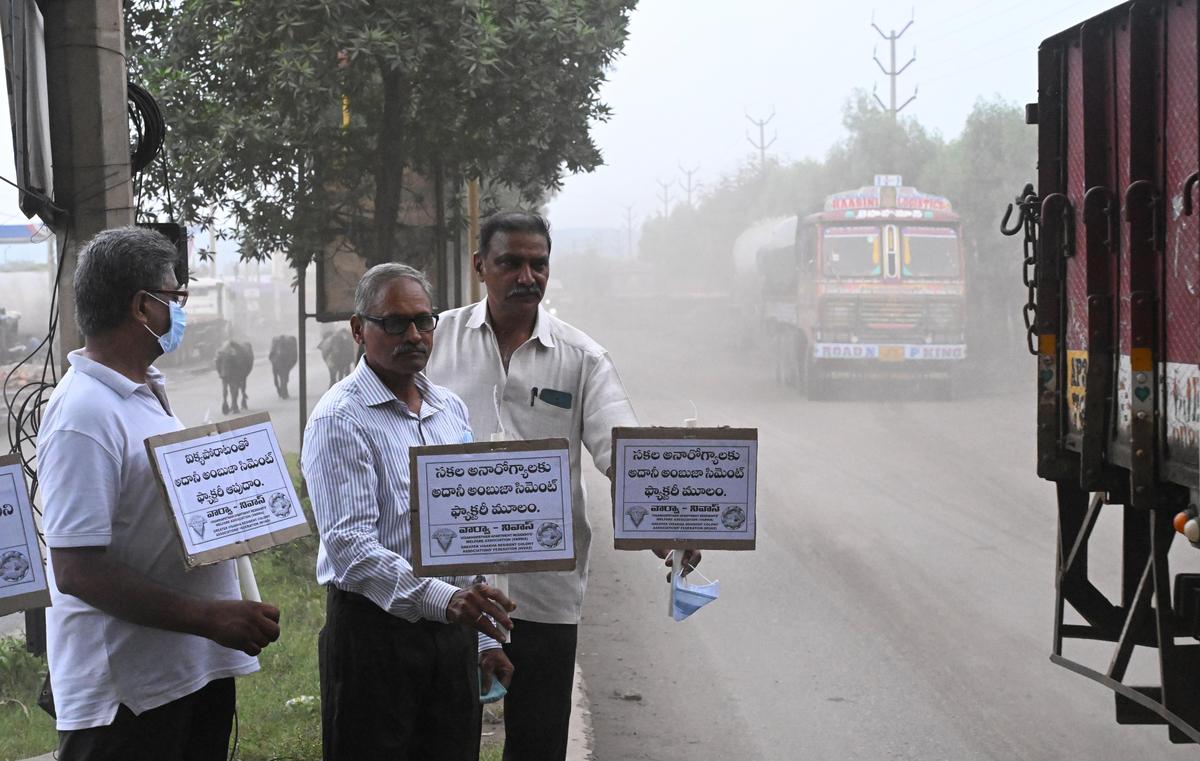
Residents holding placards against the proposed cement plant on a polluted road towards Gangavaram Port at Pedagantyada in Visakhapatnam.
| Photo Credit:
V. RAJU
The colony has a total of 1,256 Low Income Group (LIG) and Middle-Income Group (MIG) houses, across 64 acres, built in 1982–1984 during the tenure of the then Chief Minister N.T. Rama Rao, Mr. Srikanth stated. “Not only our colony, but more than 50 villages around the proposed cement plant, which fall under Wards 74, 75 and 76 of the GVMC, will be affected,” he added.
It may be mentioned here that the plant has been proposed to be established on eight hectares of land owned by Adani Gangavaram Port Limited (a subsidiary of the Adani Group) at Survey Nos. 97P, 98, 99P and 101P in Pedagantyada village, with an annual production capacity of four million metric tonnes of cement.
Mr. Srikanth mentioned that thousands of people attended the public hearing held by the A.P. Pollution Control Board on October 8 and strongly opposed the project. Due to the strong opposition, the authorities cancelled the public hearing. “The next date has not been announced yet,” said Mr. Srikanth.
It has been over five weeks, but the authorities have still not announced a date. The A.P. Pollution Control Board (Visakhapatnam regional office) environmental engineer P.V. Mukunda Rao said, “We cancelled the first public hearing held on October 8, 2025, due to opposition from the locals who expressed concerns over health hazards, environmental impact and lack of genuine consultation. As per the rules, a fresh request for a public hearing has to be submitted by the company concerned (the Adani Group). We have not received any such request yet (as of November 20, 2025). The cement plant is proposed to be developed on eight hectares of land already earmarked for industrial use inside the Gangavaram Port of the Adani Group, avoiding fresh land acquisition.”
Even though the A.P. Pollution Control Board has not issued any new announcement regarding a public hearing, local residents remain anxious and concerned.
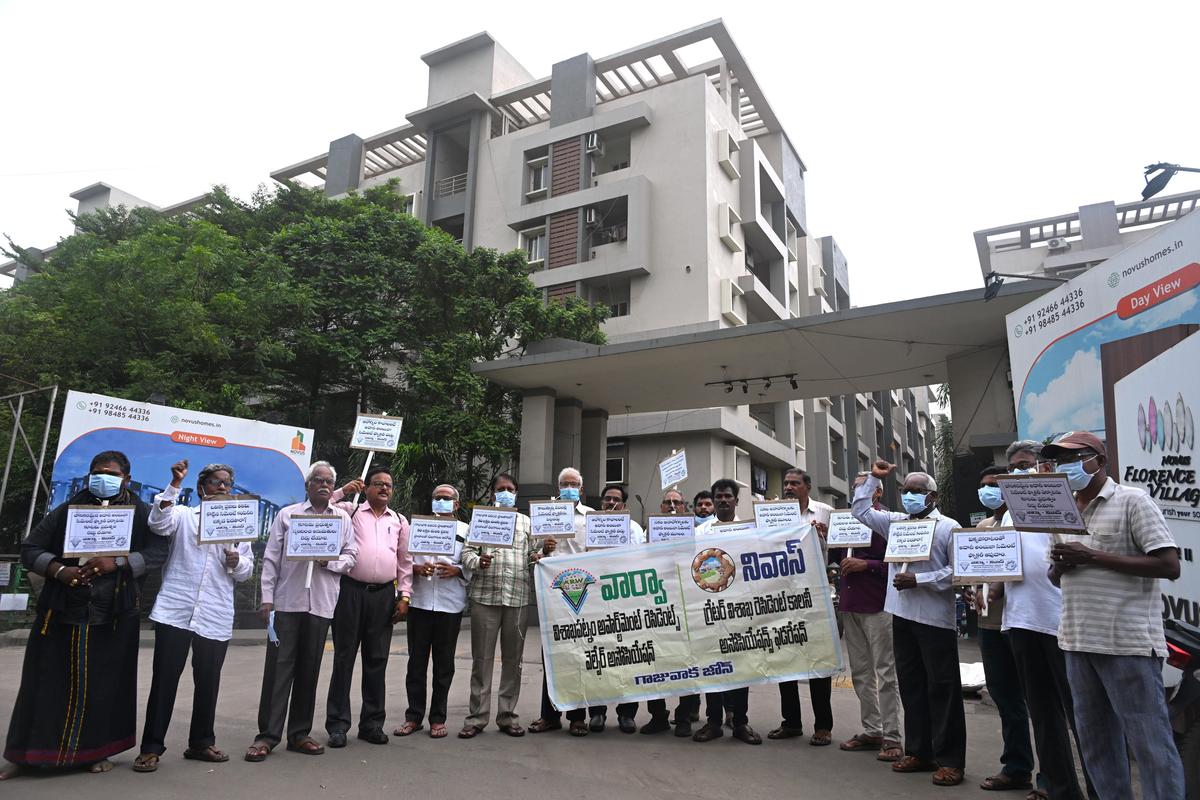
Residents under the aegis of Visakhapatnam Apartment Residents’ Welfare Association (VARWA) staging a protest against the plant, in Visakhapatnam.
| Photo Credit:
V. RAJU
The proposed plant
Once a small coastal village in Visakhapatnam city, Pedagantyada has grown into a major suburb over the years. It became part of the Greater Visakhapatnam Municipal Corporation (GVMC) in 2005 and notable local landmarks include the Visakhapatnam Steel Plant and Gangavaram Port of the Adani Group.
Industrial and port activities have created many opportunities for the locals but have also brought challenges, with pollution being the main concern.
The construction of Gangavaram Port began in December 2005 and commercial operations commenced in August 2008, with the official opening in July 2009. The port, initially a public–private partnership, was owned by a consortium comprising the DVS Raju Group (58%), Warburg Pincus (32%) and the Government of Andhra Pradesh (10%). It was fully acquired by the Adani Group in 2022. In 2009, it became the first Indian port to receive a fully loaded capesize coal import vessel and quickly grew to become the third-largest non-major port in India, handling significant coal volumes.
Now, the Adani Group through its subsidiary M/s Ambuja Cements Limited wants to set up the cement unit at Pedagantyada. The project site is connected to NH-16 (Chennai–Visakhapatnam–Howrah) at a distance of 2.49 km.
The residents of Pedagantyada, Chinagantyada, Kurmannapalem, Gangavaram, Gajuwaka, Parawada and surrounding areas are already experiencing dust and industrial pollution due to the presence of numerous small and medium industries. Constant movement of trucks from the city roads to industries in the Gajuwaka Assembly Constituency—an industrial area—adds to the problem. The proposed cement plant has heightened these worries.
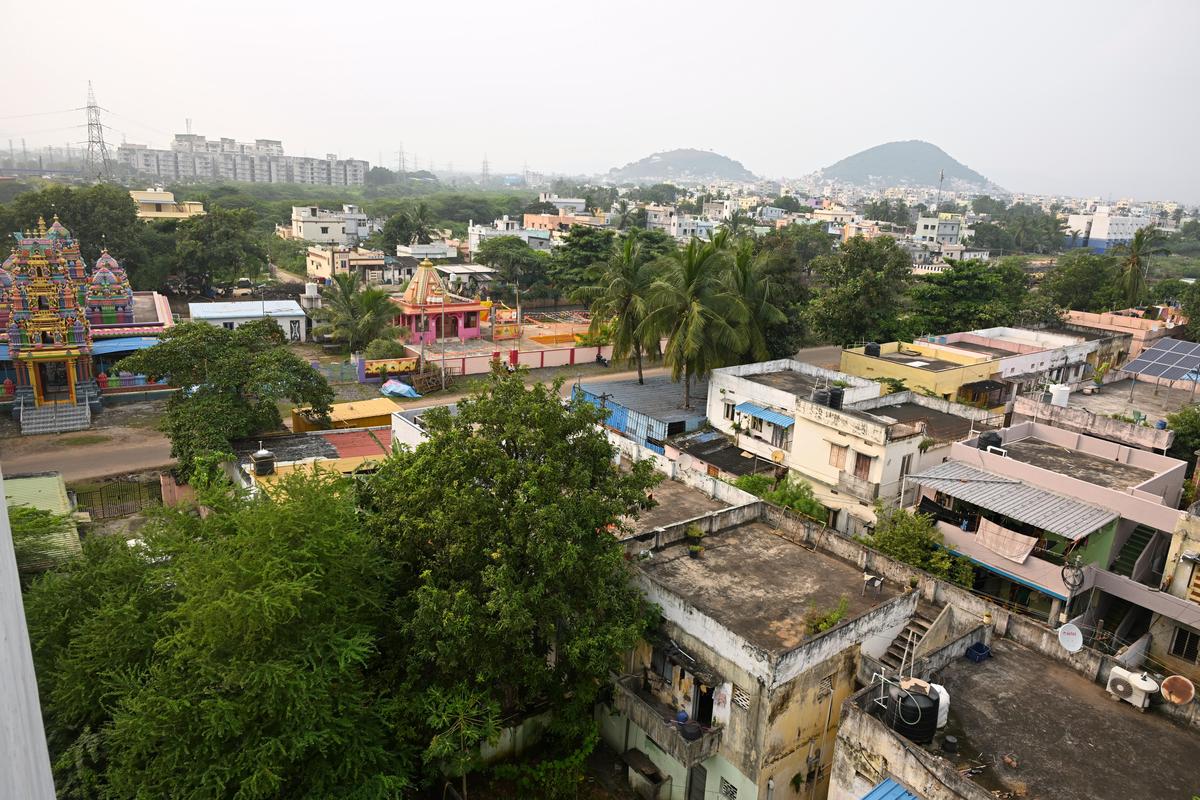
An overview of the APHB Colony which is close to the proposed site of the cement plant.
| Photo Credit:
V. RAJU
Jyoti, a senior citizen from the APHBC Colony said, “I have been suffering from a persistent throat infection and cough since I started living here with my children. I am concerned that the proposed cement project in our neighbourhood will only make my condition worse.”
Heightened fears
Like Ms Jyoti, residents of Novus Gated Apartments, located about 100 metres from the proposed site, claim that their situation is even dire. They already suffer from dust pollution caused by lorries heading towards Gangavaram Port and other industrial areas, now, the proposed cement plant has heightened their fears.
Anil Kumar, a resident of Novus Apartments said, “I have been living in this apartment for the last four years. Representatives of various industries have been coming to us with assurances about remedial measures for our problems, like dust pollution, but none of them have given anything in writing. Meanwhile, this proposal for a cement factory near our residential apartment is adding to our troubles. We do not want it. This is our appeal.”
Another resident, Ms. Jyotsna, said, “We bought a flat in this apartment four years ago. We want to sell it now, but no one is interested because of the area. We are scared for our children. No one, including our local MLA, is paying attention to our plight.”
“Ours is a gated community of 400 flats, out of which over 100 flats are lying vacant because no one wants to rent or buy them due to pollution issues. The proposed site of this cement unit is visible from our terrace—just like how people on RK Beach Road can see the Bay of Bengal. We wonder how government officials thought of building such a polluting unit in our residential area. Almost 70% of our Gajuwaka Assembly segment is already in the pollution zone due to decades of industries,” said Shankar Viswanathan, leader of the Novus Apartments Welfare Committee, a Tamilian who has settled here due to business.
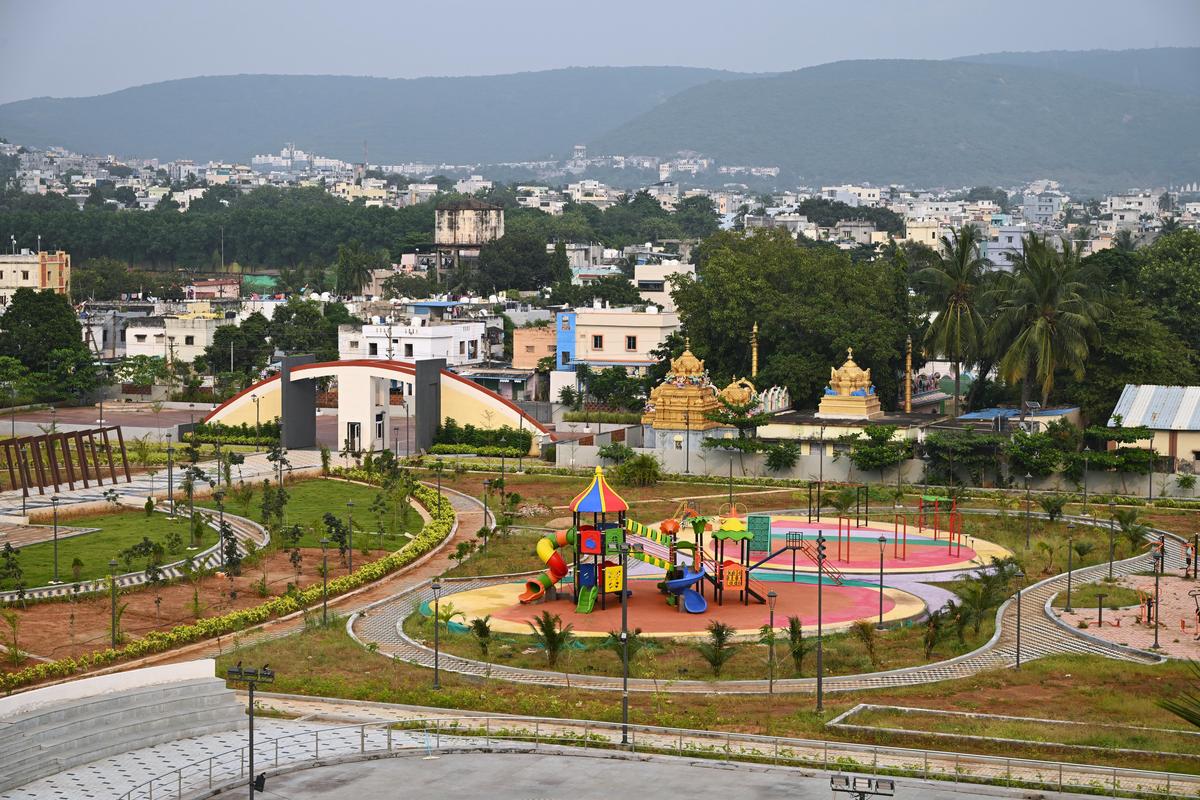
A view of the APHB Colony public park.
| Photo Credit:
V. RAJU
Environmental impact
According to reports, as per the Environmental Impact Assessment (EIA) notification dated September 14, 2006, the proposed project falls under Category B1 (Activity 3B). B1 projects are those with potential environmental impacts requiring a full EIA study to determine the extent of impact and necessary mitigation measures. These projects require public consultation, during which people can express their concerns about pollution and other issues.
Important pollution-related issues include the use of waste materials such as fly ash and slag as raw materials. Different types of cement—OPC, PPC, PSC and PCC—are manufactured depending on market demand using clinker and gypsum. For better understand, OPC (Ordinary Portland Cement) is used for high early-strength projects; PPC (Portland Pozzolana Cement) includes fly ash for durability and chemical resistance; PSC (Portland Slag Cement) includes blast-furnace slag; PCC (Portland Composite Cement) is made with various blends for general-purpose construction. The process also generates various waste materials, including air emissions, wastewater and solid waste from utilities. Emissions include dust from material handling, crushing and grinding. The main pollutant is suspended particulate matter.
The local vendors stress that they cannot leave the area because of their livelihoods, even though pollution has driven away most local customers. “I run a small shop selling snacks and tea. If I earn ₹500 profit in a day, that’s a great day for me. People are keeping away due to pollution. If the cement factory comes up, I will have to close my shop,” said K. Suribabu, a shopkeeper at Sri Krishna Devaraya Junction in Pedagantyada.
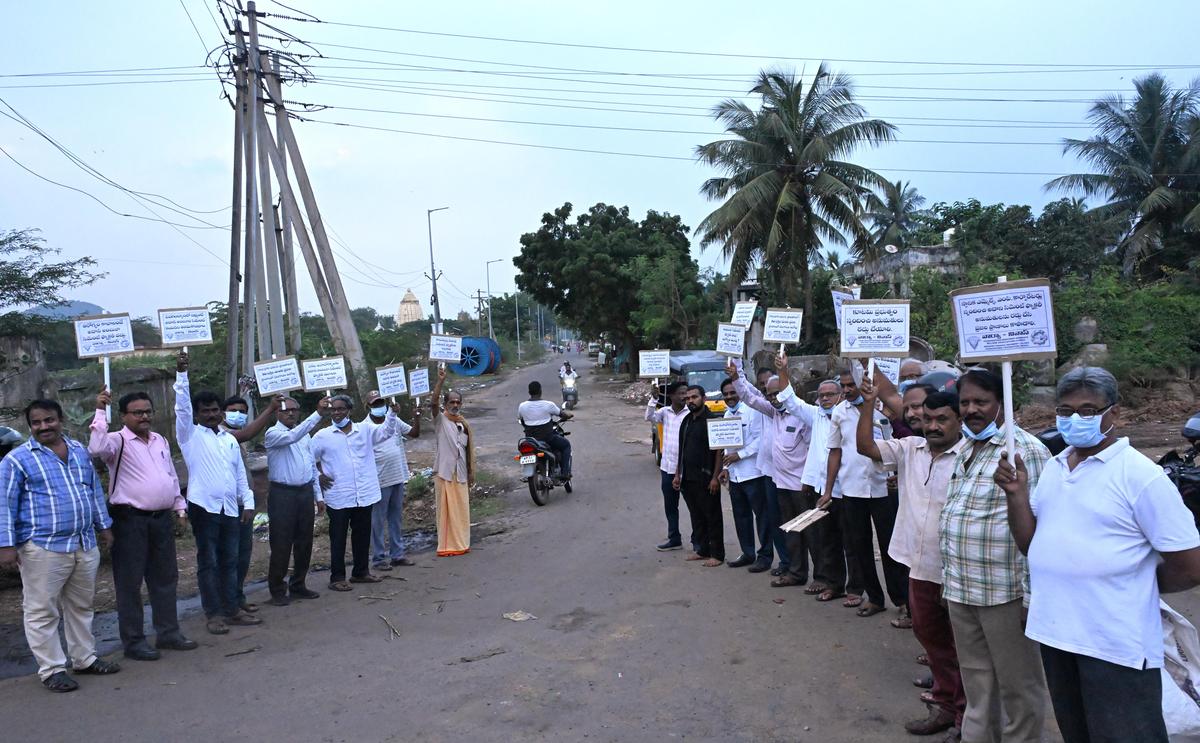
Residents holding placards against the plant at the entrance of APHB Colony.
| Photo Credit:
V. RAJU
Fight will continue
Meanwhile, the Visakhapatnam Apartment Residents Welfare Association (VARWA) has stepped in, protesting against the proposed cement project and meeting every stakeholder, including local MLA Palla Srinivasa Rao, who represents the Gajuwaka Assembly Constituency.
Mr. B.A. Trinadha Swamy, secretary of VARWA Gajuwaka, said that thousands of people gathered at the October 8 hearing to raise objections. Around 400 police personnel were deployed, but people did not allow the hearing to proceed. Even officials did not dare to conduct it in the face of public opposition. The VARWA members met the local MLA and corporators, warning that if efforts are not made to stop the plant, elected representatives will face serious consequences in the future.
When contacted, Gajuwaka MLA Palla Srinivasa Rao said, “I support the people. My concern is always with them. Whatever they want, I am ready to support.”
Mr. Swamy from VARWA added, “We will leave no stone unturned to ensure that this plant does not come up in our area. We are joining hands with all public representatives and political parties who support us in fighting this project. The Human Rights Forum (HRF) has also joined us.”
The HRF Andhra Pradesh and Telangana Coordination Committee president M. Sarath and member V.S. Krishna said that it is well known that cement plants produce toxic emissions that pose serious risks to human health.
“The people of Gajuwaka and Pedagantyada deserve a government that values their lives more than mindless industrial expansion. They deserve clean air and safe water. Surprisingly, the environmental impact assessment report itself mentions that the proposed site has habitations just 130 metres away—dangerously close and against State norms, which require a minimum distance of 500 metres between such units and human habitation. The HRF stands in full solidarity with the residents opposing the project. The proposed cement grinding unit should be scrapped altogether,” the HRF leaders said.